
Last Updated on September 1, 2026 by Umar Farooq
A dehumidifier not collecting water is usually not broken. Four of the six causes below cost nothing to rule out, take about ten minutes between them, and account for most of these complaints. Only the last two involve buying anything.
The reason to work through a dehumidifier not collecting water in order is that almost every other guide on this fault gives you nine causes in no particular order, which is the same as giving you none. A list does not tell you what to check first.
Dehumidifier not collecting water: the four free checks first
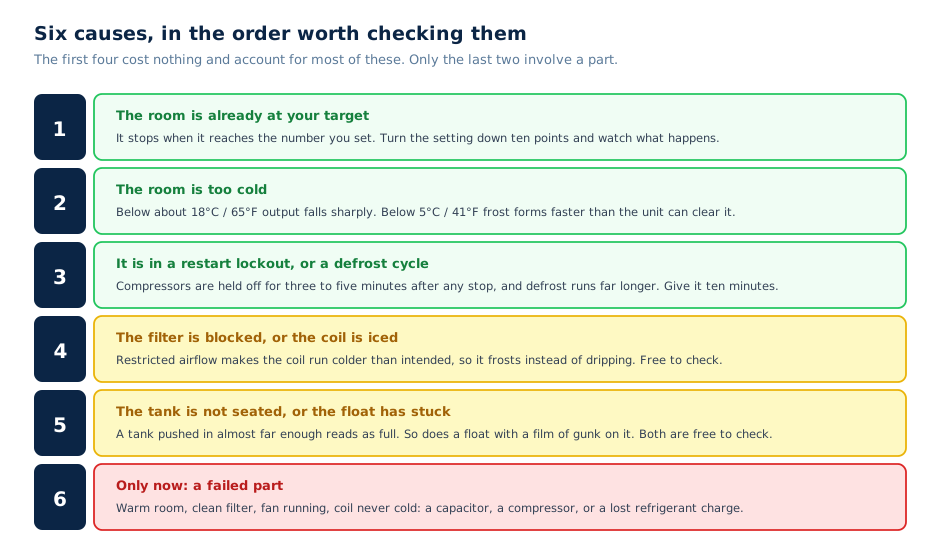
1. The room is already at your target
The machine stops when the room reaches the humidity you set. That is not a fault, it is the entire point of a humidistat — and an empty tank with a working dehumidifier are perfectly compatible states.
GE’s own troubleshooting for this symptom leads with exactly this: the unit will not collect water if the room’s humidity is already below the set point.
The test: turn the setting down ten points and watch. If the compressor starts within a few minutes, you have your answer and there is nothing to fix. Put it back to 50% afterwards — a lower setting does not dry faster, it only means the machine never stops.
2. The room is too cold
The single most under-diagnosed cause in this category, and the one that sends people out to buy parts they do not need.
A compressor dehumidifier makes a surface colder than the room and lets water condense on it. As the room gets colder that gets progressively harder, because cold air is not carrying much water to start with.
- Below about 18°C / 65°F, output falls sharply.
- Below 5°C / 41°F, GE’s documentation says frost forms faster than the machine can clear it. The compressor cuts out, the fan keeps running, and nothing collects.
The test: put a thermometer in the room. If it reads under 15°C, your machine is not faulty — it is in the wrong room. Heat the space, or use a desiccant unit, which works down to a few degrees above freezing because it has no cold coil to freeze.
3. It is in a restart lockout or a defrost cycle
Compressors are held off for three to five minutes after any stop, to avoid restarting against system pressure. A defrost cycle runs considerably longer, and during it the compressor is off while the fan carries on.
Both states look identical from the outside: fan running, nothing happening.
The test: watch it for ten minutes without touching anything. If the coil was properly iced, switch it off and give it an hour to thaw fully before judging. And put your hand at the outlet — cool air with the fan running means defrost, not failure.
4. The filter is blocked, or the coil is iced
Now we get to the one that is genuinely a fault, and is genuinely free to fix.
A blocked filter starves the coil of airflow. With less air passing over it, the coil runs colder than it was designed to and frosts over instead of dripping. Frost triggers defrost, the compressor stops, and the machine spends its life cycling rather than collecting.
The test: take the filter out and hold it up to the light. If you cannot see clear light through the mesh, it is due. Wash it in warm soapy water — never hot, never chemical cleaners — and dry it completely before it goes back. While the panel is off, look at the coil behind it: if you can see white frost on the fins, switch off and let it thaw for an hour.
The filter guide has the intervals, and the cleaning routine covers the coil.
The two that cost money
5. The tank is not seated, or the float has stuck
A tank pushed in almost far enough reads as full, and the machine simply will not run. So does a float switch with a film of biofilm on it, which is why the tank gets a wash every couple of weeks in any sensible maintenance routine.
This one is still free to check — pull the tank right out, wash it, dry it, and push it firmly home. If the full-bucket light is on with an empty, properly-seated tank, that has its own guide, because the fault is a switch rather than a measurement.
6. Only now: a failed part
If the room is warm, the filter is clean, the tank is seated, the setting is well below the room’s humidity, and you have given it ten minutes — then something has genuinely failed.
The signature is specific: fan running, coil never getting cold, tank staying dry. In order of likelihood:
- A failed run capacitor. Cheap, and the most common electrical failure. You may hear the compressor humming or clicking as it tries and fails to start.
- A failed start relay or overload protector. Also cheap, similar symptoms.
- A dead compressor, or a lost refrigerant charge. The machine is finished. Not because it is technically unfixable, but because the labour plus the part comfortably exceeds a new unit, on a machine whose every other component is exactly as old as the one that just died.
The fan-runs-but-compressor-doesn’t guide works through the electrical side properly, and how long dehumidifiers last covers whether a repair is worth doing at all.
A run capacitor holds a charge after the plug is out and can give you a serious shock. If you are not confident discharging one safely, this is the point to stop. Sealed refrigerant work requires a licence in most countries and is not a home repair. And if the machine smells of burning, unplug it at the wall and do not switch it on again.
The check that is not a fault at all
Worth saying, because it accounts for a fair share of “it collects nothing” complaints from people who have done everything right.
If the room is genuinely dry, there is nothing to collect. A machine in a room at 45% will produce a trickle at best, because the water is simply not there. That is a correctly working appliance in a room that no longer needs it — and the honest answer is to switch it off rather than to look for a fault.
The tank is the measurement that matters here. Water in it, however little, means the machine is extracting.
Frequently asked questions
Why is my dehumidifier running but not collecting water?
Most often because the room has already reached your humidity setting, or because it is too cold for a compressor unit to work. Check the setting and the room temperature before anything else — both are free.
At what temperature does a dehumidifier stop collecting water?
Output falls sharply below about 18°C / 65°F. Below 5°C / 41°F frost forms faster than the machine can clear it, so the compressor cuts out and the fan runs on. A desiccant model works down to a few degrees above freezing.
Will a dirty filter stop a dehumidifier collecting water?
Yes, and it is one of the most common causes. A blocked filter starves the coil of air, so the coil runs colder than intended and frosts over instead of dripping. Wash it in warm soapy water and dry it fully.
How long should I wait before deciding my dehumidifier is broken?
Ten minutes covers the three-to-five-minute restart lockout with room to spare. If the coil was iced, switch it off and allow an hour for it to thaw completely before judging.
My dehumidifier is blowing air but the coil is not cold — what is that?
That combination points at a failed capacitor, a failed compressor, or a lost refrigerant charge, provided the room is warm and the filter is clean. The first is cheap to fix; the last two usually end the machine.
Is it worth repairing a dehumidifier that will not collect water?
Depends entirely on the part. A capacitor, relay, float switch or filter is cheap and worth doing at almost any age. A compressor or sealed-system failure costs most of the price of a new machine and is not worth it.
Why did my dehumidifier stop collecting water in winter?
Because the room got cold. This is the normal seasonal pattern, not a fault. Either heat the space above about 15°C or use a desiccant machine, which has no cold coil to freeze.
Related guides: Dehumidifier fan runs but the compressor doesn’t · Dehumidifier blowing hot air · Dehumidifier filters · Dehumidifier in winter
Sources
- GE Appliances — Dehumidifier: Not Collecting Water — the manufacturer’s own first check, that the room may already be below the set humidity.
- GE Appliances — Dehumidifier: Ideal Operating Conditions — the 41°F frost limit and defrost behaviour.
- GE Appliances — Dehumidifier: Cleaning and Maintenance — filter washing instructions and the warning against running without one.
Where this guide and your appliance’s own manual disagree, follow the manual. And if you have already ordered a part before reading this — it happens. Keep the receipt and go and check the room temperature first.

