
Last Updated on September 1, 2026 by Umar Farooq
Set it to 50% and leave it alone. That single instruction covers most rooms in most houses, and if you read no further than this paragraph you will have better dehumidifier settings than the majority of people who own one.
The other three numbers are for specific situations: 45% where walls are cold or mould has already appeared, laundry mode when you are drying washing indoors, and off when the room is too cold for the machine to work at all. Four settings. The rest of the dial is decoration, and chasing it is how people end up with a unit that never switches off.
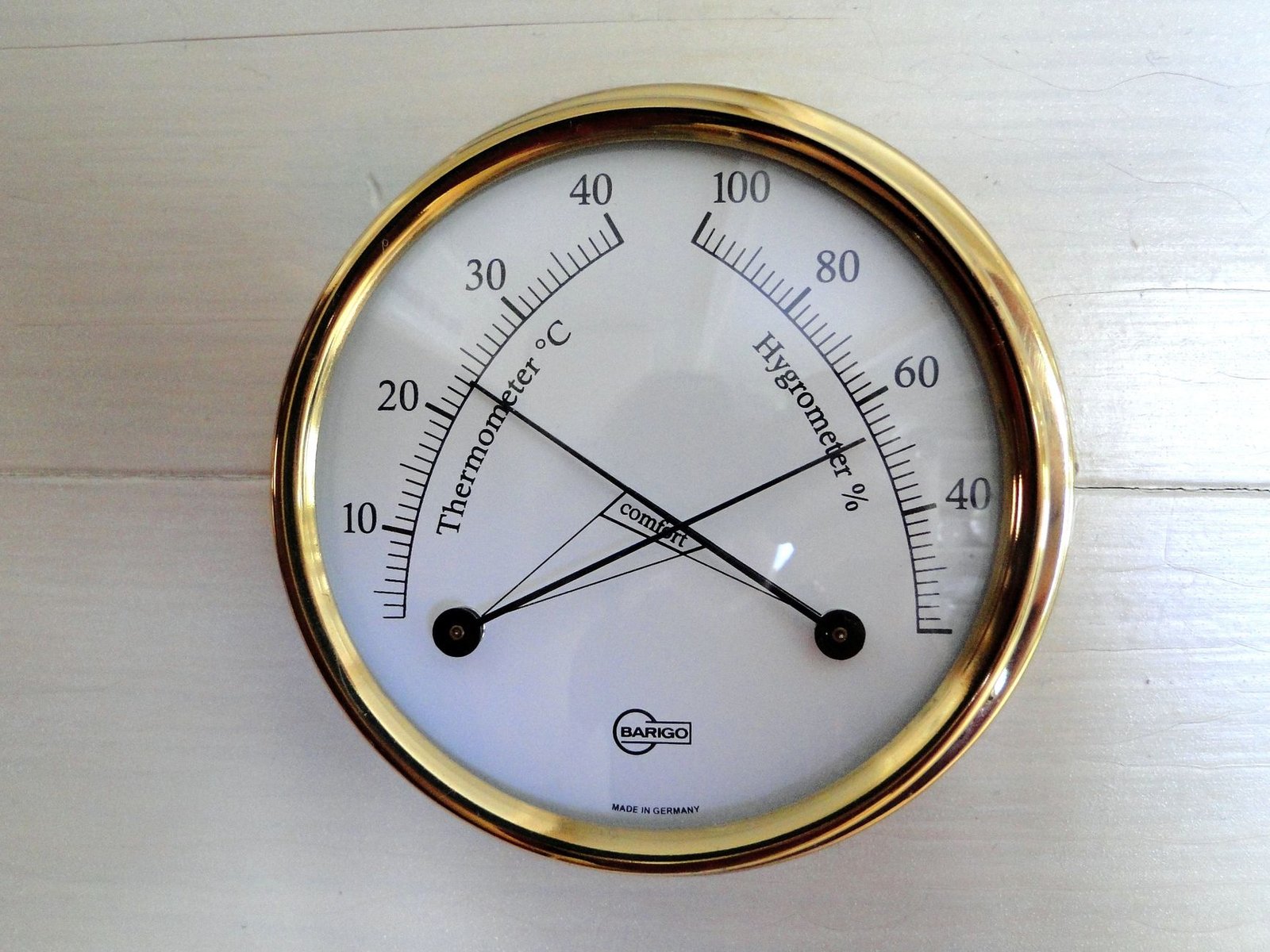
Why 50% is the default
The recommended indoor band is 30–50% relative humidity, which is what ENERGY STAR and the EPA both publish. Fifty per cent sits at the top of it, and that is deliberate.
Above 60%, mould can establish on a suitable surface within 24 to 48 hours. Dust mites need roughly 50% or more to thrive. Below 30%, timber, joinery and musical instruments start drying out and cracking, and people wake up with sore throats.
So why the top of the band rather than the middle? Because every percentage point below 50 costs you running hours and buys you almost nothing. The machine has to work progressively harder to remove each additional gram of water as the air gets drier, while the benefit — mould prevention — was already achieved the moment you crossed under 60%. Fifty is where the curve of effort and the curve of benefit cross.
The four dehumidifier settings, and when each applies
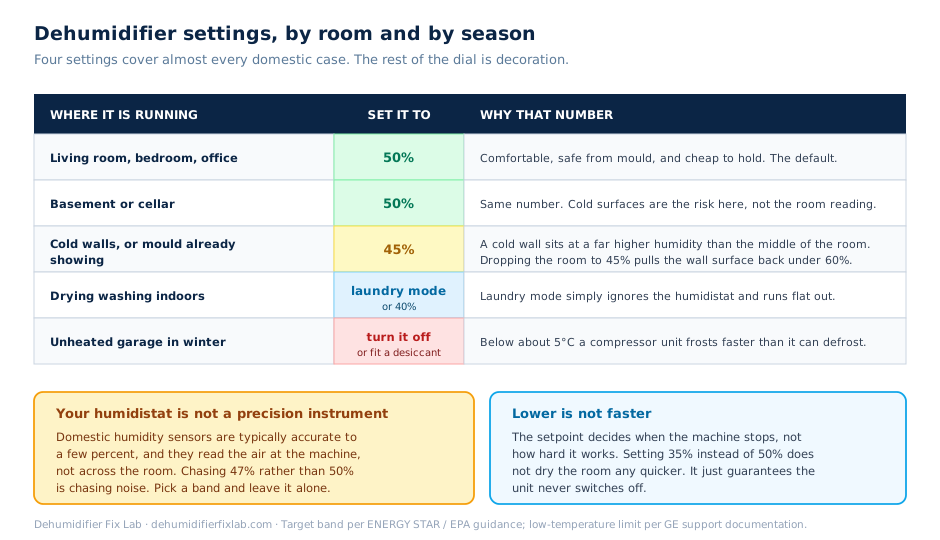
| Where it is running | Set it to | Why that number |
|---|---|---|
| Living room, bedroom, office | 50% | Comfortable, safe from mould, and cheap to hold |
| Basement or cellar | 50% | Same number — cold surfaces are the risk here, not the room reading |
| Cold walls, or mould already showing | 45% | Pulls the wall surface back under 60% |
| Drying washing indoors | Laundry mode, or 40% | The machine ignores the humidistat and runs flat out |
| Unheated garage in winter | Off, or fit a desiccant unit | Below about 5°C a compressor unit frosts faster than it defrosts |
Basements get the same number, not a special one
A great deal of published advice gives basements their own setting, usually 45% or 40%. I think that is the right instinct applied to the wrong variable.
A basement is not damper because it is a basement. It is damper because its walls and floor are colder than the rest of the house. The room reading and the wall-surface reading are two different numbers, and it is the wall that grows mould. Air at 20°C and 50% RH landing on a wall at 12°C is sitting at roughly 84% humidity at that surface — well into mould territory, while your hygrometer in the middle of the room reads a perfectly respectable 50%.
So the honest rule is not “basements need 45%”. It is “cold surfaces need 45%” — and if your basement is properly insulated and reasonably warm, 50% is fine. If your upstairs bedroom has a freezing north wall, that room needs 45% too. Judge the surface, not the postcode.
Laundry mode is not a humidity setting
Worth understanding what it actually does, because people set it and then wonder why the machine will not stop.
Laundry or continuous mode switches the humidistat out of the circuit entirely. The unit runs flat out until you tell it not to, or until the tank fills. It is not “40% but keener” — there is no target at all.
That is exactly right for drying washing, where you want maximum extraction for a few hours, and exactly wrong as a permanent setting. Leaving a machine in laundry mode all season is how people end up with a room at 32% RH, cracked skirting boards, and an electricity bill they cannot explain. The full guide to drying clothes with one covers the sensible way round.
Lower is not faster, and this trips up nearly everyone
Here is the misconception worth killing outright.
The setpoint decides when the machine stops. It does not decide how hard it works. A dehumidifier set to 35% does not extract water any faster than the same machine set to 50%. It removes water at exactly the same rate — it simply carries on removing it for longer.
So if your room is at 70% and you want it dry by this evening, setting 30% instead of 50% will not get you there any sooner. It will get you to 50% at precisely the same moment, and then keep going past the point where you were getting any benefit.
The related question is what to do about the compressor’s behaviour on the way. Nothing, is the answer. It will be held off for three to five minutes after any stop, and it will run fan-only through defrost cycles. Both are normal and neither is a fault worth investigating.
Your humidistat is not a precision instrument
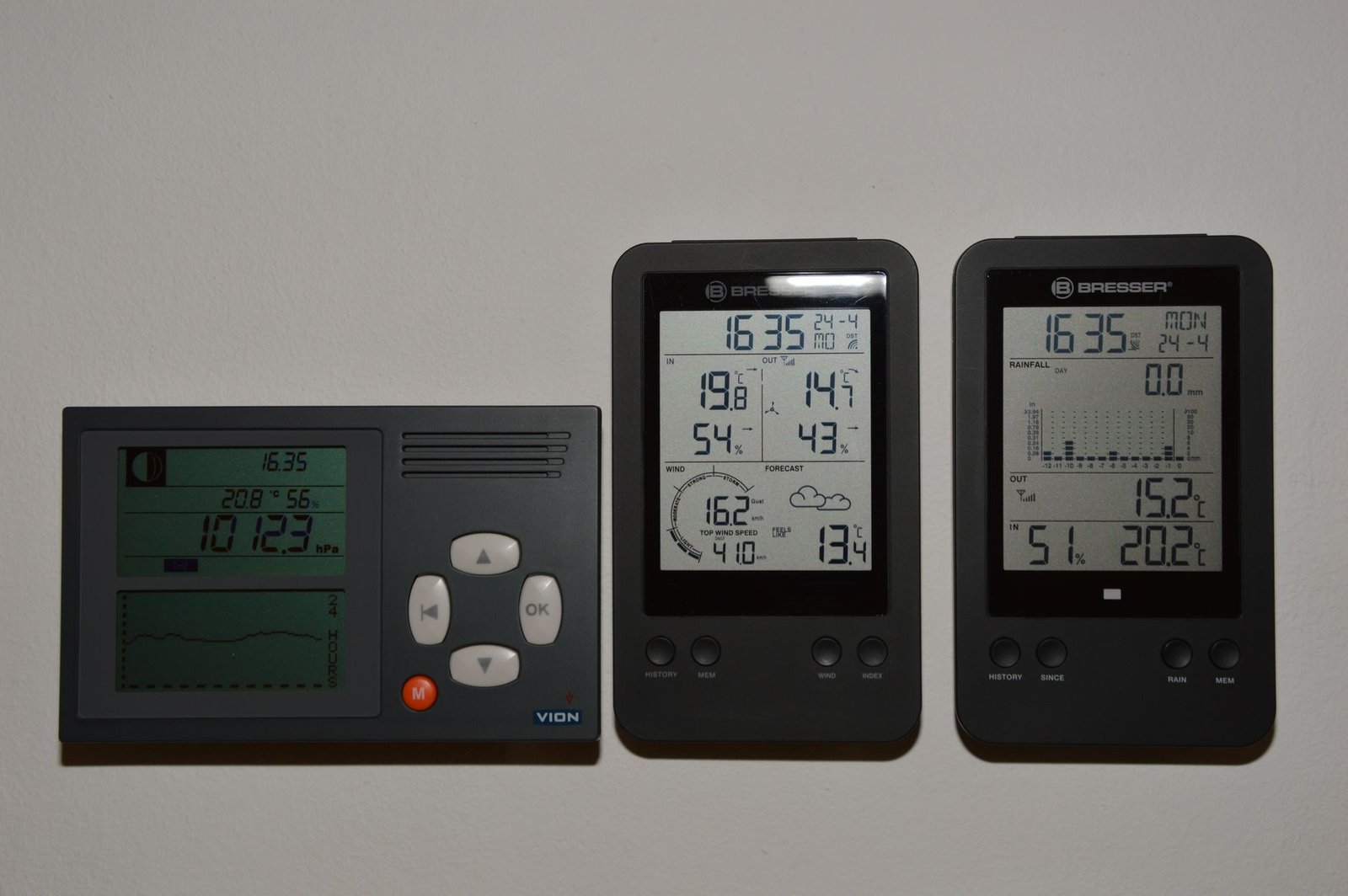
Domestic humidity sensors are accurate to a few percent, not to a decimal place. And the sensor inside your dehumidifier is reading the air at the machine — air that has just been through the machine, in a room where humidity is not uniform.
Which means chasing 47% rather than 50% is chasing noise. If two meters in the same room disagree by four points, neither of them is broken and neither is lying; that is simply the tolerance you are working with.
The practical upshot: pick a number, leave it for a fortnight, and judge the result by the room rather than the display. Are the windows still running with condensation in the morning? Has the musty smell gone? Is the washing drying? Those are the measurements that matter. If the answers are still wrong at 50%, drop to 45% and give it another fortnight.
Fan speed, and the settings that genuinely do something
Fan speed. High moves more air over the coil and dries faster. Low is quieter and, in a cooler room, gives the air more contact time with the coil. Use high while you are getting a room under control, low overnight in a bedroom.
Continuous drainage. Not a setting exactly, but the one change that makes the biggest practical difference. A full tank stops the machine, so an unattended unit on tank-only spends most of the week doing nothing. Setting up a drain hose properly takes twenty minutes and turns it into an appliance that actually holds a setting.
Those are the dehumidifier settings that change the outcome. The rest is interface.
Timers. Useful if your electricity is cheaper at certain hours. Otherwise the humidistat is a better controller than a clock, because it responds to the room rather than to a guess about the room.
Auto-restart. Check it is on. After a power cut you want the machine to come back to your setting, not sit dark for a fortnight while you are away.
Frequently asked questions
What should I set my dehumidifier to?
Fifty per cent for almost every room. Drop to 45% only if walls are noticeably cold, if condensation persists, or if mould has already appeared. Below 40% you are drying the room out for no benefit and paying for the privilege.
What should a dehumidifier be set on in a basement?
Fifty per cent, the same as anywhere else, unless the walls are cold to the touch — then 45%. The reason basements are often quoted lower is the cold surfaces, not the room itself. Insulated, reasonably warm basements do fine at 50%.
Is 30% too low for a dehumidifier setting?
For continuous running, yes. Thirty per cent is the bottom of the recommended band, and holding a room there costs a great deal of electricity while risking dried-out timber and joinery. It is a setting for a specific drying job, not a way of life.
Should I run my dehumidifier on high or low fan speed?
High while you are bringing a damp room under control, low for quiet overnight running or in a cooler room where slower air gets more contact with the coil. Neither changes the humidity target.
Does a lower setting make a dehumidifier work faster?
No. The setpoint only decides when the machine switches off. It removes water at the same rate either way — a lower number simply means it runs for longer before stopping.
What dehumidifier settings should I use in winter?
If the room is heated and above about 18°C, the usual 50%. If it is an unheated space below roughly 5°C, switch a compressor unit off — it will spend the season defrosting rather than collecting. A desiccant model is the answer if the space genuinely needs drying.
Should I leave my dehumidifier on all the time?
On a humidistat, effectively yes — that is what the setting is for. It will cycle itself off when the room reaches your target and back on when it drifts. What you should not do is leave it running in laundry or continuous mode indefinitely.
Related guides: How to dehumidify a room · Where to put a dehumidifier · Dehumidifier drain hose setup · Dehumidifier in winter
Sources
- ENERGY STAR — Dehumidifiers — the 30–50% recommended band and current efficiency standards.
- EPA — Mold Course, Chapter 2 — the 60% threshold and how surface conditions differ from room air.
- GE Appliances — Dehumidifier: Ideal Operating Conditions — low-temperature operating limits and defrost behaviour.
Where this guide and your appliance’s own manual disagree, follow the manual. And if you have been adjusting the setting every few days trying to find the sweet spot — stop. Put it on 50, walk away for two weeks, and let the room tell you whether it needs anything else.

