
Last Updated on September 1, 2026 by Umar Farooq
A dehumidifier blowing hot air is almost always working exactly as it should. Warm exhaust is not a symptom — it is the design. GE says so in its own support documentation: “Warm or hot air coming from under or behind a dehumidifier is normal and part of the dehumidification process when the appliance is drawing moisture from the air.”
The useful question is not whether the air is warm. It is warm compared with what, and is the tank filling? Those two facts together give you three possible answers, and only one of them is a fault.
Why a dehumidifier blowing hot air is the design, not a fault
Follow the air through the machine and it stops being mysterious.
Room air passes over the evaporator, a coil made deliberately cold, where it drops below its dew point and sheds water into the tank. That same air, now drier, passes straight over the condenser, a coil that is deliberately hot, on its way back out.
Both coils are inside the box. Both are in your room. So the heat the cold coil took out of the air is put straight back in by the warm one, plus the electrical work the compressor and fan have done on top. A dehumidifier is a net heater, and the warm outlet is the visible part of that.
That is also why it cannot cool a room however long you run it, and why an air conditioner — which is the same four components with the hot coil pointed outdoors — can.
The three answers, read off the outlet
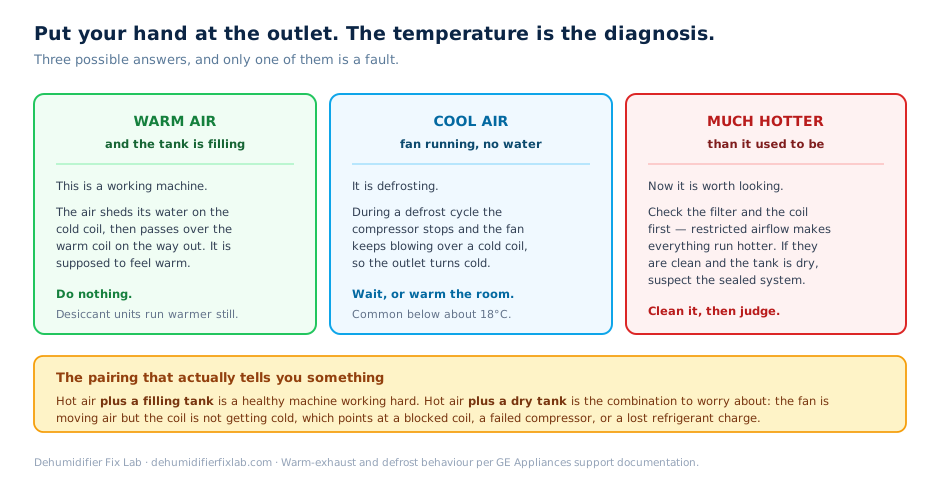
Warm air, and the tank is filling. This is a healthy machine doing its job. Nothing to fix, nothing to investigate. If the room is also getting drier, stop reading and go and do something more interesting.
Cool air, fan running, no water collecting. It is in a defrost cycle. GE notes that during defrost a dehumidifier actually produces cold air rather than warm — the compressor has stopped, and the fan is blowing over a coil that is still cold and shedding ice. This is normal in a cool room and it is the single most misdiagnosed state in this category. It happens constantly below about 18°C / 65°F, and almost permanently below 5°C / 41°F.
Noticeably hotter than it used to be. Now it is worth looking. This is the only one of the three that points at a fault, and it has an obvious first suspect.
When hot air is genuinely telling you something
The pairing that matters: hot air plus a dry tank.
The fan is moving air, and the machine is producing heat, but the coil is not getting cold enough to condense anything. In order of likelihood and cost:
1. A blocked filter or a packed coil. Restricted airflow means less air carrying heat away from the condenser, so everything runs hotter, and the evaporator runs colder than intended and frosts instead of dripping. This is free to check and five minutes to fix, and it is far and away the most common cause. The cleaning routine covers doing it properly.
2. The room is simply too cold. Not a fault at all — see the defrost answer above. Put a thermometer in the room before assuming anything.
3. Blocked clearance. A unit against a wall or behind furniture re-breathes its own hot exhaust. Thirty centimetres clear, always. Placement matters.
4. A failing capacitor or compressor. It is trying to start and failing, or running without producing cooling. You would usually hear it: clicking, humming, repeated short attempts. Worked through here.
5. A lost refrigerant charge. The sealed system has leaked. The fan runs, the coil never goes cold, and nothing collects. On a domestic portable this ends the machine — the repair costs more than a replacement.
A burning or electrical smell is a different matter from warm air, and it is not something to work through methodically. Unplug the machine at the wall and stop using it. Two large recalls in this category involved fire risk, and a burning smell is never a maintenance job.
One case where hot really is normal: desiccant units
If yours is a desiccant dehumidifier rather than a compressor one, the outlet air will be substantially warmer than a compressor machine’s, and that is inherent to how it works. A desiccant unit uses a small heater to drive moisture back out of its absorbent wheel, so heat is part of the process rather than a by-product.
Manufacturers do not agree on how much. EcoAir quote a rise of roughly 3–5°C; Meaco put it nearer 10–12°C — a genuine disagreement between two reputable makers rather than a number I can settle, so check your own model. Either way, a desiccant machine that feels hot is behaving normally, and in a cold garage that heat is a feature. The full comparison.
How much heat are we actually talking about?
Over a long run in a closed room, expect one to two degrees Celsius from a compressor unit, and less with any air movement. A precise universal figure would be a guess: it depends on power draw, room size and ventilation.
Worth knowing in summer, when the machine adds a degree or so of real heat while removing several degrees of felt heat. That trade is strongly in your favour in a muggy room and against you in a dry one. Running one in summer covers it.
Frequently asked questions
Is it normal for a dehumidifier to blow hot air?
Yes. The air passes over a cold coil to shed its water and then over a hot coil on the way out. Manufacturers state plainly that warm exhaust is part of normal operation. If the tank is filling, nothing is wrong.
Why is my dehumidifier blowing hot air but not collecting water?
That combination is worth investigating. Check the filter and coil first, then the room temperature. If the room is warm, the filter is clean and the tank stays dry, suspect a capacitor, the compressor, or a lost refrigerant charge.
Why is my dehumidifier blowing cold air?
It is almost certainly in a defrost cycle — the compressor has stopped and the fan is running over a coil that is still cold. This is normal in a cool room and very common below about 18°C.
How much does a dehumidifier heat a room?
Typically one to two degrees Celsius over a long run in a closed room. The exact figure depends on the machine’s wattage and the room’s size and ventilation, so a universal number would be an invention.
Should a desiccant dehumidifier blow hotter air than a compressor one?
Yes, noticeably. Desiccant units use a heater to regenerate their absorbent wheel, so warm output is inherent. Manufacturers quote anywhere from about 3°C to 12°C of rise, which is a genuine disagreement worth checking against your own model.
Can a dehumidifier overheat?
Modern units have thermal protection and will shut down rather than run away. What you should never ignore is a burning or electrical smell, which means unplug it at the wall and stop.
Will cleaning the filter stop it blowing hot air?
It will not stop warm exhaust, because that is by design. It can stop excessive heat, since a blocked filter restricts airflow and makes everything in the machine run hotter than intended.
Related guides: How dehumidifiers work · Dehumidifier not collecting water · Can a dehumidifier cool a room? · How to clean a dehumidifier
Sources
- GE Appliances — Dehumidifier: Exhaust Air Temperature Warm — the manufacturer’s own statement that warm exhaust is normal, and that defrost produces cold air instead.
- GE Appliances — Dehumidifier: Ideal Operating Conditions — the low-temperature limits behind repeated defrost cycling.
- Frigidaire — Dehumidifier: Putting out Hot Air — a second manufacturer saying the same thing, independently.
Where this guide and your appliance’s own manual disagree, follow the manual. And if you came here worried because the back of the machine is warm — go and look at the tank instead. That is the measurement that actually answers your question.

