
Last Updated on September 1, 2026 by Umar Farooq
The real dehumidifier benefits are narrow and genuinely valuable: it stops mould getting started, suppresses dust mites, lifts a musty smell, makes a warm room feel far cooler, protects the fabric of your house, and dries washing indoors. That is the honest list, and for a damp house it is easily worth the money.
Everything past that list of dehumidifier benefits gets progressively more oversold, and two of the most commonly repeated claims are the opposite of true. Worth knowing which is which before you spend anything.
The one reading that decides whether you need one
Before any benefit applies, the room has to be damp. Put a hygrometer in it for a week — not one reading, a week of them, because humidity swings enormously across a day.
- Consistently above 60% — everything below is available to you.
- 50–60% — worth running on a humidistat, modest gains.
- Below 50% — you have no humidity problem, and a dehumidifier will add heat, add cost, and do nothing you would notice.
That last line is the one no retailer leads with. ENERGY STAR and the EPA both put the target band at 30–50%, and a house already sitting inside it is finished. Keep your money.
The six dehumidifier benefits that hold up
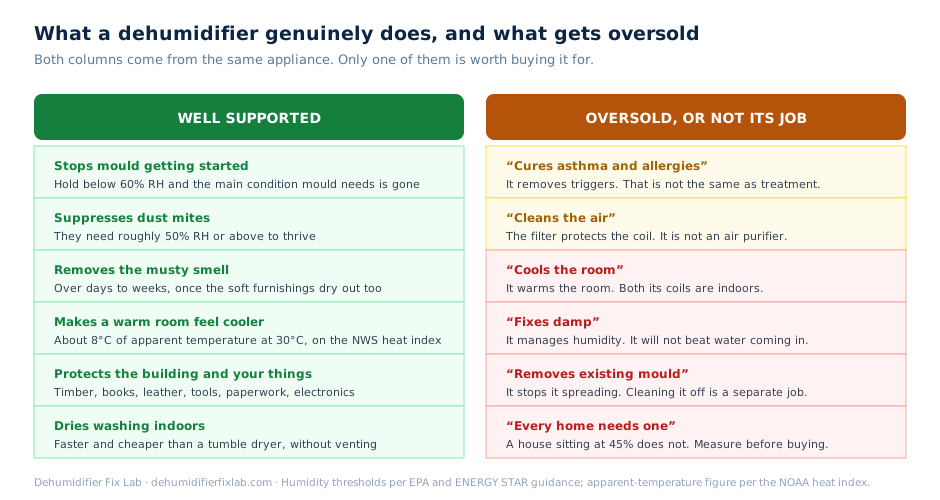
1. It stops mould getting started. This is the headline. Above 60% relative humidity, mould can establish on a suitable surface within 24 to 48 hours. Hold the room below that and you have removed the condition it needs. Nothing else on this list matters as much.
2. It suppresses dust mites. They need roughly 50% RH or above to thrive. Drop the room to 45–50% and the population falls. That is a real, mechanical effect on a real allergen.
3. It lifts a musty smell. Over days to weeks rather than overnight, because the smell lives in soft furnishings and plaster, not in the air. But it does go, provided the source was damp and not something else in the room.
4. It makes a warm room feel dramatically cooler. Sweat only cools you when it evaporates, and it evaporates badly into saturated air. On the National Weather Service heat index, a room held at 30°C feels like 38°C at 80% humidity and like 30°C at 45% — about 8°C of felt heat removed with the thermometer not moving. The full explanation.
5. It protects the building and your things. Timber, joinery, books, leather, tools, paperwork, electronics, and anything stored in a garage or a loft. This is the benefit people notice last and value most, usually after losing something.
6. It dries washing indoors. Faster than an airer alone, cheaper than a tumble dryer, and it does not need venting. Doing it properly is a genuine everyday win in a damp climate.
The six dehumidifier benefits that get oversold
“It cures asthma and allergies.” It removes triggers — mould spores, dust mites — which for some people is a meaningful improvement. That is not the same as treatment, and no appliance should be presented as one.
“It cleans the air.” The filter in a dehumidifier is there to protect the coil from dust, not to purify anything. It is not a HEPA machine and it is not an air purifier. Different appliance, different job.
“It cools the room.” It warms the room, slightly. Both its coils sit indoors, so the heat the cold one removes is put straight back by the warm one, plus the compressor and fan’s own work. The comfort improvement is real; the temperature drop is not.
“It fixes damp.” It manages humidity. If water is actively getting in through a wall, a roof or a failed seal, the machine will run permanently and never win, because it is removing water at the rate the wall supplies it. Find the water first.
“It removes existing mould.” It stops mould spreading by removing what feeds it. Cleaning off what has already grown is a separate job with a cloth and, above a certain size, a professional.
“Every home needs one.” No. A house at 45% does not. This is the claim that sells the most machines to people who did not need them.
What it is actually worth to run
Two honest notes on cost, because this is where benefit claims go vague.
Work in kWh, not currency. Take the wattage from the rating plate, multiply by hours run, divide by 1,000. A 300 W unit running eight hours a day is 2.4 kWh — multiply by whatever you actually pay. Rates differ by country and change yearly; the formula does not.
And when comparing two machines, compare Integrated Energy Factor — litres removed per kilowatt-hour — rather than capacity. That is the number that decides your bill over a season, and it is the one buyers ignore in favour of a bigger pint figure.
The one benefit I would pay for on its own
If I had to justify a dehumidifier on a single line, it would not be comfort or smell or laundry.
It is the cheapest insurance you can buy against having to replaster a wall. A machine holding a cold back bedroom at 50% through a winter costs a few pounds a month in electricity and prevents a job that costs hundreds. That is the whole argument, and it is why I would put one in a damp house before I bought anything else for it.
Frequently asked questions
What are the main benefits of a dehumidifier?
Preventing mould, suppressing dust mites, removing musty smells, making a warm room feel considerably cooler, protecting timber and stored belongings, and drying washing indoors. All of them depend on the room actually being damp to begin with.
Do I need a dehumidifier?
Measure the room for a week first. Consistently above 60% relative humidity means yes. Between 50 and 60%, it is worth running on a humidistat. Below 50%, you do not need one and running it will only add heat and cost.
Is a dehumidifier good for your health?
Indirectly. It reduces mould and dust mites, which are genuine triggers for some people, and it makes a muggy room more bearable. It is an environmental control rather than a medical device, and over-drying a room below 30% causes its own problems.
Does a dehumidifier help with dust?
Not much. It removes moisture, not particles. Its filter exists to protect the coil. If dust itself is the complaint, that is an air purifier’s job, not this one’s.
Will a dehumidifier lower my heating bill?
Marginally, and not for the reason usually given. Drier air feels warmer at the same temperature, so some people find they set the thermostat lower. The machine’s own electricity use offsets part of that.
How long before I notice the benefits?
The hygrometer moves within hours. The musty smell and the feel of the room take one to two weeks, because the soft furnishings and the plaster dry far more slowly than the air does.
Are there downsides to using a dehumidifier?
Three worth knowing: it adds a little heat, it costs electricity, and run too hard it can dry a room below 30% where timber and joinery start to crack. Set it to 50% and none of the three become a problem.
Related guides: Difference between humidifier and dehumidifier · Dehumidifier settings · Does a dehumidifier help with mould? · Can a dehumidifier cool a room?
Sources
- ENERGY STAR — Dehumidifiers — the 30–50% target band, capacity guidance and efficiency ratings.
- EPA — Mold Course, Chapter 2 — the 60% threshold and how quickly mould establishes above it.
- NOAA National Weather Service — Heat Index — the apparent-temperature figures behind the comfort benefit.
Where this guide and your appliance’s own manual disagree, follow the manual. And if you are reading this because a shop assistant told you every home needs one — go and buy a hygrometer instead, and come back in a week. Half the people who do that never buy the machine.

