
Last Updated on September 1, 2026 by Umar Farooq
How long do dehumidifiers last? Five to ten years for a domestic portable, with most failing somewhere around the six or seven year mark. Desiccant units tend to go on longer than compressor ones because there’s less to break, and whole-house models outlast both.
Worth saying up front: the published figures on this disagree more than you’d expect. One of the top-ranking guides on this question puts refrigerant units at 1–5 years; others say 5–8; another cites an industry study at about 8. That spread tells you something useful — this is a soft number that depends far more on how the machine has been treated than on what it says on the box.
What actually determines the number
Three things, and you control two of them.
Running hours. A machine running twelve hours a day, every day, in a wet basement is doing several times the work of one that comes out for a fortnight in spring. Lifespan quoted in years is really lifespan quoted in compressor cycles wearing a disguise.
Maintenance — mostly the filter. This is the big one and it’s the one people skip. A blocked filter starves the coil of air, which makes the compressor work harder and run hotter, which shortens its life. It also ices the coil, which triggers defrost cycles, which means more start-stop cycling. A five-minute monthly job genuinely adds years.
Where it lives. A unit in a cold garage spends a large part of its life short-cycling in and out of defrost, which is harder on a compressor than steady running. Dusty environments clog coils faster. Damp, corrosive air shortens everything.
How long do dehumidifiers last by type?
| Type | Typical service life |
|---|---|
| Compressor portable | 5–8 years |
| Desiccant portable | Often longer — fewer moving parts, no refrigerant circuit |
| Whole-house / ducted | 10–15 years, heavier components |
The desiccant advantage is structural rather than a matter of quality: no compressor, no sealed refrigerant loop, so two of the three things that kill a portable simply aren’t present. The trade-off is higher running cost in a warm room, which is covered in the desiccant versus compressor comparison.
Five signs yours is finished
1. It runs constantly and never reaches the target. Assuming the room isn’t ridiculous and the filter is clean, an ageing compressor loses capacity gradually. If it used to hold 50% and now runs permanently at 60%, that’s a real signal.
2. The bucket fills much more slowly than it used to. Same fault, measured differently, and often easier to notice.
3. It ices up in conditions it used to handle. Coil frosting at 20°C is not normal and usually means low refrigerant charge — which on a sealed system means the end.
4. Persistent smell you can’t clean out. If you’ve cleaned the filter, coil and tank and it still smells, biofilm has got somewhere you can’t reach.
5. Repeated electrical faults. One failed capacitor is a repair. A capacitor, then a relay, then a board fault inside a year is a machine telling you something.
What is not a sign of a dying machine: running fan-only in a cold room (that’s the defrost cycle working), or a full-bucket light with an empty bucket (that’s a switch, not the compressor). Both get people replacing perfectly good units.
Repair or replace: the actual decision
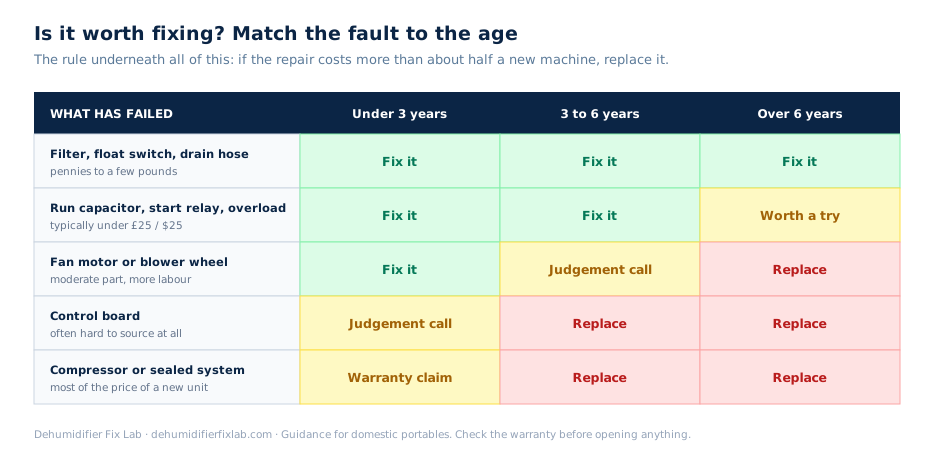
The rule everything else hangs off: if the repair costs more than about half the price of a comparable new machine, replace it. Now match that against what’s failed.
Two positions I’ll state plainly, because they pull in opposite directions and you need both.
A compressor or sealed-system failure ends a portable dehumidifier. Not because it’s technically impossible — because a compressor swap runs to a substantial fraction of a new unit’s price, fitted into a machine whose every other component is exactly as old as the one that just died. Anyone quoting you for that on a domestic portable is doing you no favours.
But the reverse mistake is more common and nobody warns you about it. A run capacitor, a start relay, a float switch or an overload protector is typically under £25 and a short job. Scrapping an otherwise sound machine over a part the size of a film canister happens constantly, largely because there’s no margin in telling you not to.
Before you decide anything: check the warranty. Sealed systems often carry a longer term than the rest of the machine, sometimes five years or more. Opening the case yourself will void it.
What kills them early
Worth naming the failure paths, because every one of them is avoidable and each is worth years.
A blocked filter, left blocked. Restricted airflow makes the compressor run hotter and forces the coil into repeated defrost cycles. It is the single most common cause of a machine dying young, and it is a five-minute job. The filter guide covers the intervals.
Running it in a room that’s too cold. Every trip into defrost is a compressor stop-start with no water collected in return. A winter in an unheated garage is a lot of wear for very little output.
Short-cycling from an oversized unit. A machine far too big for its room hits the setpoint fast, stops, and restarts minutes later. Compressors dislike that more than they dislike running.
Standing water left in the tank. Over a summer it grows biofilm; over a winter in storage it seizes floats and leaves a smell you’ll never fully clean out.
Long extension leads. Voltage drop during the compressor’s inrush causes failed starts, and repeated failed starts are what destroy overload protectors.
Making yours last longer
- Clean the filter monthly during the season. If you do nothing else on this list, do this one.
- Vacuum the coils once a season, unplugged, with a soft brush.
- Give it 30 cm / 12 inches of clear space on all sides so it isn’t re-breathing its own exhaust.
- Set it to 50% rather than the lowest setting. Chasing 35% just means more running hours for no benefit.
- Use continuous drainage if it runs unattended — a full tank stops the machine, and the standing water grows biofilm. The drain hose guide covers doing it properly.
- Don’t run a compressor unit in a freezing room. All that short-cycling into defrost is wear with nothing to show for it.
- Empty and dry the tank before storing it over winter. Water left standing for months is how floats seize and smells start.
- Plug it into the wall, not an extension lead. Voltage drop on a long thin cable causes repeated failed starts, and failed starts are what kill overload protectors.
Frequently asked questions
How long do dehumidifiers last on average?
Five to ten years for a domestic portable, with most landing around six or seven. Published estimates vary widely because running hours and maintenance matter far more than the make.
Is it worth repairing a dehumidifier?
Depends entirely on which part. Capacitors, relays, float switches and filters are cheap and worth fixing at almost any age. A compressor or sealed-system failure is the end of the machine. Anything in between comes down to the half-price rule.
Do desiccant dehumidifiers last longer than compressor ones?
Generally yes, because they have no compressor and no refrigerant circuit — two of the main failure points simply aren’t there. They cost more to run in a warm room, so it’s a trade rather than a straight win.
How long does it take a dehumidifier to work?
Different question, and worth separating. Air humidity drops within hours; damp plaster, timber and soft furnishings take days to weeks. Judge a new machine over a fortnight rather than overnight.
Should I replace a working dehumidifier with a more efficient one?
Only if it’s genuinely old and running long hours. Efficiency has improved, but the electricity saving takes years to repay a new machine unless yours runs most of the day.
Does running it constantly shorten its life?
Steady running is easier on a compressor than frequent starts and stops. What shortens life is short-cycling — which is what you get from an oversized unit in a small room, or any unit in a room cold enough to keep triggering defrost.
Can I fix a dehumidifier that won’t collect water?
Often, yes, and it’s usually not the compressor. Start with the free checks — room temperature, humidity setting, filter — before assuming the machine is finished.
Related guides: Desiccant dehumidifier vs compressor · Dehumidifier fan runs but the compressor doesn’t · Dehumidifier drain hose setup
Sources
- ENERGY STAR — Dehumidifiers — current efficiency standards and the humidity target band.
- GE Appliances — Dehumidifier: Ideal Operating Conditions — operating limits, and why running one too cold causes constant defrost cycling.
- Meaco — Desiccant and compressor dehumidifiers compared — the mechanical differences behind the lifespan gap between the two types.
Where this guide and your appliance’s own manual disagree, follow the manual. And if yours is seven years old and has just started icing up in a warm room — I’d stop spending on it. That one’s telling you something.

