
Last Updated on September 1, 2026 by Umar Farooq
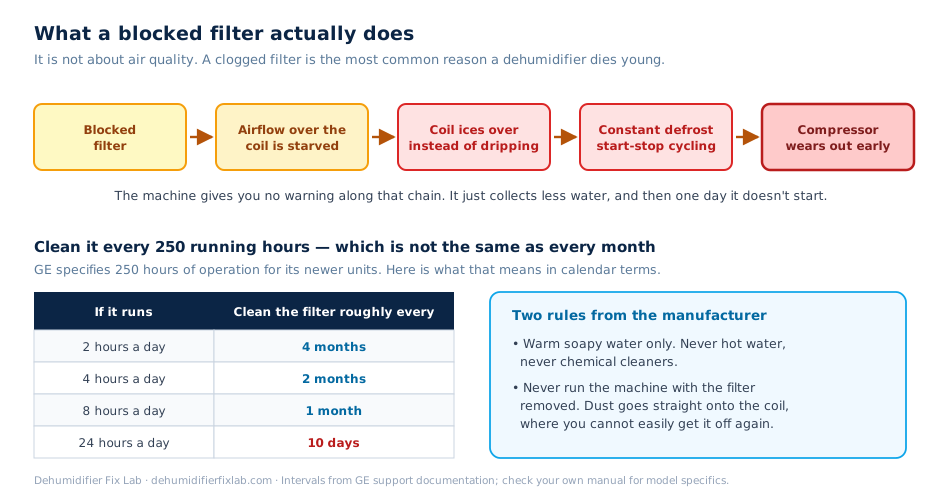
Clean your dehumidifier filter every 250 running hours — not every month. That’s the interval GE specifies for its newer units, and it’s a far more honest measure than a calendar date, because a machine running twelve hours a day gets there in three weeks while one running two hours a day takes four months.
It takes five minutes, it needs nothing but warm soapy water, and it is genuinely the highest-value maintenance job on the machine. Here’s why, and then how.
Why the filter matters more than you’d think
Most people assume the filter is about air quality. On a dehumidifier it isn’t, really — it’s there to protect the coil.
Follow the chain. A blocked filter starves the coil of airflow. With less air passing over it, the coil runs colder than it should and frosts over instead of dripping. Frost triggers the defrost cycle, so the compressor stops and the fan runs. That happens again, and again, and every one of those cycles is a compressor start-stop with no water collected in exchange.
The end of that chain is a compressor that wears out years early. And the machine never tells you any of it is happening — it just quietly collects less water until one day it doesn’t start.
That’s why “clean the filter” ends nearly every guide on this site. It isn’t filler — it’s the one job that prevents a good half of the faults I write about.
How often to clean a dehumidifier filter
Calendar intervals are a rough proxy. The real measure is running hours.
| If it runs | Clean roughly every |
|---|---|
| 2 hours a day | 4 months |
| 4 hours a day | 2 months |
| 8 hours a day | 1 month |
| 12 hours a day | 3 weeks |
| 24 hours a day | 10 days |
Clean more often with pets, in a workshop or dusty basement, or if anyone smokes indoors. GE’s guidance for older models is simply to check every two to three weeks — which for normal use lands in about the same place.
The real rule: look at it. If you can’t see clear light through the mesh, it’s due.
Cleaning it, in six steps
1. Switch off and unplug at the wall. Not because this bit is dangerous, but because it’s a good habit before opening any panel.
2. Find the filter. Usually behind a grille on the back or side, often on a small tab or tassel. If it isn’t obvious, check the manual rather than forcing a panel — the clips go brittle with age.
3. Vacuum the worst off first. A soft brush attachment lifts the loose dust before it turns to mud in the sink.
4. Wash in warm soapy water. GE is explicit here: warm water and mild detergent, never hot water and never chemical cleaners. Hot water can distort the plastic frame, and solvents damage the mesh. Rinse it thoroughly.
5. Dry it completely. The step people rush. A damp filter refitted is a mould starter kit and the machine will smell within days. Half an hour flat on a towel, and not on a radiator.
6. Refit it before you switch on. And this matters more than it sounds — see below.
While you have the panel off, it’s worth vacuuming the coil fins gently with a soft brush and wiping out the tank. GE suggests washing the bucket with dish soap, or a solution of roughly 90% water to 10% bleach if mildew has taken hold, then rinsing well.
Never run it without the filter
GE puts this in its own documentation as a plain instruction: “Never operate the dehumidifier without the filter installed.”
It gets ignored constantly — someone pulls a filthy filter out, means to wash it, and runs the machine meanwhile. But the filter is the only thing between household dust and the evaporator coil, and dust landing on a wet coil sticks, packs into the fins, and is far harder to shift than it ever was from a filter.
You end up with a permanently restricted coil and the same failure chain, except now soapy water won’t fix it. If the filter is drying, leave the machine off.
Washable or disposable?
Most domestic portables use a washable mesh filter. It’s designed to be rinsed indefinitely and only needs replacing if it tears, deforms or stops coming clean. If yours looks permanently grey after washing, that’s fine — grey isn’t blocked.
Some units also carry a disposable carbon or HEPA-type element for odour and particle capture. Those want replacing every three to six months — you can’t wash a carbon layer back to life, you’ll just destroy it.
When buying a replacement, search your model number rather than the brand. The same filter often fits across several badges, because the machines underneath are frequently identical.
What a dirty filter looks like from the outside
Symptoms that usually mean filter first:
- Collecting noticeably less water than it used to
- Icing up in a room that’s comfortably warm
- Running much longer to hit the same humidity
- A musty smell coming off the airflow
- Fan noise that’s gone louder or more strained
All have other possible causes, but the filter is free to check — so it goes first, every time. If cleaning it doesn’t help, work through why the fan runs but the compressor doesn’t next.
Frequently asked questions
How often should I clean my dehumidifier filter?
Every 250 running hours as a working rule — about monthly if it runs eight hours a day, or every ten days if it runs continuously. Check it every two to three weeks and clean when you can’t see clear light through the mesh.
Can I wash a dehumidifier filter?
Almost always, yes — most domestic units use a washable mesh. Use warm soapy water, never hot water or chemical cleaners, and dry it completely before refitting.
Can I run a dehumidifier without the filter?
No. Manufacturers say so plainly, and the reason is practical: dust goes straight onto the coil, where it sticks and is very hard to remove. Leave the machine off while the filter dries.
How do I know when a dehumidifier filter needs replacing?
Washable mesh filters rarely need replacing — only if torn, deformed or no longer cleanable. Disposable carbon or HEPA-type elements typically want changing every three to six months.
Why does my dehumidifier smell after I cleaned the filter?
Usually because the filter went back in damp, or because the tank and coil weren’t cleaned at the same time. Dry the filter fully, wash the bucket, and gently vacuum the coil fins.
Does a dirty filter make a dehumidifier use more electricity?
Yes. Restricted airflow means longer running for the same water removed, and more of that time spent defrosting rather than collecting.
Will cleaning the filter fix a dehumidifier that isn’t collecting water?
Sometimes, and it’s the first thing to try because it’s free. If it doesn’t, the usual next suspects are room temperature and the humidity setting — both also free to check before you buy anything.
Related guides: How long do dehumidifiers last? · Dehumidifier fan runs but the compressor doesn’t · Dehumidifier in winter
Sources
- GE Appliances — Dehumidifier: Cleaning and Maintenance — the 250-hour interval, the warm-soapy-water instruction, the bucket cleaning solution, and the warning against running without a filter.
- GE Appliances — Dehumidifier: Ideal Operating Conditions — the coil and frost behaviour behind the failure chain.
- ENERGY STAR — Dehumidifiers — efficiency and the humidity target band.
Where this guide and your appliance’s own manual disagree, follow the manual. And if you’ve never taken the filter out of yours — go and look at it now. I’ve yet to open a machine that had been running a season where it wasn’t worse than the owner expected.

