
Last Updated on October 24, 2026 by Umar Farooq
How long should a dehumidifier run? However long the humidistat says — which in a room already under control is two to six hours a day in short bursts, and in a damp basement is eight to sixteen. Hours per day is the wrong thing to be controlling. Set a target humidity, leave it alone, and the machine works out its own runtime.
That is a genuinely different answer from the one most guides give, and it is worth explaining why, because there is a widely repeated figure in this subject that I do not think stands up.
Why hours per day is the wrong control
A dehumidifier already has a controller built into it, and it is better at this job than you are.
The humidistat measures the room and switches the compressor on when humidity drifts above your setting and off when it drops below. It responds to what is actually happening — the weather, a shower, washing drying, the heating coming on. A timer responds to a guess you made last Tuesday.
On a timer, one of two things happens: it is off when the room needs it, or on when it does not. On a humidistat it runs precisely when it should. The runtime is an output, not an input.
Which means the real question is not “how many hours” but “what should I set it to” — and the answer is 50% for almost every room.
The five scenarios, and what runtime to expect
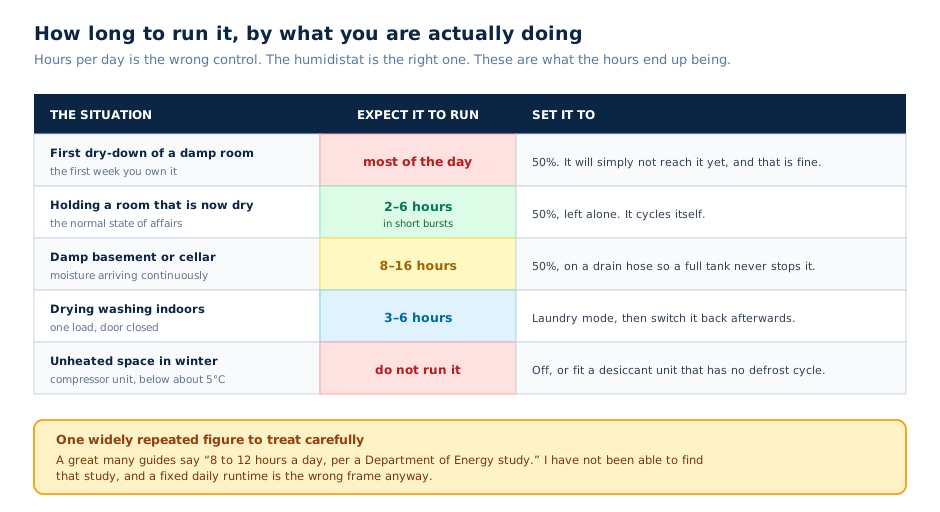
| The situation | Expect it to run | Set it to |
|---|---|---|
| First dry-down of a damp room | Most of the day | 50%, and accept it will not reach it yet |
| Holding a room that is now dry | 2–6 hours, in short bursts | 50%, left alone |
| Damp basement or cellar | 8–16 hours | 50%, on a drain hose |
| Drying washing indoors | 3–6 hours | Laundry mode, then switch back |
| Unheated space below about 5°C | Do not run it | Off, or fit a desiccant unit |
The first week is not representative. A machine brought into a genuinely damp room will run almost continuously for the first few days, because it is not just drying the air — it is pulling water out of plaster, carpet and soft furnishings, which release it slowly. That process takes weeks, not hours. Judge the runtime after a fortnight, not after a night.
The figure I could not verify
Worth flagging plainly, in the spirit of not repeating things because everyone else does.
A great many articles on this question state that “a Department of Energy study recommends running a dehumidifier 8 to 12 hours a day.” The phrasing is nearly identical across sites, which usually means one source has been copied round.
I have not been able to find that study. The DOE publishes dehumidifier efficiency standards and test procedures — those exist and are easy to find — but I can locate nothing that recommends a daily runtime, and it would be an odd thing for a standards body to recommend, since runtime depends entirely on the room.
So I am not going to repeat it. Eight to twelve hours is a perfectly plausible figure for a moderately damp room in summer. It is not, as far as I can tell, a government recommendation, and it certainly is not a target to aim for.
Should it run overnight?
Depends on the room and on how much the noise bothers you.
In a basement or a utility room: yes, leave it on the humidistat. There is nobody to disturb, and overnight is often when the space is coolest and dampest.
In a bedroom: try the day-running experiment first. Run it hard with the door shut from morning to evening, switch it off at bedtime, and take a reading each morning for a week. If the humidity holds, you have removed the noise problem entirely and saved the electricity. If it creeps up, run it overnight on sleep mode. The bedroom noise guide covers making that liveable.
In a living room: it does not matter much either way, because the room is usually empty overnight anyway.
Should it run 24/7?
On a humidistat, effectively yes — and that is fine. A machine “left on” is not running constantly; it is switching itself on and off around your setting. In a damp basement it may well be running most of the time, and there is nothing wrong with that. Steady running is the easy life for a compressor; what wears them out is repeated starting and stopping.
Two things to get right if it is going to run unattended:
Continuous drainage. A full tank stops the machine, so a unit on tank-only in a damp room spends most of the week doing nothing. A hose to a floor drain turns it into an appliance that actually holds its setting.
Auto-restart. Check it is enabled. After a power cut you want it back on your setting, not sitting dark while you are away.
When to stop running it altogether
- The room has held below 50% for a fortnight. Switch it off and check weekly. There is nothing left to remove, and every hour it runs is heat and electricity for nothing.
- You are running air conditioning in the same room. The AC is already dehumidifying as a side effect of its cold coil, and the two machines are fighting each other. Separate them.
- The space is unheated and below about 5°C. A compressor unit will spend the season defrosting rather than collecting. Off, or a desiccant machine.
- It has run for weeks with no downward trend at all. That is not a runtime problem. Something is feeding water into the room faster than the machine removes it, and no number of hours fixes an active leak.
What running it actually costs
Work in kWh rather than currency, because tariffs differ by country and change every year while the arithmetic does not.
Take the wattage from the rating plate, multiply by the hours it runs, and divide by 1,000. A 300 W machine running eight hours a day is 2.4 kWh — multiply that by whatever you actually pay per unit. That is the honest calculation, and it is why I will not print a monthly cost figure that would be wrong for most readers.
If you are comparing two machines, compare Integrated Energy Factor — litres removed per kilowatt-hour — rather than capacity. A more efficient machine running the same hours simply costs less.
Frequently asked questions
How long should a dehumidifier run per day?
Whatever the humidistat decides. In a room already under control that is typically two to six hours in short bursts; in a damp basement, eight to sixteen. Set 50% and let it work its own runtime out rather than using a timer.
Should I leave my dehumidifier on all the time?
On a humidistat, yes. It will cycle itself on and off around your setting rather than running constantly, and steady operation is easier on a compressor than repeated starts. Just make sure a full tank cannot stop it.
Is it safe to run a dehumidifier 24 hours a day?
Yes, in a damp room. Modern units have thermal protection and are designed for continuous duty. What you should not do is leave one in laundry or continuous mode indefinitely, which ignores the humidistat entirely.
How long should a dehumidifier run in a basement?
Typically eight to sixteen hours a day, because moisture keeps arriving through the walls and floor. Set 50%, run continuous drainage, and let it decide. If it never stops, check for an actual water source.
Should I run a dehumidifier at night?
In a basement or utility room, yes. In a bedroom, try running it during the day with the door shut and see whether the morning reading holds. If it does, you have solved the noise problem for free.
Does running a dehumidifier longer dry the room faster?
No. The setpoint decides when it stops, not how hard it works. Setting a lower target simply means it runs for longer past the point where you were getting any benefit.
How do I know when to turn my dehumidifier off?
When the room has held below 50% for a couple of weeks, or when the tank is barely collecting anything. Both mean the job is done and the machine is now just adding heat and cost.
Related guides: Dehumidifier settings · How long does a dehumidifier take to work? · Dehumidifier drain hose setup · Quiet dehumidifier for a bedroom
Sources
- US Department of Energy — Dehumidifier standards — the federal efficiency standards and test procedures that do exist, as distinct from the runtime recommendation that is widely attributed to them.
- ENERGY STAR — Dehumidifiers — the 30–50% target band and Integrated Energy Factor.
- GE Appliances — Dehumidifier: Ideal Operating Conditions — the low-temperature limits behind the “do not run it” row.
Where this guide and your appliance’s own manual disagree, follow the manual. And if you have been switching yours on and off to a schedule — stop. Put it on 50%, walk away for a fortnight, and the clock question answers itself.

