
Last Updated on September 1, 2026 by Umar Farooq
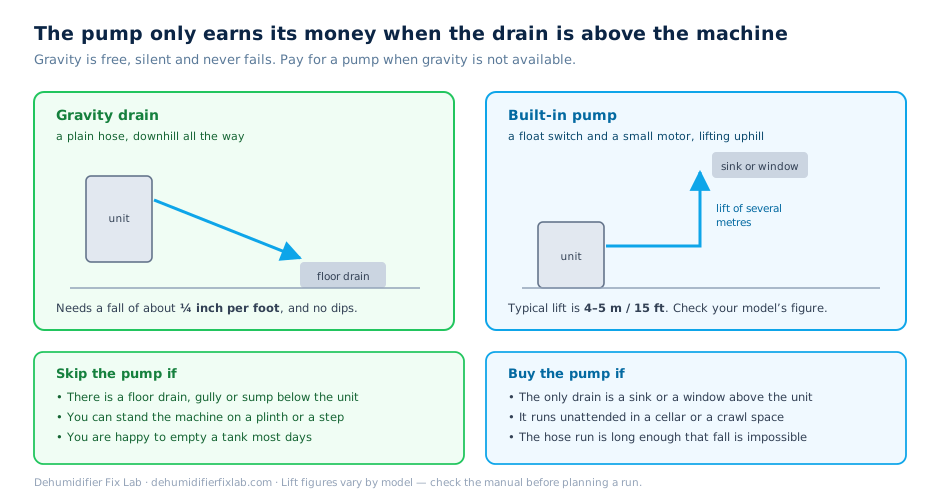
A dehumidifier with built in pump is worth the extra money in exactly one situation: when the only place to send the water is higher than the machine. A sink, a window, a soil stack, an outside gully up a step. If your drain is below the unit, gravity does the same job for free, silently, with nothing that can fail.
That is the whole decision. A dehumidifier with built in pump adds cost, a moving part and a noise every time it runs, so it is worth making deliberately.
How a dehumidifier with built in pump actually works
Simpler than people expect, and worth knowing because it tells you what can go wrong.
Water condenses on the cold coil and drips into a small internal reservoir. Inside that reservoir sits a float switch. When the level reaches a set point, the float rises, closes the switch and starts a small electric pump. The pump pushes the water out through a narrow hose — typically about 5 mm bore — until the level drops and the float switches it off again.
Two consequences follow directly:
- The pump runs intermittently, not continuously. You will hear a short buzz every so often, which is normal.
- The float and the narrow hose are the two things that fail. Biofilm on the float means the pump never starts; silt in a 5 mm hose means it starts and cannot shift anything.
Gravity versus pump, side by side
| Gravity hose | Built-in pump | |
|---|---|---|
| Direction | Downhill only | Up to roughly 4–5 m / 15 ft |
| Cost | The price of a hose | A meaningful premium on the machine |
| Noise | Silent | A short buzz each cycle |
| Can it fail? | Only if it silts up or kinks | Float, pump motor, or a blocked narrow hose |
| Maintenance | Flush it once a season | Flush it, and keep the float clean |
The three cases where a pump earns its money
1. The only drain is above the machine. A utility sink, a basin, a window, a soil pipe. This is the classic case and there is no gravity alternative.
2. It runs unattended somewhere awkward. A cellar, a crawl space, a garage with no floor drain, a holiday property. Anywhere a full tank stopping the machine for a fortnight would matter. This is the same argument as running any continuous drainage, just applied where gravity is unavailable.
3. The hose run is too long to keep a fall. A gravity hose needs about ¼ inch of fall per foot the whole way, with no dips. Across a long basement, that adds up to a drop you may not have. A pump does not care about the route.
The three cases where gravity wins
1. There is a floor drain, gully or sump below the unit. Use it. Free, silent, and nothing to go wrong.
2. You can raise the machine. A concrete block, a small stand or a step often converts an impossible run into a gravity one. This is the trick most people miss, and it is worth ten minutes of looking before spending anything.
3. You are happy to empty the tank. In a mildly damp room, a tank every couple of days is no hardship. Pumps are for machines nobody watches.
An external pump is a third option
Worth knowing, because it changes the buying decision.
You do not have to buy a machine with the pump inside it. A separate condensate pump — the same part fitted to air conditioners and condensing boilers — sits under the dehumidifier, takes the gravity outflow into its own small tank, and lifts it from there.
The advantages are real: usually cheaper than the premium on a pump-equipped machine, movable to a different unit later, and when it fails you replace a small part rather than losing the dehumidifier. The disadvantage is another box on the floor.
If you already own a machine and have discovered you need lift, this is the answer. Do not replace the dehumidifier.
What goes wrong with pumps, and how to stop it
The failures are boringly predictable and almost entirely preventable.
The hose silts up. That 5 mm bore blocks far more easily than a garden hose. Disconnect it and flush it through with water once a season. If the pump buzzes but nothing arrives, this is the first suspect.
The float sticks. Biofilm on the float means it stops rising, so the pump never starts, so the reservoir overflows into the tank or onto the floor. Clean it whenever you clean the tank — dish soap, or a 10:1 water-to-bleach solution if there is mildew. The full cleaning routine covers it.
The lift is beyond the pump’s rating. Typical figures are 4–5 m / 15 ft, but they vary by model and they are measured with a short hose. A long horizontal run eats into the vertical capability. Check your own manual before planning anything ambitious.
The discharge end comes adrift. A 5 mm hose in a sink is a light thing that moves. Secure it. A hose that jumps out overnight while the machine runs unattended is how a floor gets ruined.
Do not discharge condensate onto a carpet, into a socket’s vicinity, or anywhere it can run back under the machine. If the hose is going out of a window, make sure it cannot freeze in winter — a frozen discharge line backs the water up into the unit.
Is it worth paying the premium?
My honest position: for most domestic buyers, no. The majority of dehumidifiers live in a basement, a garage or a spare room where either a floor drain exists or the machine can be raised onto a block. In those rooms the pump is a moving part you are paying for and will eventually have to maintain.
Where it is worth it — a machine that runs unattended with only a sink for a drain — it is worth it decisively, because the alternative is a machine that works until the tank fills and then does nothing. That is the same reason continuous drainage matters at all: an appliance that has stopped is not removing anything, however well it is sized.
Frequently asked questions
Do I need a dehumidifier with a built in pump?
Only if the drain you want to use is higher than the machine — a sink, a window, or a soil pipe. If there is a floor drain below the unit, or you can stand the unit on a block, a plain gravity hose does the same job for nothing.
How high can a dehumidifier pump water?
Typically about 4–5 metres / 15 feet, though it varies by model and a long horizontal run reduces the vertical capability. Check the figure in your own manual before planning the route.
Can I add a pump to a dehumidifier that does not have one?
Yes. A separate condensate pump sits underneath, takes the gravity outflow into its own reservoir and lifts from there. It is usually cheaper than the premium on a pump-equipped machine and replaceable on its own.
Why is my dehumidifier pump not working?
Two usual causes: a silted 5 mm discharge hose, or a float coated in biofilm so it never rises to start the pump. Flush the hose and clean the float before suspecting the motor.
Does the pump run all the time?
No. It runs in short bursts when the internal reservoir fills to the float’s set point, then stops. An intermittent buzz every so often is normal operation.
Is a pump noisier than a normal dehumidifier?
Only during those short bursts, and it is a different noise from the compressor. In a bedroom it is worth knowing about; in a cellar it is irrelevant.
Can I use a garden hose instead of the supplied pump hose?
Not on the pump outlet — it is sized for a narrow bore and pushing into a wide hose loses the pressure it needs. A garden hose is the better choice for a gravity drain, where the wider bore silts up far less.
Related guides: Dehumidifier drain hose setup · Dehumidifier for basement · How to clean a dehumidifier · 50 pint dehumidifier
Sources
- GE Appliances — Dehumidifier: Cleaning and Maintenance — tank and float cleaning, and the solutions to use.
- Frigidaire — Dehumidifier: Not Draining — manufacturer guidance on blocked drain lines and continuous drainage.
- ENERGY STAR — Dehumidifiers — capacity and efficiency guidance behind unattended running.
Where this guide and your appliance’s own manual disagree, follow the manual. And before you pay the premium — go and look at whether a concrete block under the machine would have solved it. It does, more often than anyone selling pumps would like.

