
Last Updated on October 24, 2026 by Umar Farooq
White mold vs efflorescence comes down to one test: mist the white patch with plain water, and if it dissolves or soaks away it is efflorescence (mineral salt), while if it stays put and looks fuzzy it should be treated as mould. Texture and location back that up, and the answer matters because the two are telling you different things about the wall.
I have lost count of the basement walls where someone has sent me a photo captioned “white mould?” and the wall turned out to be perfectly clean, just very damp. Efflorescence is one of the most commonly mistaken, and most commonly mis-treated, things on a masonry wall.

White mold vs efflorescence: two things that look alike and are nothing alike
Efflorescence is not a living thing. It is a salt. Masonry contains soluble salts, from the cement, the mortar, the bricks themselves or the ground. When water moves through the wall it dissolves some of them, carries them to the surface and evaporates, and the salts are left behind as a white crust or powder. The Concrete Masonry & Hardscapes Association puts it as three requirements: soluble salts, enough moisture to carry them, and some force (evaporation or pressure) to move the solution. Take away any one and it does not form.
White mould is a growth. It feeds on whatever organic material is on or in the surface: paint, wallpaper paste, dust, wood, cardboard, the paper face of plasterboard. It needs a damp surface rather than a damp wall, and it does not care what the wall is made of as long as there is something to eat.
So one is a mineral deposit left by water passing through a wall, and the other is an organism living on a wall’s surface. Both want moisture. Neither is much use as a decoration.
The mist test: how to tell white mold from efflorescence in two minutes
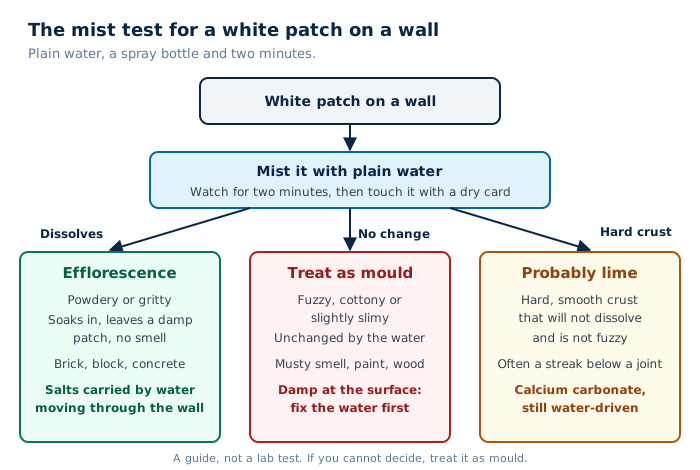
Do not brush, scrape or sand a white patch before you know what it is. If it is mould, you will put spores into the air. Mist first, and wear a well-fitting mask and gloves for any of this. EPA guidance says a patch under about 10 square feet (roughly 3 ft by 3 ft) is generally manageable yourself; anything larger, or anything following serious water damage, needs the fuller EPA guidance on mold and moisture.
- Fill a clean spray bottle with plain water. No bleach, no vinegar: you want to see what the water does.
- Mist a small area of the patch lightly and wait two minutes.
- Efflorescence softens, dissolves, or soaks into the wall and leaves a darker damp patch. When it dries it often comes back as a fine white film.
- Mould does not dissolve. The surface looks the same wet or dry, and a dry card or a gloved fingertip shows fuzz or a cottony pile rather than loose grit.
- A hard, smooth crust that does not dissolve and is not fuzzy is usually lime (calcium carbonate). It is still water-driven, but the CMHA note describes it as extremely difficult to remove.
This is a field test, not a lab result. The guides I read from remediation companies all agree on the water test and I found nothing that contradicts it, but if the patch is large, on wood, or you simply cannot decide, treat it as mould.
Texture, smell and surface give the same answer
The water test is quickest, but other clues tell you the same thing without a spray bottle.
| Clue | Efflorescence | White mould |
|---|---|---|
| Texture | Dry, powdery, gritty or crystalline; crumbles | Soft, fuzzy, cottony or slightly slimy |
| Smell | None | Often musty or earthy |
| Surface | Brick, block, concrete, mortar, stone | Paint, wood, plaster, wallpaper, fabric, anything with dust on it |
| Shape | Even patches, or streaks below joints and cracks | Spreading spots that join into rings or blotches |
| When wet | Dissolves or darkens | Looks unchanged |
| After brushing | Dry powder falls off | Smears, or leaves a stain |
Smell is the clue people forget. A salt deposit has no smell at all, so a musty one on a basement wall deserves attention even if the white bit turns out to be salt. Both can be present on the same wall, which is the other reason to test several spots rather than one. For a fuller look at mould itself, my guide to what black mold looks like covers the colour, texture and smell clues in depth, and much of it applies to white growth too.
Location tells you which one, and which way the water is going
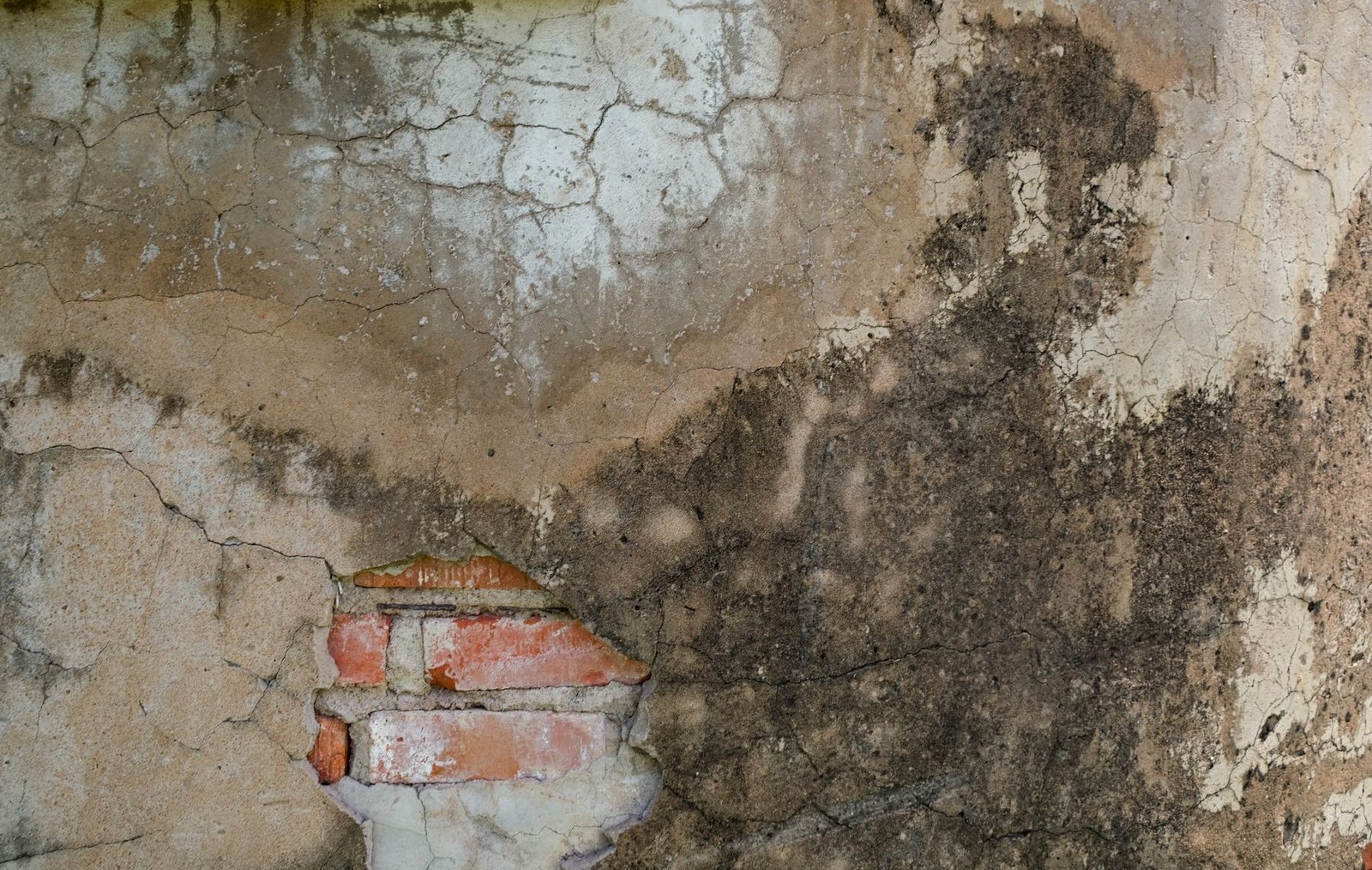
Look at where the white is, not just what it looks like.
- Low on a basement wall, on bare block or brick, in even patches: very likely efflorescence. Water is being drawn through the masonry and evaporating at the face.
- Streaks running down from a mortar joint, crack or window sill: efflorescence again, and the CMHA note reads heavy local streaks as a sign that water is entering the wall at a higher level.
- Spots on painted walls, behind stored boxes, on a wooden shelf, on the paper face of plasterboard or in a corner with no airflow: treat as mould.
- Both on one wall: common. Salts on the block, mould where the paint or stored cardboard is touching it.
The location also hints at which sort of damp you have. Efflorescence means water is travelling through the wall, from soil, a leak or a high water table. Mould means the surface is staying damp, which is usually humidity or condensation. They need different fixes, and that is the useful part of getting the identification right.
What a white deposit says about moisture
Neither is a diagnosis on its own, but each is a clue.
Efflorescence says water is moving through the masonry. The same CMHA note says a light, even deposit on new work is normal as the building loses construction water, and that efflorescence does not affect structural performance. It is unsightly rather than damaging. On an older wall, though, it is a reasonable sign the wall is wet, and winter is the worst time because slower evaporation favours it.
Mould says the surface has been damp long enough to feed something. If you want the timescale, how long mould takes to grow explains it without the usual myths. The air in the space is the thing to check: EPA advises keeping indoor relative humidity below 60 percent, ideally 30 to 50 percent, and a cheap hygrometer tells you in minutes where your basement sits. My piece on what humidity a basement should be gives the targets.
One point the competing pages mostly skip: a dehumidifier helps with one of these and not the other. It lowers the humidity that lets mould grow on a surface. It will not stop groundwater pushing salts through a wall, and I have not measured whether drier air changes how fast deposits form, so I will not promise it.
Dealing with each one, without making it worse
Efflorescence: fix the water first. The CMHA note says to repair the source before removing the deposit, because otherwise it will simply return. Most of it can then be removed by dry brushing and rinsing with clean water. Go easy with the rinse: the same source warns that water, especially under pressure, puts extra moisture into the wall. Expect a second round of deposits as the wall dries out.
White mould, small patch on a hard surface: follow the EPA’s small-patch guidance, wearing the mask and gloves mentioned above. Clean the surface, dry it thoroughly, and sort out the humidity or leak that fed it. If it is on porous material such as plasterboard or carpet, cleaning rarely gets it all and replacement is the usual answer. How to get rid of mold in a basement walks through the sequence.
Not sure which? Do the mould thing, which is also the safer thing. Wear the mask, keep the patch damp so nothing is stirred up, and clean it. You lose nothing if it turns out to be salt. If you then decide a machine is part of the fix, what size dehumidifier you need covers a basement.
A white patch is a moisture report, not just a cosmetic problem
Whichever it is, the white patch is the symptom. Mist it, check the texture and the smell, note whether it sits on bare masonry or on something organic, and then go and find the water. Efflorescence is salt that tells you water is moving through the wall; white mould is a growth that tells you the surface stays damp. Fix that and the white patch stops coming back, whatever its name.
FAQ
Does efflorescence turn into mould?
No. Efflorescence is a mineral salt and cannot become a living growth. They can share a wall, though, because both appear where there is moisture, and mould can start on paint or dust sitting on the same damp wall.
Can I just use vinegar or bleach to tell the difference?
Plain water is the better test, because it shows you what the patch does without a chemical reaction muddying the result. Vinegar may soften some salt deposits and tell you little, and bleach may only whiten a mould stain rather than tell you what it is.
Is white mold or efflorescence worse?
Neither is “worse” in a way I can measure, and I will not make health claims. Practically, mould needs cleaning up and the humidity fixing. Efflorescence is usually cosmetic, but it signals water moving through the masonry, which is worth tracing.
Why does efflorescence keep coming back?
Because the water is still moving through the wall. Brushing off the salt does nothing about the source. It can also reappear for a while after cleaning as the wall dries and more salt reaches the surface.
What does white mould smell like?
Typically musty or earthy, like a damp cellar. Efflorescence has no smell. A musty smell next to a white deposit is a reason to test several spots on the wall.

