
Last Updated on September 7, 2026 by Umar Farooq
What humidity should a basement be? Fifty per cent, year-round, measured in the middle of the room. Drop to 45% if the walls are bare block and cold to the touch, or if mould has already appeared. Below 40% you are drying out timber for no benefit; above 60% you are handing mould everything it needs.
So what humidity should a basement be in practice? Three numbers, and the middle one covers most houses. But the reason behind them is worth two minutes, because it explains why so much published advice gives basements a special number — and why that instinct is right for the wrong reason.
What humidity should a basement be: the three numbers
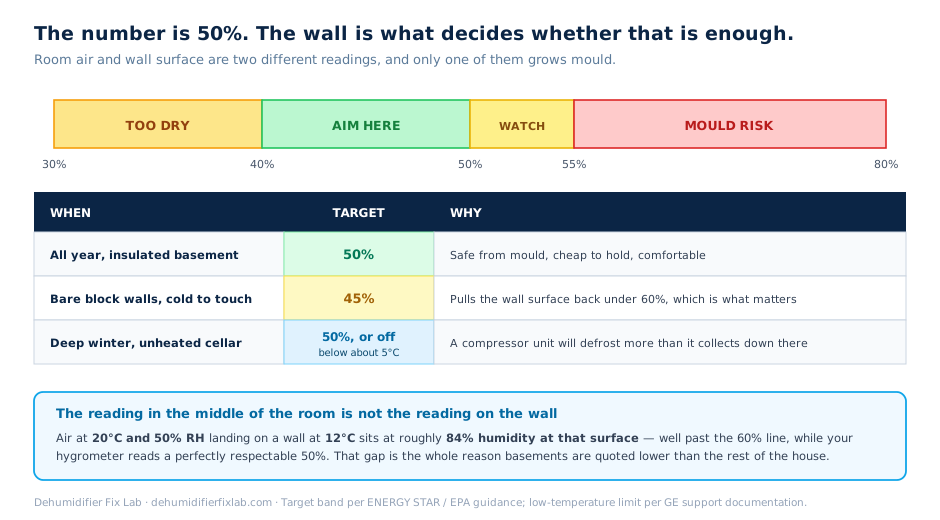
| Your basement | Target | Why |
|---|---|---|
| Insulated, reasonably warm | 50% | Safe from mould, cheap to hold, comfortable |
| Bare block walls, cold to touch | 45% | Pulls the wall surface back under 60% |
| Deep winter, unheated cellar | 50%, or switch off below about 5°C | A compressor unit will defrost more than it collects |
The band underneath all three is 30–50% relative humidity, which is what ENERGY STAR and the EPA recommend for indoor air generally. A basement is not exempt from that band. It just sits closer to the wrong end of it.
Why basements get quoted lower than the rest of the house
Here is the bit almost nobody explains, and it changes what you do.
A great deal of advice says “basements need 40–45%”. The instinct is right and the reasoning is usually wrong. A basement is not damper because it is a basement. It is damper because its walls and floor are colder than the rest of the house — and cold surfaces, not room air, are where mould grows.
Relative humidity is relative to temperature. Air at 20°C and 50% RH that touches a wall at 12°C is cooled at that surface, and cooled air holds less. At the wall it is sitting at roughly 84% humidity — comfortably past the 60% line where mould can establish within 24 to 48 hours — while your hygrometer in the middle of the room reads a perfectly respectable 50%.
That is the whole mechanism. Which gives a cleaner rule than “basements need 45%”:
Cold surfaces need 45%. Warm ones are fine at 50%.
And it cuts both ways. A properly insulated, heated basement is fine at 50%. A freezing north-facing bedroom upstairs needs 45% just as much as any cellar does. Judge the surface temperature, not the floor level.
How to measure what humidity a basement is actually at
Three things people get wrong here, all of them free to fix.
Measure for a week, not once. Basement humidity swings with the weather outside, the season, and whether anyone has showered. One reading on a Tuesday evening tells you almost nothing.
Put the hygrometer in the middle of the room, at about waist height, away from the dehumidifier. A meter sitting next to the machine is reading air that has just been through the machine, which is not the room.
Touch the walls. This is the measurement that matters most and it needs no instrument. If the walls feel noticeably cold against the back of your hand, you are in 45% territory whatever the meter says. If they feel the same as the walls upstairs, 50% is fine.
An infrared thermometer is worth having if you want to be precise — roughly the price of a takeaway, and it tells you the surface temperature directly. Anything more than about 5°C below room temperature is a cold surface.
What happens outside the band
Above 60% — mould, mildew, that basement smell, dust mites, and cardboard boxes that go soft. This is the failure mode everyone knows about.
50–60% — nothing dramatic, but you are living on the edge. A cold snap or a wet fortnight tips you over, and cold surfaces are already past 60% even when the room is not.
Below 30% — the one nobody warns about. Timber, joinery and furniture dry out and shrink. Doors stop fitting, floorboards gap, and anything glued starts to let go. It also costs a great deal in electricity to hold a basement that dry, for no benefit at all.
That last point matters because the instinct when a basement smells is to set the machine as low as it will go. The setpoint decides when the machine stops, not how hard it works — so 35% does not dry the room any faster than 50%. It just means the unit never switches off. The settings guide goes through that properly.
Holding the number, rather than chasing it
Getting a basement to 50% is easy. Keeping it there without thinking about it takes three things.
A humidistat, not a timer. Set 50% and leave it. The machine will cycle itself as the weather changes, which a clock cannot do. How long it ends up running is an outcome, not something to set.
Continuous drainage. This is the big one in a basement specifically. A full tank stops the machine, and a damp cellar can fill a tank overnight — so a unit on tank-only spends most of the week switched off. A hose to a floor drain turns it into an appliance that actually holds its setting.
The right capacity. Sized for the damp you measured, not the worst week of the year. Sizing a basement dehumidifier covers the arithmetic, including the 25% you add for a high ceiling.
When the number will not hold at all
Worth saying plainly, because it saves people months.
If the machine has run for weeks with no downward trend, and one specific area stays wet, you do not have a humidity problem — you have water coming in. A failed damp-proof course, a gutter discharging against the wall, hydrostatic pressure through the slab, or ground levels that have crept up over the years.
A dehumidifier manages humidity. It cannot beat a supply of liquid water, and it will run permanently trying. Go outside and look at the gutters, the downpipes and the ground levels before you spend anything else. Then set a target for whatever humidity is left, which is usually a far smaller job than it looked.
Frequently asked questions
What is the ideal humidity level for a basement?
Fifty per cent for an insulated, reasonably warm basement, and 45% where the walls are bare block and cold to the touch. Both sit inside the 30–50% band recommended for indoor air generally.
Is 60% humidity too high for a basement?
Yes. Above 60%, mould can establish on a suitable surface within 24 to 48 hours, and cold walls will already be past that threshold even when the middle of the room reads 60%.
Should basement humidity be different in summer and winter?
The target does not change — 50% year-round. What changes is the effort. Summer air carries far more moisture so the machine runs longer, and in an unheated cellar below about 5°C a compressor unit should be switched off entirely because it will spend its time defrosting.
Why is my basement humid even with a dehumidifier running?
Usually a full tank stopping the machine, a room too cold for a compressor unit, or water actively entering through the walls or slab. Check the tank first, then a thermometer, then go outside and look at the gutters.
Is 45% too dry for a basement?
No. Forty-five per cent is comfortably inside the recommended band and is the right target where walls are cold. Below 40% is where you start drying out timber and joinery for no benefit.
How do I measure basement humidity properly?
Put a hygrometer in the middle of the room at about waist height, away from the dehumidifier, and read it daily for a week. A meter sitting beside the machine is measuring air that has already been through it.
Does a cold basement wall change the humidity I should aim for?
Yes, and it is the single most useful thing to know. Air at 20°C and 50% RH sits at roughly 84% humidity where it touches a wall at 12°C. Cold surfaces are why 45% exists as a target.
Related guides: Dehumidifier for basement · Dehumidifier settings · Does a dehumidifier help with mould? · Dehumidifier drain hose setup
Sources
- ENERGY STAR — Dehumidifiers — the 30–50% recommended indoor band and capacity guidance.
- EPA — Mold Course, Chapter 2 — the 60% threshold, and why surface conditions differ from room air.
- EPA — A Brief Guide to Mold, Moisture and Your Home — finding and fixing the water source before running any equipment.
Where this guide and your appliance’s own manual disagree, follow the manual. And if you have been adjusting the dial every few days trying to find the right number — stop. Put it on 50, touch the walls, and only drop to 45 if they are cold. That is the whole decision.

