
Last Updated on October 24, 2026 by Umar Farooq
How to get rid of mold in basement: find and stop the water first, scrub a small patch (under about 10 sq ft / 0.9 m²) off a hard surface with detergent and water, dry it completely, and hand anything bigger to a professional. Nothing in that sentence involves a special product, which is rather the point.
Most basement mould advice is a list of cleaners. I think that is backwards: the cleaner decides how the wall looks this week, and the water decides whether you are back in the same spot in March.
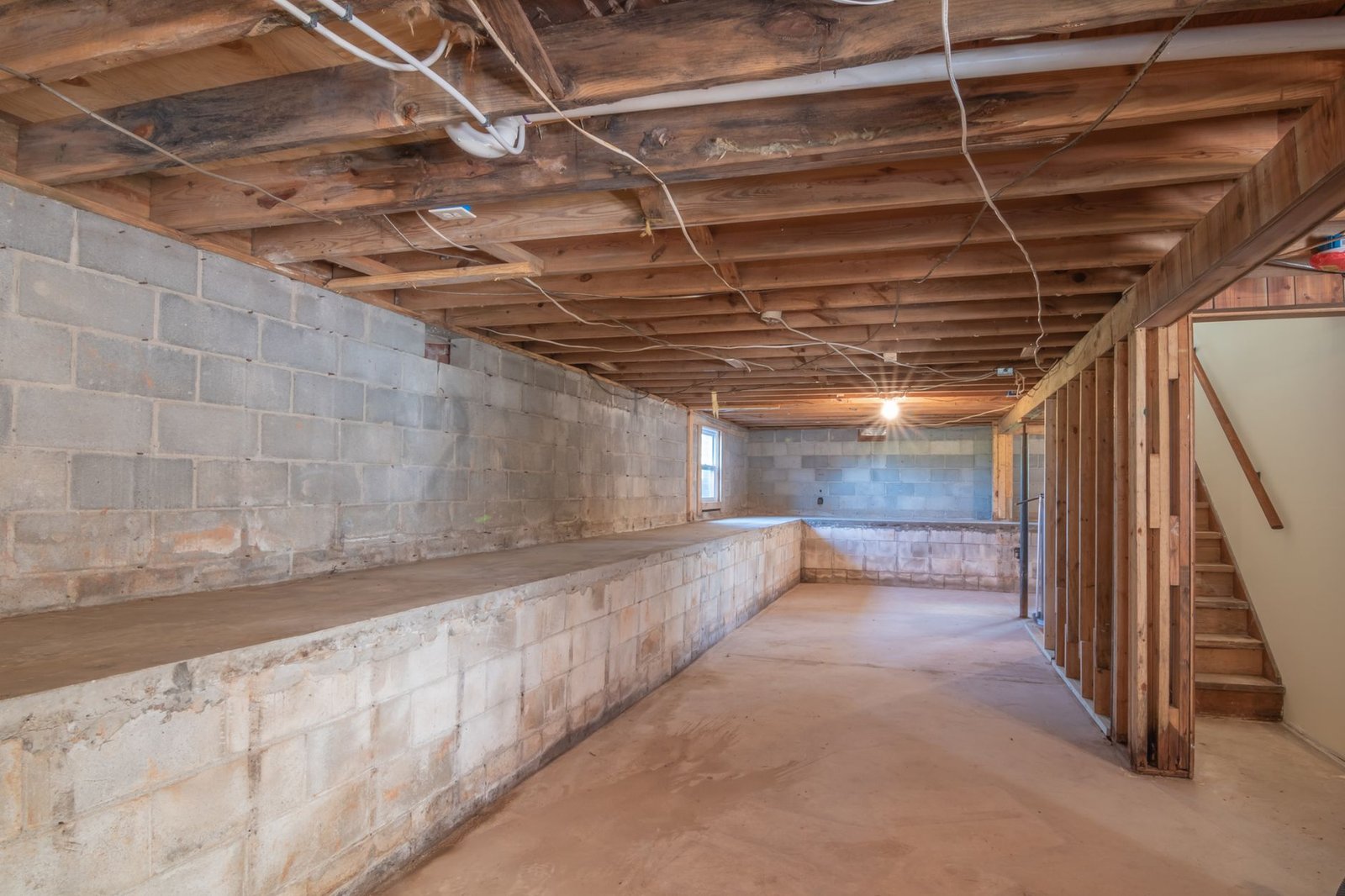
Find where the water is coming from before you touch the mould
Mould needs moisture, and the EPA says so plainly: the key to mould control is moisture control. So the first job is detective work, not scrubbing.
In a basement the water nearly always arrives one of three ways, and each leaves a different fingerprint:
| Source | What it looks like | First thing to check |
|---|---|---|
| Liquid water getting in | Dark staining low on the wall, a tide mark, damp at the floor joint after rain | Gutters, downpipes, ground sloping towards the house |
| Plumbing or an appliance | Mould or staining that follows a pipe, the water heater or the washing machine | Joints, valves and drain hoses, with a dry paper towel |
| Condensation | Mould on the coldest surfaces, worst in summer when warm air meets cool block | A hygrometer, and the foil patch test |
Neither a cleaner nor a dehumidifier will beat the first two. A dehumidifier manages humidity in the air, and it cannot out-run a steady supply of liquid water. Condensation is the one case where controlling the air is genuinely the fix.
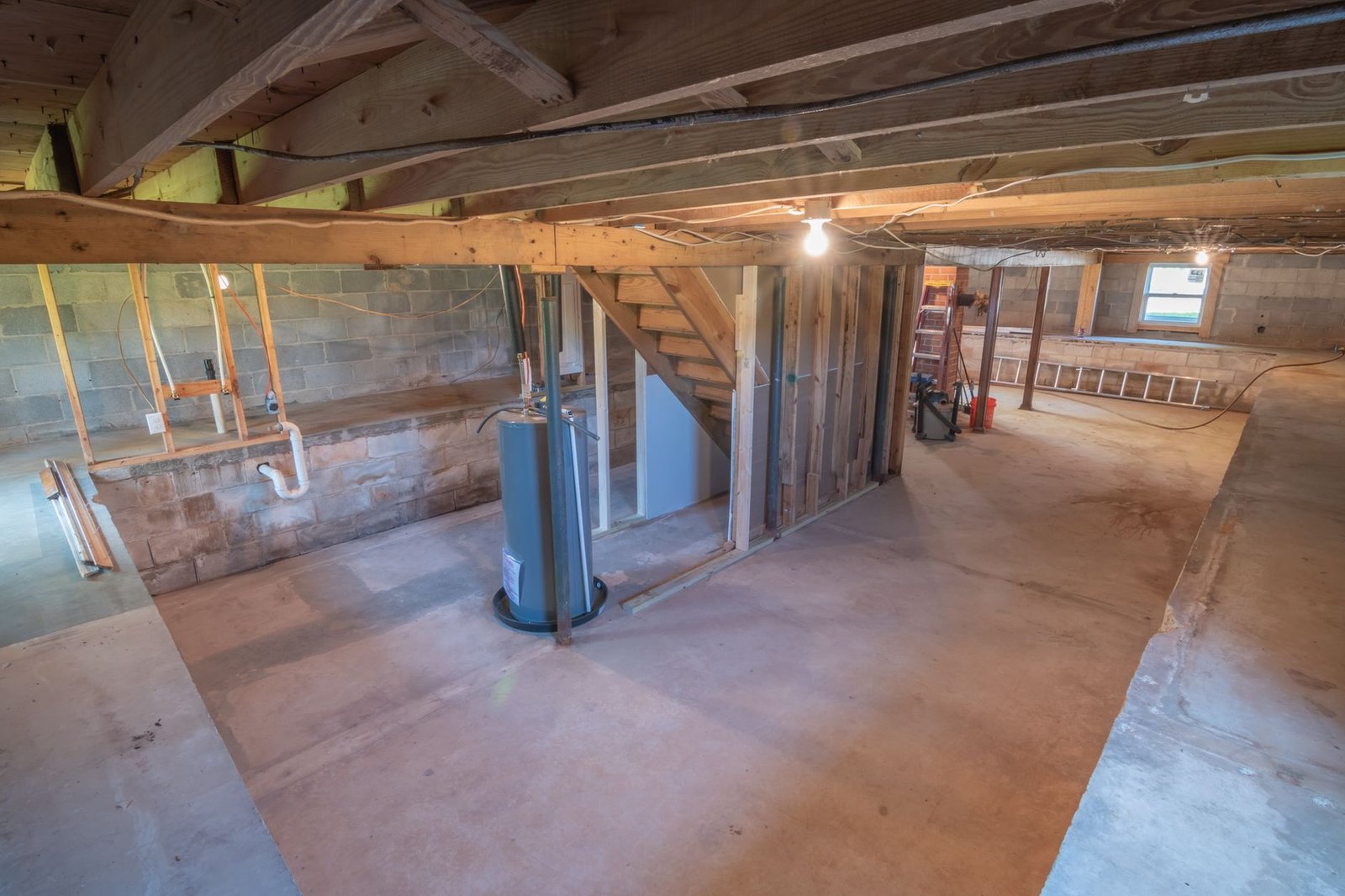
The EPA also says that if materials are dried within 24 to 48 hours of a leak or spill, mould will in most cases not grow. That is the useful number to remember after a wet event: speed beats product.
Measure the patch and note what it is growing on
This is the decision most articles skip, and it settles who does the job. Run a tape measure over it.
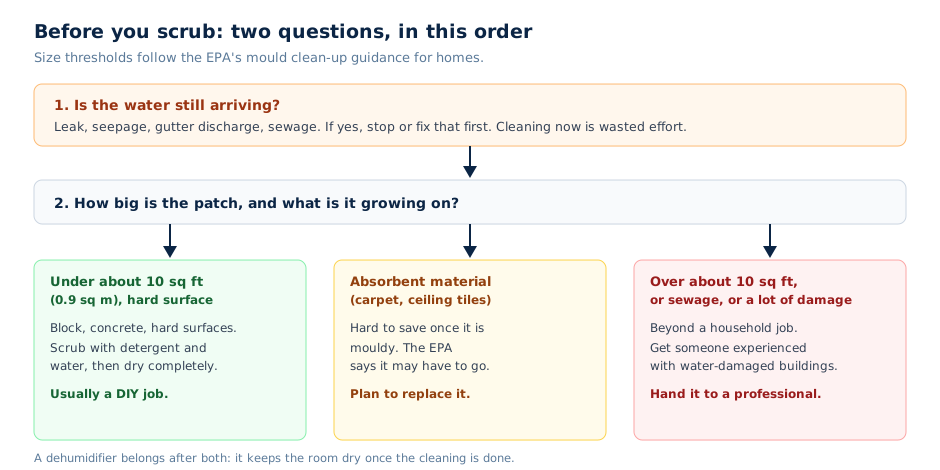
The EPA’s guidance for homes says that if the area is less than about 10 square feet, roughly a 3 ft by 3 ft patch, you can in most cases handle it yourself. It also points to a professional where mould covers more than 10 square feet, where there has been a lot of water damage, or where the water was sewage or otherwise contaminated.
I would add one rule of my own, which is judgement and not EPA text: if you cannot tell how far it goes, treat the measurement as unknown. Mould you can see on a wall can continue behind panelling or under flooring, and “I can see about a hand’s width” is not a measurement.
Clean a small patch on block, concrete or hard surfaces
Never mix cleaning products, especially bleach with anything else, and keep the area ventilated while you work. If anyone in the household has a health concern, the EPA says to consult a health professional before starting clean-up.
For a patch under the 10 sq ft line, on a hard surface:
- Stop the water first. Cleaning a wall that is still wet is wasted work.
- Scrub with detergent and water. That is the EPA’s instruction for hard surfaces, and it is the one I follow. I do not reach for bleach: it is one more chemical to handle, and the guidance on this page does not call for it.
- Dry it completely. Open the window if the outside air is drier, run a fan across the wall, and run the dehumidifier. A wall that is merely wiped is a wall that is damp.
- Bag the cloths. Throw away the rags and the disposable brush rather than reusing them somewhere else.
- Watch it for a month. Regrowth in the same place is the basement telling you the water is still there.
Throw out what cannot be dried
Block and concrete can be scrubbed. A cardboard box cannot, and neither can carpet or ceiling tiles. The EPA is direct that absorbent or porous materials, such as ceiling tiles and carpet, may have to be thrown away if they become mouldy.
Basements collect exactly this kind of thing: stored boxes, old rugs, a sofa nobody wants. If it is mouldy and soft, replacing it is usually cheaper in time than trying to rescue it. If it is a fitted carpet over a whole floor, or insulation inside a wall, you have probably crossed into the “bigger than it looks” category above.
Where a dehumidifier fits, and where it does not
A dehumidifier does not remove mould. It removes the condition mould needs, so its place is after the cleaning, not instead of it. I covered the full argument in what a dehumidifier does and does not do about black mould, and the short form is: clean the patch, fix the water, then hold the room dry.
The EPA’s own target is to keep indoor humidity below 60 percent, and ideally between 30 and 50 percent, and it lists dehumidifiers as a tool for getting there. For a basement, the three humidity numbers worth knowing are 50% for a warm, insulated space and 45% for cold bare block.
Hold the room, so the patch stays gone
Once the surface is clean and dry, the job changes from removal to maintenance, and three things matter.
Measure it. A hygrometer costs little and tells you the number the walls are living at. Without one you are guessing.
Size the machine for the damp, not the floor area. How to size a dehumidifier for a basement goes through the arithmetic, including why a cold basement needs more capacity than the label suggests.
Drain it continuously. A damp cellar can fill a tank overnight, and a full tank is an off switch. A drain hose to a floor drain keeps it running on its humidistat all week.
A basement that regrows mould is telling you something
If you have done everything above and the same wall greens or blackens again, stop cleaning. The explanation is one of three: the water source is not the one you fixed, the wall is a cold surface in an otherwise humid room, or the mould is bigger than the patch you can see.
At that point a professional is no longer an upsell, it is the next sensible step: someone who can trace the water and check behind finishes. Leave the cleaning products on the shelf until they have.
How to get rid of mold in basement for good: the water, then the wall
Get rid of the mould by removing what feeds it. Fix or divert the water, scrub a small patch of hard surface with detergent and water, dry it completely, throw away what is soft and mouldy, and let a dehumidifier hold the room dry afterwards. Keep to the 10 sq ft line, and when you cross it, make the phone call rather than the bigger bottle.
FAQ
Will drying out my basement kill mold?
Drying it stops the mould growing, but it does not clean it off. A dry colony is dormant and still on the wall, so you still scrub it away with detergent and water, then keep the room dry.
Will a dehumidifier get rid of mold in a basement?
No. A dehumidifier lowers the humidity that mould needs to grow, which helps prevent a return. It does not remove mould that is already there.
Should I use bleach to clean basement mold?
The EPA’s home clean-up guidance tells you to scrub hard surfaces with detergent and water and dry completely, and does not mention bleach. I stick to that. If you do use any other product, never mix it with another cleaner.
How big a patch of basement mold can I clean myself?
The EPA’s rule of thumb is under about 10 square feet, a patch roughly 3 ft by 3 ft (0.9 m by 0.9 m), on a hard surface. Above that, or after sewage or heavy water damage, bring in a professional.
Why does mold keep coming back in my basement?
Because the moisture source is still there. Recurring mould usually means an unfixed leak, water coming through the wall, or a cold surface being hit by humid air, and not that the cleaning was too gentle.

