
Last Updated on October 24, 2026 by Umar Farooq
What humidity does mold grow at? Mould generally needs the surface it sits on to stay at about 70% relative humidity or higher, and because walls are colder than room air, that usually means a room reading above roughly 60%. The EPA’s advice is to keep indoor humidity below 60%, ideally 30-50%.
Notice that there are two numbers in that answer, one for the air and one for the wall. Almost every page on this topic quotes one and forgets the other, which is why a perfectly respectable 50% reading can sit in a room with a mouldy corner.
What humidity does mold grow at? The 60% line is a ceiling, not a trigger
Two sources are worth keeping apart here. The EPA’s Brief Guide to Mold, Moisture and Your Home says: “If possible, keep indoor humidity below 60 percent (ideally between 30 and 50 percent) relative humidity.” That is a target for room air. Nothing in it says mould appears the moment you cross 60%.
The number for the surface comes from building science. Building Science Corporation’s report on relative humidity puts the critical humidity for biological activity on building surfaces at 70 percent, says growth can be controlled where humidity near surfaces stays below that, and adds that interior humidity “should never rise above 60 percent in any event”.
So 60% in the room is the line you draw to stay safely under 70% at the cold spots. My one strong opinion: treat 60% as the alarm, 50% as the working target, and never read 55% as “fine” on a cold wall. The gap between those numbers is the margin that a cold surface eats.
Time matters too, and it is the part nobody can give you as a single figure. Sustained is the word. A damp evening does not do it; weeks of damp can. For the detail on how fast visible growth actually appears, and why “24-48 hours” is a drying deadline for wet materials rather than a mould timer, see how long it takes for mould to grow.
Room humidity versus surface humidity: the same air, different readings
Relative humidity depends on temperature. Cool the same air and its relative humidity rises, because cold air holds less water vapour. A wall on the outside of the house, a window reveal or the back of a wardrobe sits colder than the room, so the thin layer of air against it is more humid than the air in the middle of the room.
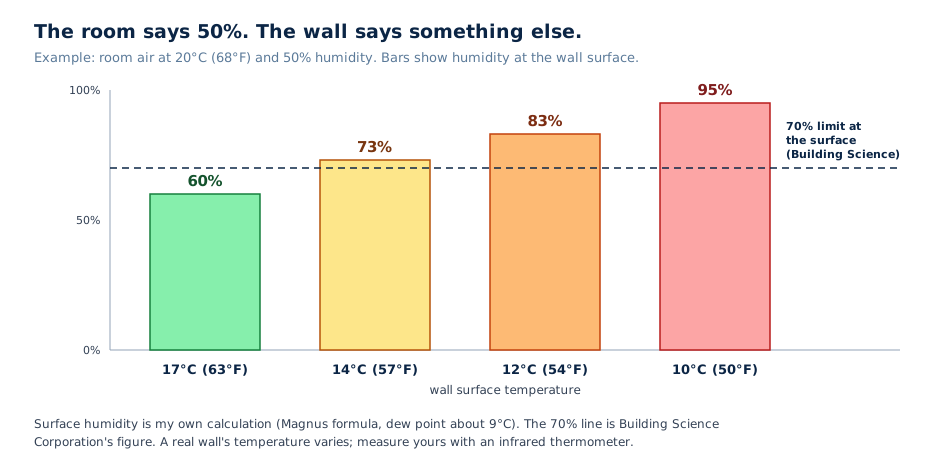
The chart is my own arithmetic from the standard dew point formula, not a measurement of any real wall. Room air at 20°C (68°F) and 50% humidity gives about 60% at a wall surface of 17°C (63°F), about 73% at 14°C (57°F), and about 83% at 12°C (54°F). Two of those walls are past the 70% line while the room hygrometer still says 50%.
That is why the EPA notes that mould is frequently found on walls in cold corners behind furniture where condensation forms, in its mould course chapter on why and where mould grows. It is also the reason a bedroom that reads 55% can be fine in the middle and grim behind the wardrobe. If you want to see the mechanism on a real piece of furniture, mould in the bedroom walks through it.
What each humidity band means for mould
These are working bands, built from the two sources above plus my own rounding. They are not lab thresholds for any particular species, and the cut-offs shift a little with temperature and material.
| Room reading | What it means for mould | What to do |
|---|---|---|
| Under 30% | Very low risk | Check you are not over-drying |
| 30-50% | The EPA’s ideal range | Leave it alone |
| 50-60% | Growing risk on cold surfaces | Check the coldest wall; watch for condensation |
| Above 60% | Above the EPA ceiling; cold surfaces likely past 70% | Lower humidity and find the source |
| Above 80% | Surfaces damp most of the time | Treat as a moisture problem to fix first |
The bands for ordinary living rooms and bedrooms are covered, with the winter exception, in what indoor humidity should be. I will not repeat that here, but the short version is that winter wants the lower end.
Moisture does not need humidity to start a problem
A leak, a wet wall or a flooded floor supplies liquid water directly, and at that point the humidity of the room is beside the point. A dripping pipe in a room reading 45% still wets the plaster under it. Humidity is the slow route to mould; liquid water is the fast one.
This is also why a hygrometer cannot clear you. A normal reading tells you the air is fine. It tells you nothing about a damp patch behind a wall or a cold pipe. If you see staining, a musty smell or condensation, go and find the water, not the number.
Mould also needs a food source and time, and an ordinary home is full of the former (dust, paint, paper, timber), so moisture is the ingredient you can actually control.
If mould covers more than about 10 square feet (roughly 1 square metre), the EPA’s guidance is to treat it as a larger job. Fix the water source first. Cleaning mould is a separate topic from this one.
How to check mould-risk humidity with a hygrometer
A hygrometer is the cheapest tool in this whole subject. The EPA describes it as a small, inexpensive ($10-$50) instrument available at many hardware stores. Use it in this order.
- Read the room. Put it at chest height, away from windows, radiators and the bathroom door, and give it a few hours to settle. If you want to be sure the reading is honest, how humidity is measured covers placement and a salt test.
- Look at the coldest surfaces. Outside-facing walls, window corners, behind big furniture, inside wardrobes. Condensation on the glass in the morning is the sign that the surface is far more humid than the room.
- Log it for a week. Evening and early morning, because humidity peaks when the house is cooler. One reading proves little.
- Act on the pattern. Sitting above 60%, or condensation on most mornings, is the moment to lower it.
Bringing it down once the number is wrong
The sequence is source, air, machine. Fix leaks and stop drying washing on radiators, vent the kitchen and bathroom to outside, and keep furniture off cold walls. After that, a dehumidifier handles whatever is left. Choosing the right size matters, because one that is too small spends the winter running without ever reaching 50%.
The main thing I would resist is buying a machine to chase a figure on one cheap hygrometer. Measure first, find the cold surfaces, and only then decide whether the problem is the air or the wall.
Mould wants about 70% at the surface, so aim for 50% in the room
That is the whole answer in one line. The room number you can read; the wall number you have to infer. Keep the air around 50% and well under 60%, give cold walls some air and warmth, and treat any damp patch as a water problem first. A 55% room is not a guaranteed mould problem, but it is a reading that deserves a look at the coldest wall.
FAQ
Can mold grow at 50% humidity?
Not usually on a surface at room temperature, because 50% is inside the EPA’s 30-50% guidance. It can still happen on a cold wall or behind furniture, where the surface can be much more humid than the room, or wherever liquid water is present.
Can mold grow at 60% humidity?
It can on cold or damp surfaces, because 60% in the room can mean 70% or more at a cold wall. That is why the EPA advises staying below 60%, and why I treat 60% as the alarm rather than the safe limit.
Does mold grow at 70% humidity?
Yes, 70% at the surface is where Building Science Corporation puts the critical level for growth on building surfaces. If that is the room reading rather than the wall reading, it is high enough that the walls are almost certainly worse.
What humidity kills mold?
No ordinary household humidity setting reliably kills it. Dropping humidity can stop growth and leave existing mould dormant, but it does not remove it. Dry the area, fix the water, and clean or remove the affected material.
What temperature does mold grow at?
Mould grows across the temperatures people live at, not just in warm rooms, so cold is not protection. Cold walls are in fact the problem spots, because they push surface humidity up. Warmth matters mainly through how it changes humidity.
How do I know if humidity is too high for mold?
Use a hygrometer in the room and look at the coldest surfaces. Readings above 60%, mornings with condensation on windows, or a musty smell all mean the humidity is high enough to act on.

