
Last Updated on October 23, 2026 by Umar Farooq
How long does it take for mold to grow? Visible mould usually takes days to weeks on a wet surface, and the famous “24 to 48 hours” is the EPA’s deadline for drying wet materials, not a measured growth time. Those are two different claims, and the internet has welded them together.
I went looking for the study behind “mould in 48 hours” expecting a stopwatch. What I found was a drying instruction, a handful of small experiments, and a lot of restoration-company pages repeating each other.
The 24-48 hour figure is a drying deadline, not a stopwatch
The EPA says it plainly in its Brief Guide to Mold, Moisture and Your Home: “It is important to dry water-damaged areas and items within 24-48 hours to prevent mold growth.” A few lines on, it adds that if wet or damp materials are dried within that window, “in most cases mold will not grow.”
Read that again with the grammar in mind. It is advice about what to do after a leak or spill, and the promise is conditional: dry it in time and you will usually be fine. It does not say that mould appears at hour 48, or that nothing happens before then.
My one strong opinion here: treat 48 hours as a deadline you set yourself, not a countdown the mould is running. Fire-safety advice works the same way. “Get out within two minutes” is a planning number, not a claim that the building ignites at 2:01.
It also helps to know what the number is not. Chapter 2 of the EPA mold course uses the same 24-48 hour window for wet items and separately says indoor relative humidity should stay below 60%, ideally 30-50%. Those are two rules for two situations. A room sitting at 65% for a week and a carpet soaked by a burst pipe are not the same clock.
Four things have to line up, and you control one
None of the mould species indoors will grow without water or moisture, as the EPA puts it. Spores are already around; the EPA describes mould beginning “when mold spores land on surfaces that are wet”. So the useful question is not “how long until mould?” but “how long has this been wet, and what is it made of?”
In practice it comes down to:
- Water that stays. A one-off splash that dries in an afternoon is a different event from a damp patch that never fully dries.
- Something to eat. Most household mould feeds on organic material: paper facing on plasterboard, timber, dust, cardboard, fabric. Bare glass and glazed tile give it very little.
- Temperature in a livable range. Rooms people live in already sit there, so you have no real lever.
- Time. Which is the bit everybody asks about and nobody can give you as a single number.
You control the first one. That is why the advice never changes: fix the water, then dry, and the rest takes care of itself.
How long does it take for mold to grow? What was measured
Here is the evidence I could actually trace, with the caveat that most of it reaches us through a trade summary rather than the original papers. The Cleanfax article by restoration consultant Richard Driscoll reviews the lab practice and two studies:
- Lab dish, fast-growing moulds: spores germinate within hours, the first tiny colonies appear at roughly 3 days, and colonies large enough to count at roughly 4 days.
- Informal garage test on drywall (Pittsburgh): the team expected visible growth in two to three days. It appeared on day 18.
- Controlled office study, untreated wallboard: invisible growth after at least a week, visible mould at about 3 weeks. Primer-coated wallboard showed no visible mould.
- Chamber study, drywall and framing lumber at 27°C / 80°F and 80% relative humidity: visible mould at week 5.
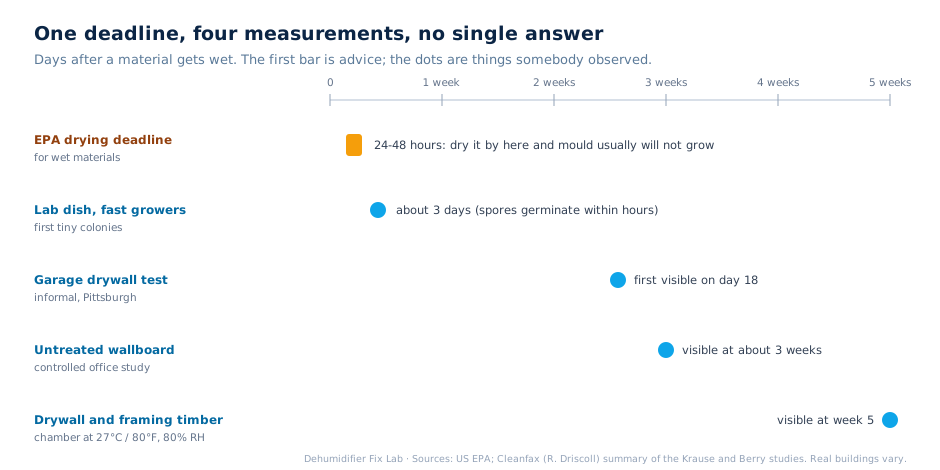
Notice the spread. Hours to germinate, three days in a lab dish with ideal food, and three to five weeks on actual building materials. Driscoll himself notes the same 24-48 hour idea was implied in a 2002 New York City guideline and dropped from the 2008 edition.
The honest summary is that nobody can tell you the exact number for your wall. A figure like “3 to 21 days until visible” turns up on restoration sites, but I could not trace it to a measurement, so I am not going to hand it to you as one.
Why one wet patch moulds and another does not
Same leak, different outcome: this is the part that explains why the numbers above are so far apart.
- The material decides the menu. Untreated paper-faced board is a buffet; primed or painted surfaces clearly slowed it in the study above. Tile and glass are a diet.
- How wet, and for how long. A film of condensation that evaporates daily is not the same as a saturated skirting board. I have no measurement for the boundary, and neither does anyone honest.
- Cold surfaces are wetter than the room. Air at 20°C / 68°F and 50% humidity that touches a 12°C / 54°F wall reaches roughly 80% right at the surface (my own arithmetic from standard saturation figures). Your hygrometer in the middle of the room cannot see that, which is why corners behind wardrobes are where it usually starts.
- Airflow. Still air lets moisture sit. A moving room dries the film off.
That last point is why a damp patch that gets some sun, heat and a draught can stay clear for weeks while the one behind the sofa goes dark.
If something got wet, work to this schedule
If you can already see or smell mould, do not brush, scrub dry or blow air across it, because that spreads fragments around the room. The EPA says a moulded area under about 10 square feet (a patch roughly 3 ft by 3 ft) can usually be handled by the householder; for anything larger, or mould that keeps coming back, follow its mold cleanup guidance and consider a professional.
The timings below are my own working schedule built on the EPA deadline, not measured thresholds.
| How long it has been wet | What I would do |
|---|---|
| Within 24 hours | Stop the water, remove standing water, open windows if the outside air is drier, and start a dehumidifier plus a fan immediately. |
| 24-48 hours | This is the EPA’s drying window. Get fabrics, carpets and porous items fully dry or out of the building. |
| Beyond 48 hours | Do not assume mould has started or that it has not. Check the surfaces, the back of the skirting and the underside of carpets for smell, spotting or staining. |
| Over a week | Assume something is growing out of sight. Look behind and under before deciding what is salvageable. |
Absorbent materials such as carpet and ceiling tiles may have to be thrown away if they become mouldy, according to the EPA, and that is usually the cheaper decision than hoping.
A dehumidifier buys you time, it does not stop the clock
Once the leak is fixed, a dehumidifier is the sensible way to pull the room’s humidity down quickly. Run it in the wet room with the door shut and the windows closed. If you are not sure which machine can cope with a flooded room rather than a damp one, what size dehumidifier you need is worth a look before you buy.
What it cannot do is dry a soaked carpet pad from the inside in an afternoon. Air dries quickly, materials dry slowly, and the materials are what mould feeds on. Judge it with a hygrometer rather than by how the room feels, and aim for the 30-50% band the EPA recommends.
FAQ
How fast can mould grow after water damage?
Spores can start germinating within hours, but visible mould in measured studies took about 3 days in a lab dish and several weeks on real building materials. Dry the area within 24-48 hours, as the EPA advises, and in most cases mould will not grow.
Can mould grow in 24 hours?
Germination can begin that quickly in ideal conditions, but you will not see a colony at 24 hours. That is why the 24-48 hour advice is about drying fast, not about waiting for something to appear.
How long does it take for mould to grow on drywall?
In the studies summarised above it was about 3 weeks on untreated wallboard in a controlled office, 18 days in an informal garage test, and 5 weeks at 80% humidity in a chamber. Primer-coated wallboard stayed clear in the office study, so surface treatment matters.
How long does it take for mould to become visible?
Anywhere from a few days to several weeks depending on how wet the material stays, what it is made of and how warm it is. I could not find a single trustworthy figure that covers every house, and I would be suspicious of any page that offers one.
Can mould grow in a room that is not leaking?
Yes, if surfaces stay damp from condensation or high humidity. The EPA suggests keeping indoor humidity below 60%, ideally between 30% and 50%, because mould needs moisture to grow.
Use the first two days, and stop trusting any single number
So, how long does it take for mold to grow? Hours for the first spores to stir, days in a lab dish, weeks on a real wall, and an unknown amount in yours. The only figure with a clear job is the EPA’s 24-48 hours, and its job is to tell you how quickly to dry things.
Fix the water, dry it fast, watch it with a hygrometer, and you will almost never need the stopwatch version. If you have already spent three days arguing with a soggy carpet, that is fine. Start the clock now and call it day one.

