
Last Updated on October 24, 2026 by Umar Farooq
Mould in corners of rooms is almost always condensation: a corner is the coldest, stillest patch of wall in the room, so moist air drops its water there first and stays damp longest. It is the first place to go wrong and the last place anyone looks, which is a poor combination.
If it is the top corner of an outside wall in a bedroom, you have the textbook case. If it is wet to the touch in dry weather, or has a brown ring, read the leak section before you pick up a cloth.
Why mould in corners of rooms starts before the flat wall does
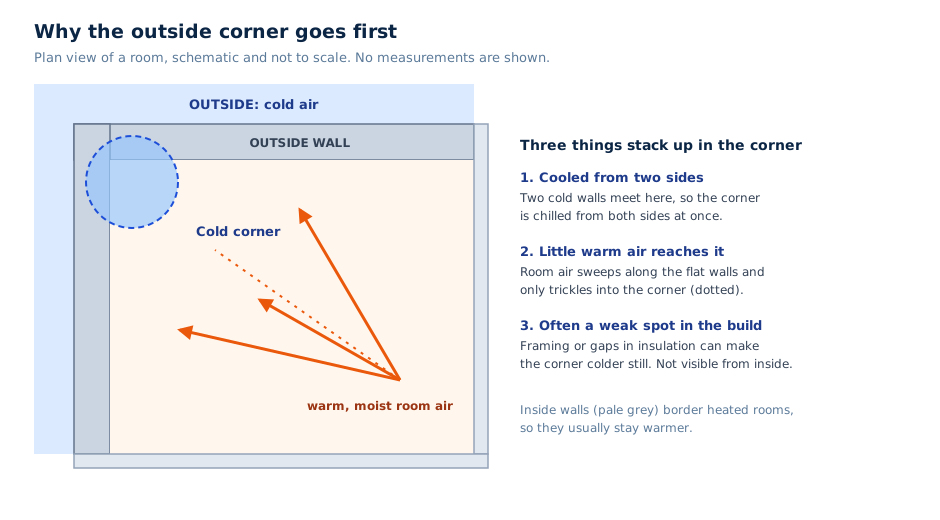
Three things stack up, and the corner suffers all three at once.
- It is cooled from two sides. On an outside corner two cold walls meet, so the corner surface sits colder than the middle of either wall. Building Advisor puts it plainly: corners are often cold because framing meets little insulation, which is called thermal bridging.
- Warm air barely reaches it. Room air moves along flat walls and only trickles into a corner, so the surface is neither warmed nor dried. The same source notes the little air movement in corners, especially behind tall furniture.
- The cold spot can be built in. A gap in insulation, or a missing patch at the eaves, makes the top corner colder than the rest of the ceiling. You cannot see that from inside the room.
Cold surfaces matter because condensation damp forms when moisture made inside the home cools and condenses onto colder parts of the building, according to UK government guidance. The moisture comes from breathing, cooking, showers and washing on radiators. The corner is just where it lands.
Corner mould or a leak? Read the pattern before you scrub
The fix depends on this call, so make it first. These are my rules of thumb, not a survey method.
| What you see | Points to |
|---|---|
| Black or grey speckles, worst in the corner, worse in winter, dry between spells | Condensation |
| Both corners of an outside wall, or any corner behind a wardrobe or bed | Condensation plus still air |
| A brown tide-mark or ring, a patch that grows after rain, damp that is cold and wet even in a dry week | A leak: gutter, roof, pipe or brickwork |
| Soft, bubbling plaster or paint | Probably water getting in, not only vapour |
Hidden leaks can send water into wall corners as well, so if the damp follows the weather rather than the room’s habits, look outside first. My longer comparison is in mould on walls: leak or condensation, and the foil-patch check for condensation is in condensation on walls and ceilings.
Upper and lower corners tell a story too. A top corner where wall meets ceiling often means a cold strip at the eaves or a steamy room with the door shut. A bottom corner behind a sofa means still air. Neither is proof, but it tells you where to look.
Pull things out of the corner, then warm and air the room
If you can see mould, do not dry-brush, sweep or vacuum it: that throws spores into the air. Fix the water source first, open a window and wear gloves and a respirator-type mask.
Do these in order, cheapest first. Most corners need only the first three.
- Clear the corner. Pull wardrobes, bedsteads and curtains a hand’s width or more away from outside walls, and keep boxes out of the corner itself. The cold pocket behind furniture is the same problem with a sofa added.
- Keep a little background heat in the room. An unheated spare room is a classic. Steady low heat beats short bursts, because the walls then stay warmer. The aim is a warmer wall surface, not a hot room.
- Vent the wet at source. Run the extractor fan or open a window during and after showers and cooking, and keep the bedroom door from sealing in a night’s breath.
- Measure humidity, do not guess. The EPA advises keeping indoor relative humidity below 60%, ideally 30-50%. A cheap hygrometer on an inside wall settles it. A dehumidifier is the tool if the reading stays high after steps 1 to 3.
- Only then think about the building. If one corner stays cold and wet however you live, the cause is probably insulation or a cold bridge. That is a job for a surveyor and a quote, and I will not tell you which fix to buy from here.
My opinion: most corner mould is a habits-and-airflow problem first and a building problem second. Test the cheap explanation before you pay for the expensive one.
Clean a small patch properly, once the corner stays dry
Cleaning without fixing the cause just resets the clock. Once the corner has stayed dry for a week or two, the EPA says you can handle a patch of mould under about 10 square feet (roughly 1 square metre) yourself: scrub with detergent and water and dry the surface completely. Larger areas, or anywhere water damage is extensive, call for professional advice. The wall-cleaning steps are in how to get mould off walls. If the corner is on a cold north wall, see north-facing wall condensation as well.
A warmer, airier corner stays clean
A corner grows mould because it is the coldest, stillest, least dried surface in the room, not because it is dirty. Check for a leak, move things out, add gentle steady heat, ventilate the wet and watch the humidity reading. If the same corner fails after all that, it is a building question, and by then you will have the evidence to hand over.
FAQ
Why is there mould in corners of rooms?
Corners are usually the coldest and least ventilated surfaces, so moisture condenses there first and dries slowest. Outside corners and corners at ceiling level are the most exposed.
Why is there mould in the top corner of my bedroom?
A top corner where an outside wall meets the ceiling is often cold because of thin or missing insulation at the eaves, and bedrooms collect a lot of moisture overnight. A brown ring or growth after rain points to a roof or gutter leak instead.
Is mould in a corner a sign of a leak?
Sometimes. Speckled growth that comes and goes with the season usually means condensation. A tide-mark, soft plaster or damp that follows rainfall suggests water coming in from outside or from a pipe.
Will a dehumidifier stop mould in corners?
It helps when the room air is humid, because lower humidity means less condensation on cold surfaces. It will not fix a leak or a very cold, un-insulated patch, so use it alongside clearance, heat and ventilation.
How do I stop mould coming back in the corner?
Keep furniture and curtains off the wall, keep the room gently heated, ventilate after showers and cooking, and aim for humidity below 60%, ideally 30-50%. If it returns despite that, have the cause of the cold spot looked at.

