
Last Updated on October 24, 2026 by Umar Farooq
Do radiators dry out the air? Not in the sense of removing water: a radiator only warms the room, and warmer air gives a lower relative humidity reading for exactly the same amount of moisture. The air feels drier and your hygrometer agrees, but nothing has left the room.
That distinction matters more than it sounds, because “drier air” is exactly what a damp house wants and exactly what a radiator does not deliver.

Why a radiator lowers the reading but not the water
Relative humidity is the water vapour in the air as a share of the most the air could hold at that temperature. Warm air can hold more, so the same vapour is a smaller share. Conservation Physics states it directly: heating a well-ventilated building reduces interior relative humidity, because the saturation vapour pressure rises with temperature while the actual vapour pressure stays the same as outside.
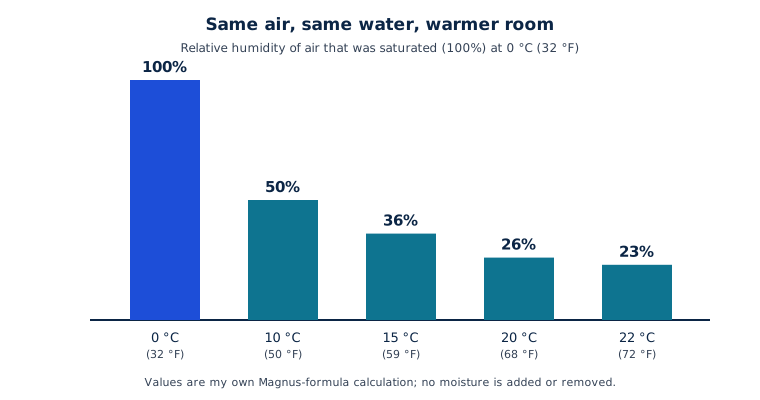
Carel, a humidity-control manufacturer, gives the worked example: foggy outdoor air at 0 °C (32 °F) and 100% relative humidity, heated indoors to 22 °C (72 °F), reads 23%. I ran the same sum for the steps in between with the Magnus approximation, so the middle figures are my own arithmetic:
A radiator has no coil, no condensate tray and no way to collect water. It is a warm panel. The only thing it removes from your life is the number on the hygrometer.
Where the lower reading helps: rooms that were running too wet
For a house that sits at 65% in winter, a warmer room genuinely does help, because a lower relative humidity at the surfaces and in the air is what slows condensation and mould. That is why councils tell tenants to keep rooms heated. Coventry City Council advises keeping the temperature above 15 °C, not leaving rooms unheated, and holding a steady temperature instead of switching the heating on and off.
So the honest answer is that a radiator makes damp air behave like drier air without making it drier. That is a perfectly good trade, up to a point. If you want target numbers, what indoor humidity should be has them, and a cheap meter will show you the effect; how humidity is measured explains what the number means and how far to trust it.
Where the lower reading misleads: cold walls and wet laundry
Here is the catch. The reading is taken in the warm middle of the room, and condensation happens at the coldest surface. A single-glazed window, a north wall or a bedroom corner far from the radiator is still cold, so air touching it cools and the vapour in it can condense there, however good the figure on the shelf looks. My opinion, for what it is worth: a hygrometer reading of 40% in a room with wet window sills is telling you about the middle of the room, not the sills. North-facing wall condensation shows how this plays out on a cold wall.
The other trap is the radiator as a clothes airer. It looks like a drying machine, and it does dry the washing, but every drop goes into the room’s air. Coventry’s advice is to dry clothes outdoors rather than on the radiator, and it notes that condensation forms when steam from cooking, washing and drying clothes meets cold surfaces. If you must dry indoors, how to dry clothes indoors without mould covers the routine.
Do radiators dry out the air in your room? Three checks first
- Look at the windows first. Dry skin and a low reading are one thing; streaming glass is the opposite problem. If the glass is wet in the morning, the room is not too dry for its walls and glazing, whatever the meter says.
- Read the number with the temperature beside it. The same vapour reads 50% at 10 °C and 23% at 22 °C in the chart above. A low figure after you turn the heating up is expected, not a fault.
- Add moisture only if both the glass and the walls stay dry. Carel concludes that air heated to a very low reading needs humidifying to get back to the optimum. That is its view as a humidity-control maker. I would only act on it in a room with no condensation, and never in one that grows it.
If you are weighing a dehumidifier against heating in a damp room, can you use a dehumidifier and a heater together covers how the two combine.
Heat changes the percentage; ventilation and moisture control change the water
The takeaway I would pin to the fridge: heating lowers relative humidity, it does not remove moisture, so do radiators dry out the air? Only on the dial. The damp problems that matter happen on cold surfaces your hygrometer is not touching. Keep the heating steady, keep wet washing off the radiator, ventilate the moisture-making rooms, and judge the result by the windows, not just the number.
FAQ
Do radiators remove moisture from the air?
No. A radiator warms the air and surfaces in a room, and the amount of water vapour stays the same. Because warm air can hold more water, the relative humidity reading falls even though no moisture has been removed.
Why does my room feel so dry when the heating is on?
Because cold outdoor air carries little water, and warming it drops the relative humidity a long way. In Carel’s example, saturated air at 0 °C reads 23% at 22 °C.
Do radiators make damp worse or better?
Steady heating usually helps, because warmer surfaces and a lower relative humidity make condensation less likely. Radiators make things worse mainly when they are used to dry washing in a closed room, since the water goes into the air.
Is it bad to dry clothes on a radiator?
It adds the load’s water to the room’s air, and that moisture can condense on cold walls and windows. Coventry City Council advises drying clothes outdoors rather than on the radiator, or on a rack in a room with a window slightly open and the door closed.
Does a bowl of water on a radiator help?
It adds a small amount of moisture to a room that is genuinely too dry, but it does nothing for a room that is damp or has condensation. I would test the windows first, and I have no measurement of how much a bowl adds.

