
Last Updated on October 24, 2026 by Umar Farooq
How to dry clothes indoors without mould: spin the load hard, hang it spaced out in one room with the door shut, and give the vapour an exit, either an extractor fan or a window open a crack. The clothes are never the problem. The litre or two of water they release into your air is, because it settles on the coldest wall it can find.
I have nothing against the airer. I just think of it as a slow, silent kettle with no lid.
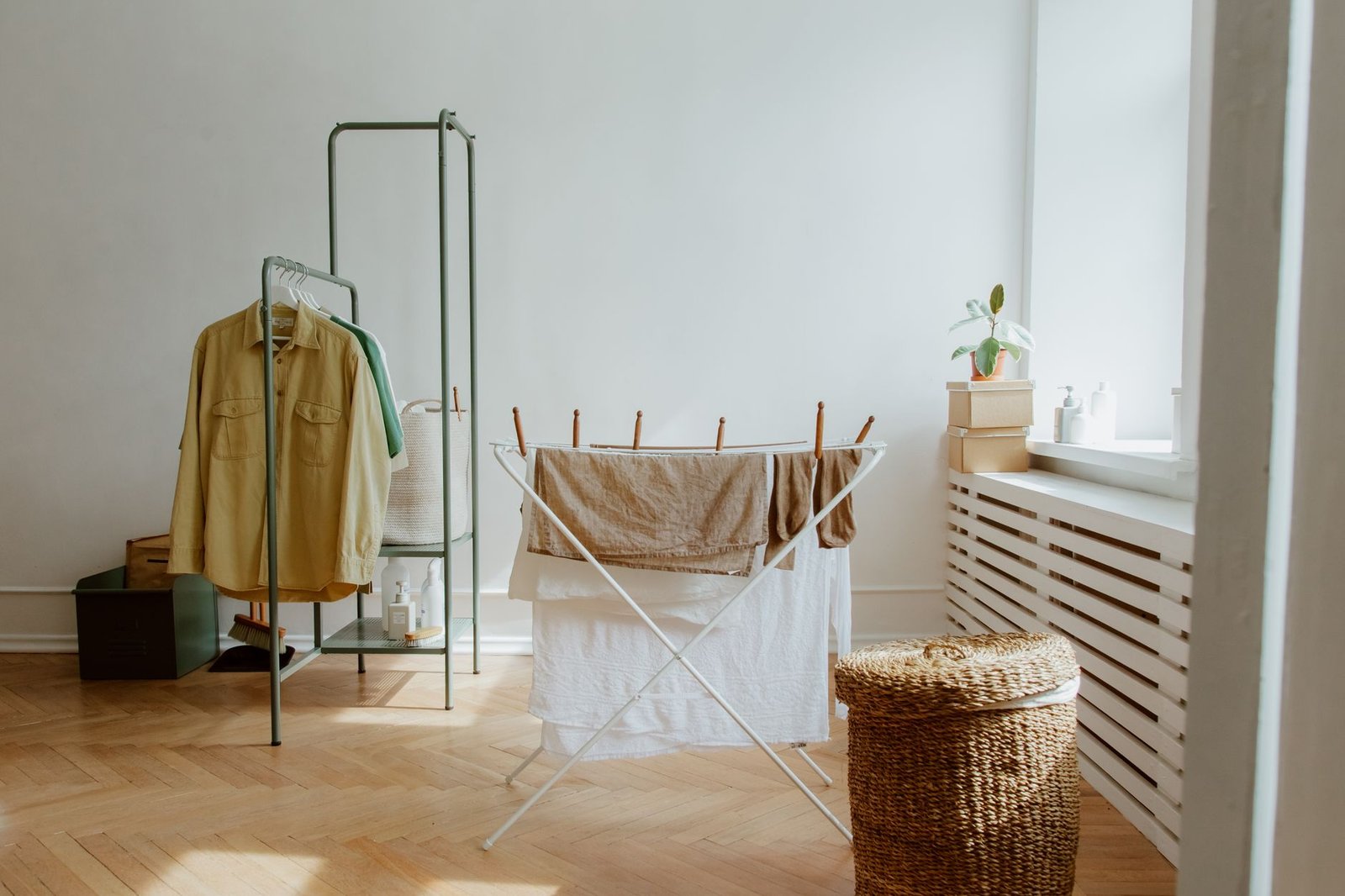
How to dry clothes indoors without mould: the routine, in order
- Give the load an extra spin, or run the machine’s highest spin speed the fabric allows.
- Don’t cram the drum, or the airer.
- Pick one room, and shut its door.
- Give the vapour an exit: extractor fan on, or a window open a crack.
- Space the garments out and put thick items on the outside of the airer.
- Keep wet washing off radiators.
- Wipe the window and check the corners the next morning.
Why a damp load turns into a mould problem
Mould needs a damp surface that stays damp. Your washing does not make walls damp directly. The water evaporates into the air, the air drifts, and the vapour condenses wherever a surface is colder than the air around it: window glass, an external wall, the back of a wardrobe. The EPA’s guidance boils mould control down to controlling moisture, and an airer in an open-plan room is a moisture source with no control at all.
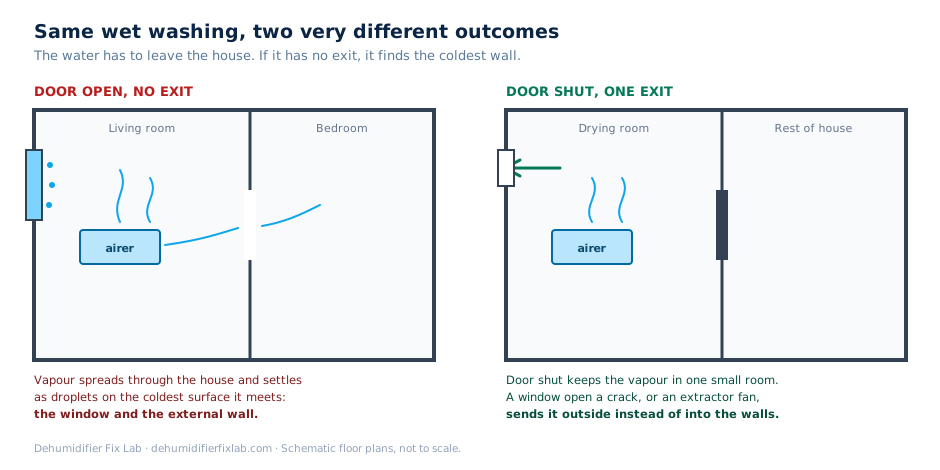
I am not putting a number on how much damp one load adds, because nobody has measured your house. The mechanism is enough: a shut door confines the vapour, and an exit removes it. Without the exit, a shut door just makes one very humid room.
Spin it harder before it reaches the airer
Water spun out in the machine is water you never evaporate indoors, which makes it the cheapest moisture removal there is. Use the highest spin the care label allows, and give towels and jeans a second go. A packed drum spins out less, so don’t overload it.
Choose the drying room by its exit, not its size
- A bathroom with an extractor fan: usually the best. The fan is already there and tiled walls shrug off a little moisture. Run it while the washing is in and for a while after.
- A spare room with a window open a crack: good. A few centimetres is enough, with the door shut so the vapour leaves by the window.
- The bedroom you sleep in: avoid it. No extraction, and you then shut yourself in with it.
- The open-plan living room: the worst case, as the diagram shows. Nothing contains the moisture.
A window only helps when the air outside is drier than the air inside. On a still, drizzly day the extractor wins. More on that trade-off in does opening windows reduce humidity.
Leave gaps, and put the heavy things on the outside
Air has to reach both faces of a garment, so overlapping washing stays damp in the middle, which is where the sour smell starts.

Hang thin things in the middle and thick ones (towels, jeans, jumpers) on the outer bars, where the air moves fastest. Two light loads finish sooner than one crammed one.
Radiators, heated airers and the bedroom: three places to stop
Radiators. Wet clothes add vapour and block the heat, so the boiler works harder. Which? advises against it for that reason.
Heated airers. Cheap to run, at about 7p an hour on Which?’s figures, but they still evaporate every drop into the room, so they need the same shut door and exit. I go through it in do heated airers cause damp.
The bedroom. Covered above.
If you see mould that covers more than about 10 square feet (roughly a metre square), that is beyond a wipe-down job. Fix the source of the water first, then follow the EPA’s cleanup guidance or call a professional.
The signs that drying is already costing you
Check for streaming windows in the morning, black speckling in window seals or external-wall corners, and a musty smell from the wardrobe on that wall. Wipe the glass dry daily and treat small patches promptly. Fix the water first: cleaning without fixing the source just resets the clock.
When a dehumidifier earns its place
If you dry washing indoors most days from October to March, a dehumidifier in the drying room works whatever the weather outside. Room set-up and timings are in dehumidifier for drying clothes, and capacity in what size dehumidifier do I need.
My opinion, and I’ll stand by it: sort the extractor fan or open-window habit first, and buy a dehumidifier second. A dehumidifier treats vapour that stays in the room. It cannot fix a room with no way out, and it costs far more than a fan.
One shut door and one open vent do most of the work
How to dry clothes indoors without mould comes down to two things: keep the vapour in one room, and give it a way out of the house. Spin harder, space things out and leave the radiators alone, and you have dealt with nearly all the risk without buying anything. If you wanted a clever trick, I’m sorry: it’s a door and a window.
FAQ
How do you dry clothes indoors in winter without a dehumidifier?
Dry them in one room with the door shut and either an extractor fan running or a window open a crack. Give the load an extra spin first, space the garments out, and keep them off radiators. A bathroom with a fan is the easiest place to do it.
Is it OK to dry clothes in a bedroom?
I would avoid it. A bedroom normally has no extractor fan, so the vapour settles on cold surfaces while you sleep in it. If it is the only option, open the window a crack.
Does drying clothes indoors cause mould?
It can, if the moisture has no way out and keeps landing on cold walls and windows. Occasional indoor drying in a ventilated room is not the issue. Daily drying in a closed, unventilated house is where mould tends to start.
Should I open a window when drying clothes indoors?
Yes, slightly, as long as the room door is shut so the vapour goes outside and not into the rest of the house. A gap of a few centimetres is enough. It helps most when the outside air is drier than the air indoors.

