
Last Updated on September 7, 2026 by Umar Farooq
A dehumidifier for condensation works on exactly half the problem, and that half is usually enough. Water forms on your windows when two things are true at once: the air is carrying moisture, and a surface is cold enough to make it let go. A dehumidifier removes the first ingredient. It cannot do a thing about the second.
Which is why a dehumidifier for condensation fixes it completely in some houses and only partly in others — and why the answer depends far more on your glazing than on the machine you buy.
Truth 1: it takes two ingredients, and you only control one cheaply
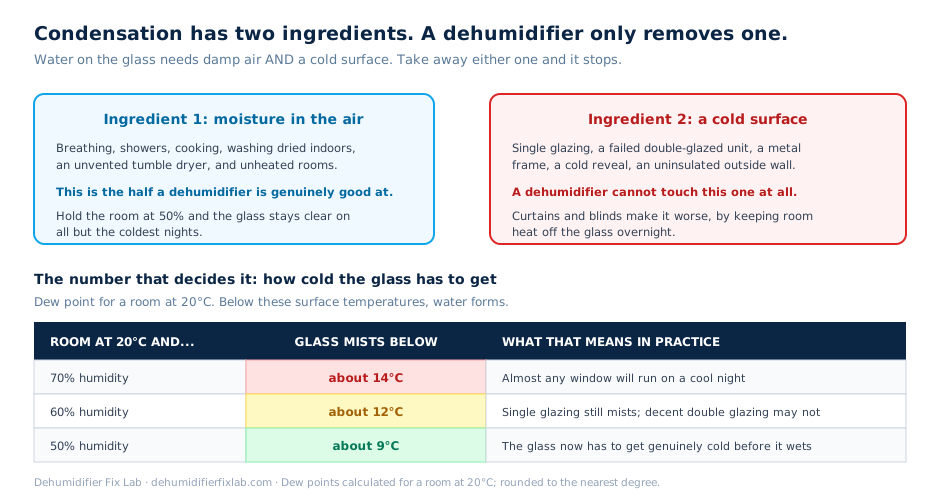
Ingredient one: moisture in the air. Breathing, showers, cooking, washing dried indoors, an unvented tumble dryer. Two adults asleep in a closed bedroom put a surprising amount of water into the air overnight, which is exactly why bedroom windows are worst at 7am.
Ingredient two: a cold surface. Single glazing, a failed double-glazed unit, a metal frame, an uninsulated reveal. The glass drops below the dew point of the room air, and the air touching it has to give up its water.
A dehumidifier only ever addresses the first. New windows address the second and cost a hundred times more. That asymmetry is the whole practical argument for trying the machine first.
Truth 2: the number that decides whether a dehumidifier for condensation is enough
Here is the useful arithmetic, and almost nobody publishes it.
For a room at 20°C, this is how cold the glass has to get before water forms:
| Room humidity | Glass mists below | What that means in practice |
|---|---|---|
| 70% | about 14°C | Almost any window will run on a cool night |
| 60% | about 12°C | Single glazing still mists; decent double glazing may not |
| 50% | about 9°C | The glass now has to get genuinely cold before it wets |
Dropping a bedroom from 70% to 50% moves the trigger point down by about 5°C. On single glazing in January that may not be enough. On modern double glazing it very often is, because the inner pane rarely gets that cold.
So the honest prediction: decent double glazing plus 50% humidity usually means dry windows. Single glazing plus 50% means less condensation, not none.
Truth 3: it works overnight, in the room where the moisture is made
Condensation is a morning phenomenon because the moisture is generated overnight and the glass is coldest just before dawn. That tells you where to put the machine.
In the bedroom, on 50%, running while you sleep. Not in the hallway, not in the living room downstairs — where you put it matters more than capacity, and a closed door is a wall as far as the machine is concerned.
If the noise is the obstacle, try running it hard during the day with the bedroom door shut, then switching it off at bedtime. Take the morning reading for a week; in a lot of bedrooms the humidity holds and you have solved it without running anything overnight. Making one liveable in a bedroom covers the rest.
Truth 4: the free things work, and some of them work better
Before the machine, and alongside it:
- Extractor fan during and twenty minutes after every shower. Most bathroom fans go off with the light, which is exactly when the room is wettest.
- Lids on pans, and the extractor on while cooking.
- Vent the tumble dryer outside, or empty the condenser tank.
- Dry washing outdoors when you can. Indoors, do it properly in one closed room with a dehumidifier rather than spread over radiators.
- Trickle vents open. They exist for exactly this and people tape them shut.
- Ventilate for ten minutes when the outside air is drier than the inside air.
And one that is not obvious: open the curtains and blinds during the day. Closed coverings keep room heat off the glass overnight, so the pane runs colder and mists more. Heavy curtains make bedroom condensation measurably worse.
The myth: that a dehumidifier will not help with condensation at all
You will find this said, usually by someone selling windows: condensation is a cold-surface problem, so a dehumidifier is pointless.
Half right, and wrong in the half that matters. It is true that the machine cannot warm your glass. It is not true that this makes it useless, because the dew point is not fixed — it moves with humidity, and moving it down by 5°C is genuinely enough in a great many houses.
The honest framing is that a dehumidifier is a cheap partial fix for an expensive complete one. A few pounds a month against several thousand for glazing, and in a house with reasonable double glazing it frequently ends the problem entirely.
When it will not be enough
Be realistic about these, because no machine wins them:
- Single glazing in a cold climate. You will reduce it, not stop it. Secondary glazing or thermal blinds do more.
- A failed double-glazed unit — misting between the panes. A dehumidifier cannot reach that. The unit needs replacing.
- Water actually coming in. If the moisture is a leak, a failed seal or rising damp, the machine will run permanently and never win. Find the water first.
- Condensation on walls rather than glass. Glass is a warning; walls mean a cold spot with poor air movement, and that needs insulation and furniture moved off the wall as well as drier air.
What to set a dehumidifier for condensation to
Fifty per cent, and leave it. In a bedroom with cold single glazing, 45% is worth trying — the same logic as cold basement walls, where the surface sits at a far higher humidity than the room reading suggests.
Not lower. The setpoint decides when the machine stops, not how hard it works, so 35% will not clear the glass faster. It will only mean the unit never switches off, and a room below 30% dries out timber and joinery. Settings in full.
Frequently asked questions
Will a dehumidifier stop condensation on windows?
Often, yes — completely on decent double glazing, and partly on single glazing. It removes the moisture half of the problem, which lowers the temperature at which glass mists by about 5°C when you go from 70% to 50% humidity.
Why do I still get condensation with a dehumidifier running?
Usually because the glass is very cold, the machine is in a different room from where the moisture is generated, or a door was closed between them. Single glazing in winter can be below the dew point even at 50% humidity.
What humidity stops condensation on windows?
For a room at 20°C, 50% humidity means the glass has to fall below about 9°C before it mists, against 14°C at 70%. Fifty per cent is the target; 45% is worth trying with single glazing.
Where should I put a dehumidifier for bedroom condensation?
In the bedroom itself, with the door shut, running overnight or hard during the day. Moisture generated in that room has to reach the machine, and a closed door stops it doing so.
Is condensation on windows a sign of damp?
Not by itself — it is a sign of humid air meeting cold glass, which happens in perfectly dry houses in winter. It becomes a damp problem when it runs down onto frames and sills often enough to feed mould.
Do curtains make condensation worse?
Yes. Closed curtains and blinds keep room heat off the glass overnight, so the pane runs colder and mists more. Opening them during the day genuinely helps.
Will a dehumidifier fix condensation between double glazing panes?
No. Misting between the panes means the sealed unit has failed and moisture is inside the glazing itself, where no appliance can reach it. That unit needs replacing.
Related guides: Where to put a dehumidifier · Dehumidifier settings · Does a dehumidifier help with mould? · How to dehumidify a room
Sources
- ENERGY STAR — Dehumidifiers — the 30–50% recommended band behind the target setting.
- EPA — Mold Course, Chapter 2 — how surface conditions differ from room air, and the 60% threshold that turns condensation into a mould problem.
- EPA — A Brief Guide to Mold, Moisture and Your Home — ventilation and source control, which do more than any appliance.
Where this guide and your appliance’s own manual disagree, follow the manual. And if a window company has told you a dehumidifier will not help — get a hygrometer and try it for a fortnight first. It is a few pounds against a few thousand, and it settles the argument either way.

