
Last Updated on September 1, 2026 by Umar Farooq
There is no genuinely silent quiet dehumidifier for bedroom use, and anyone telling you otherwise is quoting a number measured on the lowest fan speed with the compressor off. The World Health Organization’s guidance for a bedroom at night is below 30 dB, and no mains-powered dehumidifier on sale meets it.
That is not a reason to give up on a quiet dehumidifier for bedroom use. A well-chosen machine, placed properly, is perfectly liveable overnight — plenty of people sleep better with the steady hum than without it. But you should go in knowing what the numbers on the box do and do not tell you.
Where a quiet dehumidifier for bedroom use really sits on the scale
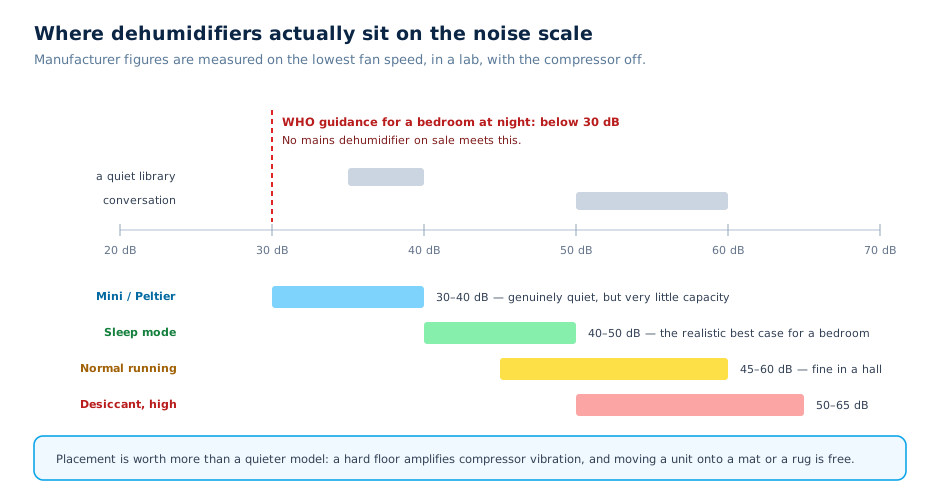
| Type | Typical range | What that means |
|---|---|---|
| Mini desiccant or Peltier | 30–40 dB | Genuinely quiet, very little capacity |
| Compressor, sleep mode | 40–50 dB | The realistic best case for a bedroom |
| Compressor, normal running | 45–60 dB | Fine in a hallway, noticeable in a bedroom |
| Desiccant, high fan | 50–65 dB | The loudest of the lot |
For reference, a quiet library is about 40 dB and normal conversation about 55–60 dB. So a “quiet” 45 dB dehumidifier is roughly a library — which is quiet for an appliance and not silent for a bedroom.
Rule 1: treat the quoted dB figure as a floor, not an average
This is the honest complaint about the whole category.
Manufacturers publish a single number, and it is invariably measured under the most flattering conditions the machine can produce: lowest fan speed, and often with the compressor not running. Your actual experience alternates between that number and something noticeably higher every time the compressor cuts in.
A dehumidifier is not a fan. It is a fan plus a compressor that starts, runs, and stops on a cycle you cannot predict. The change in noise is what wakes people, not the level. A steady 48 dB is far easier to sleep through than a machine that alternates between 38 and 50 all night.
Which leads to a slightly counter-intuitive conclusion: a machine that runs steadily is better in a bedroom than one that cycles, and a right-sized unit runs steadily where an oversized one cycles. Sizing it properly is a noise decision as much as a capacity one.
Rule 2: placement is worth more than the model
Free, and it makes more difference than paying extra for a quieter unit.
- Get it off a hard floor. A compressor’s vibration couples straight into floorboards or tiles and the whole floor becomes a soundboard. A rug, a mat, or a folded towel under it kills a surprising amount.
- Away from the bed, and away from walls. Sound reflects off hard surfaces; a unit in a corner is louder at the pillow than the same unit in open space.
- Not blowing its warm outlet air at anyone. It is a net heater, so its exhaust will make a sleeper warm as well as dry.
- Consider the landing instead. With the bedroom door open, a machine outside the room dries it nearly as well and is a metre or two further from your head. Placement generally covers why that works.
Rule 3: use sleep mode, and know what it actually does
“Sleep” or “quiet” mode is not marketing. On most machines it does two real things: drops the fan to its lowest speed, and often lets the humidity drift a little above target before restarting the compressor, which means fewer start-stop events overnight.
Both help. The trade is capacity — a machine on low fan moves less air over the coil and removes less water per hour. In a bedroom that is almost always the right trade, because a bedroom is a small space generating modest amounts of moisture.
Set it to 50% and leave it. A lower setting does not dry the room any faster; it only guarantees the compressor runs more of the night. The settings guide has the reasoning.
Rule 4: consider whether it needs to run at night at all
The most effective noise reduction is switching it off.
Bedroom humidity peaks overnight — two people breathing in a closed room put a surprising amount of water into the air — but that moisture does not have to be removed while it is being produced. In many bedrooms, running the machine hard during the day with the door shut, then switching it off at bedtime, holds the room perfectly well.
Worth testing for a week: run it 9am–9pm, take a reading each morning, and see whether the number creeps up. If it holds, you have solved the noise problem entirely and saved the electricity.
Rule 5: a mini unit is quiet because it is barely working
The 30–40 dB machines on the market are genuinely quiet, and they are quiet because they use a thermoelectric plate or a small desiccant wheel rather than a compressor. There is no compressor to hear because there is no compressor.
The trade is capacity, and it is a big one. These units remove a small fraction of what a compressor machine does, and Peltier units in particular perform poorly below about 15°C — which is a problem, because cold bedrooms are exactly the ones with condensation on the windows.
So: fine for a small, warm, mildly damp bedroom. Not a solution for a genuinely damp room, where the honest answer is a proper machine placed thoughtfully, or run during the day instead.
What noise actually means for sleep
Two things worth knowing, because they pull in opposite directions.
The WHO’s guidance for good-quality sleep is below 30 dB in the bedroom at night. No mains dehumidifier meets that, which is the honest headline of this article.
But a steady, broadband hum is also what a white-noise machine produces deliberately, and many people find it masks more disruptive noises — traffic, a neighbour, a partner. A dehumidifier at a constant 45 dB may genuinely improve your sleep even though it is above the guideline, while the same machine cycling on and off will not.
Judge it on a week of actual nights rather than on a specification.
Frequently asked questions
How many decibels is a quiet dehumidifier?
Around 40–50 dB for a compressor unit on sleep mode, and 30–40 dB for a mini desiccant or Peltier machine. For context, 40 dB is roughly a quiet library. Nothing mains-powered reaches the WHO’s 30 dB bedroom guidance.
Can you sleep with a dehumidifier running in the bedroom?
Yes, and many people find the steady hum helps. What disturbs sleep is the change in level each time the compressor cycles, rather than the level itself — which is why a right-sized machine running steadily beats an oversized one cycling.
How do I make my dehumidifier quieter?
Put it on a rug or a mat rather than a hard floor, move it away from walls and the bed, use sleep mode, and make sure it is not undersized so much that it runs flat out. Moving it onto the landing with the door open is the biggest single improvement.
Are mini dehumidifiers quieter than normal ones?
Considerably, because they have no compressor. They also remove far less water, and Peltier models work poorly below about 15°C. Quiet, but only useful in a small, warm, mildly damp room.
What should I set a bedroom dehumidifier to overnight?
Fifty per cent, on low fan or sleep mode. A lower setting will not dry the room faster — it only means the compressor runs more of the night, which is exactly what you are trying to avoid.
Is it better to run a dehumidifier during the day instead?
Often, yes. Run it with the door closed while you are out, then switch it off at bedtime and check the morning reading for a week. If the humidity holds, you have removed the noise problem completely.
Do desiccant dehumidifiers make good bedroom machines?
Not usually. They are among the loudest on high fan and put out noticeably more heat than compressor units. Their advantage is cold rooms, which is a different problem from a quiet bedroom.
Related guides: Where to put a dehumidifier · Dehumidifier settings · How long should a dehumidifier run? · What size dehumidifier do I need?
Sources
- World Health Organization — Noise — the guidance figure for bedroom noise at night and its effects on sleep.
- ENERGY STAR — Dehumidifiers — capacity and efficiency guidance behind the sizing-for-noise argument.
- GE Appliances — Dehumidifier: Ideal Operating Conditions — clearance and operating-temperature guidance relevant to placement.
Where this guide and your appliance’s own manual disagree, follow the manual. And if you are comparing two machines on a single dB figure — put the spec sheets down and try the day-running experiment first. It costs nothing and it settles the question in a week.

