
Last Updated on September 7, 2026 by Umar Farooq
Dehumidifier error codes are not standardised across brands, and anyone who tells you E6 means one specific thing on every machine is guessing. What is consistent is the small list of things that can actually go wrong inside one — a tank switch, two sensors, a defrost state and a pump. Nine code patterns cover nearly everything, and most of them are not faults at all.
Your own model’s table beats this page every time. But if you have lost the manual, or the manual just says “contact an authorised service centre” and stops, this will get you to the right part of the machine.
Why the codes disagree between brands
Worth knowing, because it stops you trusting the first search result.
There is no industry standard for dehumidifier fault codes. Each manufacturer picks its own, and the same factory will use different tables for different badges. Midea builds dehumidifiers sold under more than fifty brand names; Gree’s recall alone covered thirteen. The hardware underneath is frequently identical while the code table on the display is not.
So the useful question is never “what does E6 mean” in the abstract. It is “what are the four or five things a dehumidifier can even report, and which one is this?”
The nine patterns
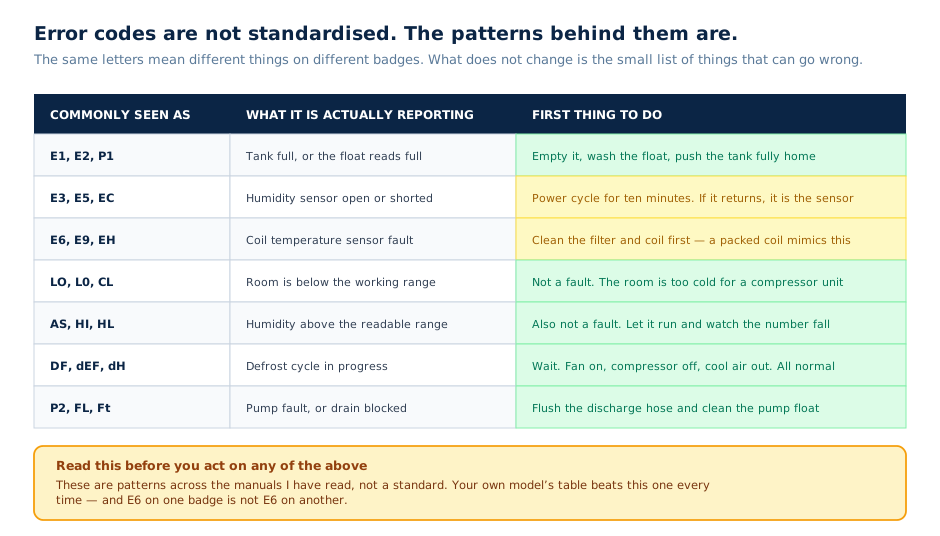
| Commonly seen as | What it is actually reporting | First thing to do |
|---|---|---|
| E1, E2, P1 | Tank full, or the float reads full | Empty it, wash the float, push the tank fully home |
| E3, E5, EC | Humidity sensor open or shorted | Power cycle ten minutes; if it returns, it is the sensor |
| E6, E9, EH | Coil temperature sensor fault | Clean the filter and coil first — a packed coil mimics this |
| LO, L0, CL | Room below the working range | Not a fault. Too cold for a compressor unit |
| AS, HI, HL | Humidity above the readable range | Also not a fault. Let it run and watch it fall |
| DF, dEF, dH | Defrost cycle in progress | Wait. Fan on, compressor off, cool air out |
| P2, FL, Ft | Pump fault, or drain blocked | Flush the discharge hose, clean the pump float |
| F0, FC | Fan fault | Check nothing is fouling the blade, then the motor |
| CH, EE | Control board or memory fault | Ten-minute power cycle, then it is a board |
The four that are not faults
This is the useful half, because these send people to a repair shop for nothing.
LO / CL — the room is too cold. Many units simply refuse to run below their working range rather than icing themselves solid. Below about 18°C / 65°F output falls sharply and below 5°C / 41°F frost forms faster than the machine can clear it. The machine is protecting itself. Heat the room, or use a desiccant unit which has no cold coil to freeze.
AS / HI — the humidity is off the top of the scale. Most sensors read a range, commonly around 30–90%. A very wet room reads above it, so the display says “high” rather than a number. Leave it running; the code clears as the room dries.
DF / dEF — it is defrosting. The compressor stops, the fan keeps running, and the outlet air goes cold rather than warm. Entirely normal in a cool room, and the single most misread state on any dehumidifier. Why the outlet temperature is a useful diagnostic.
E1 / P1 — the tank. Nine times out of ten this is a tank pushed almost home, or a float held up by biofilm, rather than a genuine sensor failure. Both are free to fix, and if the code persists with a clean, seated, empty tank, that has its own guide.
The ones that mean something
Sensor codes (E3/E5/EC, E6/E9/EH). These report a sensor reading outside a plausible range — either open circuit, shorted, or disconnected. Two things worth doing before you accept it:
Do a proper ten-minute power cycle at the wall, not a five-second one. Control boards latch a fault state and stay latched.
Then clean the filter and coil. A coil packed with dust runs at a temperature the board does not expect, and a coil sensor buried in that dust reads wrong. I would not order a sensor before doing this, and a surprising number of these clear afterwards.
If the code survives both, it is genuinely a thermistor. They are cheap parts, but the labour to reach one on a sealed-ish cabinet is what decides whether it is worth doing on an older machine.
Pump codes (P2/FL/Ft). The pump cannot clear its reservoir. Almost always the narrow discharge hose has silted, kinked or been left with its end in standing water — the same five failures as any drain. Clean the pump float while you are in there.
Fan codes (F0/FC). The board is not seeing the fan turn at the speed it commanded. Unplug and check nothing is fouling the blade before suspecting the motor.
Board codes (CH/EE). Power cycle once. If it returns, that is a control board, and on a machine over about five years old the part is frequently unobtainable — which effectively ends it. The repair-or-replace arithmetic.
The universal first move
Whatever the code says, do this before anything else:
- Unplug at the wall for ten minutes. Not five seconds — the board needs to lose power properly to clear a latched state.
- Empty and refit the tank, checking the float drops back freely.
- Wash the filter and vacuum the coil, then let everything dry.
- Put a thermometer in the room.
Those four take twenty minutes, cost nothing, and clear a genuinely large share of codes — because most of what a dehumidifier can report is a tank, a temperature, or a blocked airway.
A code alongside a burning smell, a scorched plug or visible heat damage is not a code to look up. Unplug it at the wall and stop using it. Four recalls across Midea, Gree and New Widetech cover roughly nine million units and more than 580 documented fires — check your model number against the CPSC recall list before you switch it on again.
Frequently asked questions
What do dehumidifier error codes mean?
They report one of a small number of internal states: tank full, humidity sensor fault, coil sensor fault, room out of range, defrost in progress, pump or drain blocked, fan fault, or a board fault. The letters vary by brand; the underlying list does not.
Are dehumidifier error codes the same across brands?
No. There is no industry standard, and the same factory uses different tables for different badges. E6 on one machine is not E6 on another, which is why your own model’s manual beats any general table.
What does E9 mean on a dehumidifier?
On most machines that use it, a coil temperature sensor fault. Before assuming the sensor, clean the filter and coil — a packed coil runs at a temperature the board does not expect and produces the same code.
How do I reset a dehumidifier error code?
Unplug at the wall for ten minutes, then plug back in. That is long enough for the control board to lose power and clear a latched state. There is almost never a dedicated reset button.
Is a defrost code a fault?
No. DF, dEF and similar mean the machine is clearing ice from the coil: compressor off, fan running, cool air at the outlet. It is normal in a cool room and clears on its own.
My dehumidifier shows LO or CL — what is wrong?
Nothing. The room is below the machine’s working range. A compressor unit cannot usefully dry air that cold, so it declines rather than icing solid. Heat the room or use a desiccant model.
Should I repair a dehumidifier showing a sensor error?
Try a ten-minute power cycle and a proper clean first, which clears a fair number of them. If the code survives, sensors are cheap but the labour is not — weigh it against the machine’s age.
Related guides: Dehumidifier not collecting water · Dehumidifier says the bucket is full when it’s empty · Dehumidifier blowing hot air · How to clean a dehumidifier
Sources
- GE Appliances — Dehumidifier: Ideal Operating Conditions — the working temperature range and defrost behaviour behind the LO and DF codes.
- GE Appliances — Dehumidifier: Cleaning and Maintenance — filter and coil cleaning, which clears a real share of sensor codes.
- CPSC — Dehumidifier recalls — the recall list to check a model number against before repairing anything.
Where this guide and your appliance’s own manual disagree, follow the manual. And if the code came with a phone number and nothing else — that is the manufacturer’s failure, not yours. Work through the four free checks first; most codes do not survive them.

