
Last Updated on October 25, 2026 by Umar Farooq
Can mold grow in the dark? Yes: it does not need light at all, only moisture, something to feed on and a workable temperature. The EPA puts it plainly, and it means the dark parts of a house are not risky because of the dark. They are risky because nobody looks at them.
I used to assume mould was a shade-lover, like moss. It is not. It is more like a tenant who pays no attention to the lighting and a great deal of attention to the damp.
Can mold grow in the dark? What the EPA actually says
The EPA’s mould course states that mold does not need light to grow, and that it can grow in dark areas and on hidden surfaces such as the back of drywall or under carpet padding. Its separate home guide adds the part that matters: none of the many types of mold will grow without water or moisture.
So the working recipe has three parts, and the lights are not on the list:
- Moisture. Damp materials, condensation, a slow leak, or air that stays humid.
- Food. Almost anything organic in a home: paper, wood, fabric, plasterboard facing, even dust.
- A suitable temperature. Most rooms people live in already sit in a range moulds tolerate. That is my reading rather than a figure from the EPA, which is why I have not put a number on it.
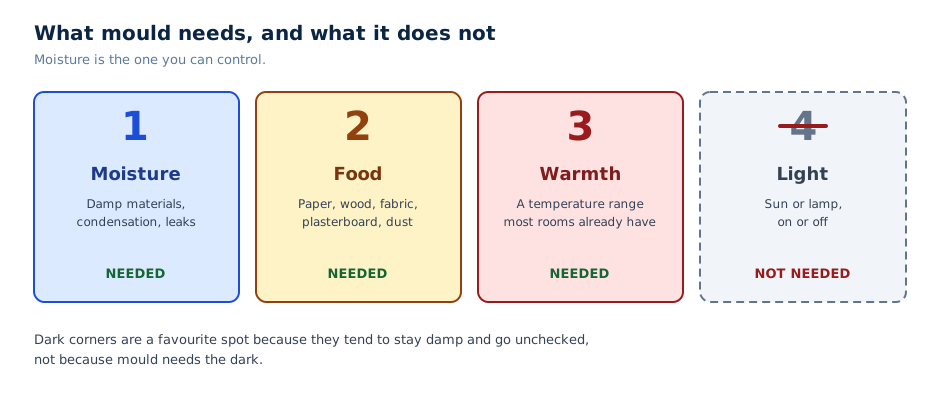
Two of those three you cannot sensibly remove from a house. You cannot take away the food (your home is the food) or the warmth (you want to be warm). That leaves moisture, which is the lever, and it is why every mould guide on this site ends up at the same place. How wet is wet enough is covered in what humidity mould grows at.
Why dark corners, wardrobes and the back of the sofa get it first
If darkness does not cause mould, why does it keep turning up there? Because the places we call dark are usually also still, cold and ignored. That is my own reasoning from how damp behaves, not an EPA claim, but the pattern is consistent:
- No airflow. Closed doors and furniture pushed flat to the wall stop room air reaching the surface to dry it.
- Colder surfaces. Outside walls, corners and the backs of units run cooler than the room, so moisture condenses on them. The UK government’s damp guidance names low points on walls behind sofas and wardrobes as typical places for condensation damp.
- Nobody is looking. A bright, busy room gets noticed within days. A cupboard under the stairs can be damp for months.
There is a nice irony here. Because mould does not need light, it also does not mind you switching the light on. It just sits there while you fail to see it. The practical consequence is that “it looks fine” tells you nothing about the back of a wardrobe, which is why I have written separate guides on mould behind furniture and mould in a wardrobe.
Hidden spots that count as dark, even in a bright house
The dark in question is often a few centimetres deep. Rooms with plenty of windows still have these:
| Hidden spot | Why damp lingers there |
|---|---|
| Back of a wardrobe or headboard against an outside wall | Cold surface, no air movement |
| Under carpet and underlay | Moisture trapped against a cold floor, nothing to dry it |
| Behind kitchen and bathroom units | Steam and splashes with no ventilation |
| Loft and eaves | Warm moist air meets cold roof timbers |
| Inside walls, around pipes | Slow leaks that never show on the surface |
The EPA lists the back side of drywall, wallpaper and paneling, and areas inside walls around pipes, among the places mould may be hidden. A musty smell with nothing visible is the usual clue.
Is sunlight a fix? Not for a damp problem
Online you will find the claim that mould cannot survive ultraviolet light and needs the dark. One mould-inspection page I read states exactly that, with no source behind it, and the EPA pages I opened do not mention light, sunlight or UV at all. I would not build a plan on it.
Even if some brightness helped at the surface, the water in the wall, the carpet or the cold corner is still there. Sun through a window does not dry out the inside of a wardrobe. Fix the moisture first: the EPA’s advice is to dry wet areas and items within 24 to 48 hours after water damage, and to keep indoor humidity below 60%, ideally between 30 and 50%. For how fast growth shows once conditions are right, see how long mould takes to grow.
Check the dark places this week, without making it worse
If you find mould, do not dry-brush or vacuum it, because that can put spores into the air. Wear gloves and a respirator-type mask, open a window, and stop if the patch is bigger than about 10 square feet (roughly 1 square metre): the EPA says larger areas need its remediation guidance or professional help.
A ten-minute round is enough:
- Torch the corners. Hold the light flat to the wall so speckles and texture show up.
- Pull one thing away. Move a wardrobe or sofa a hand’s width forward and look at the wall behind it.
- Sniff before you look. A damp, earthy smell with no visible cause means it is worth looking harder.
- Put a hygrometer in the worst spot. Compare it with one in the middle of the room. A reading well above the room is your evidence of a pocket.
- Note the cause, not just the spot. A leak, a cold wall or wet washing is the thing to fix. Wiping the patch alone buys you a few weeks.
Keep dark spaces dry and mould has nothing to work with
Prevention here is about moisture and air, not lighting. These are the habits that do the most:
- Leave a gap. A couple of centimetres between furniture and cold walls lets air move.
- Open doors and vents on wardrobes and cupboards for an hour now and then, and do not pack them tight.
- Never store damp things. Wet towels, gym kit and boxes from a damp garage bring the moisture with them.
- Ventilate wet rooms while showering and cooking, and keep an eye on the room’s overall humidity. The full routine is in how to prevent mould in the house.
- Dry the air if it stays damp. A dehumidifier is the tool for a space where humidity remains high despite the habits above.
Darkness hides mould, but damp grows it
The honest answer to “can mold grow in the dark” is yes, and it is also the wrong thing to worry about. Light neither starts mould nor stops it. Moisture decides, and dark, still, cold spots are simply where moisture lingers longest and where you look least. Open up the hidden places, keep the air moving and the humidity under control, and the dark can stay dark.
FAQ
Does mold grow faster in the dark or in light?
I could not find a reliable source that measures this for the mould found in homes, so I will not invent a number. The EPA says only that mould does not need light. What decides how fast it grows is moisture, food and temperature, and dark places tend to be damp ones.
Does turning the lights on kill mold?
No. Ordinary room lighting does not stop mould, and the EPA pages I read do not suggest light as a treatment. Removing the moisture, and cleaning or replacing affected material, is what works.
Where does mold grow most in a house?
Wherever materials stay damp: bathrooms, kitchens, basements, lofts, behind furniture and inside wardrobes. The EPA also notes hidden surfaces such as the back of drywall, wallpaper and paneling, and under carpet padding.
Can mold grow in a closet or wardrobe with no light?
Yes. A closed wardrobe on a cold outside wall, packed with slightly damp clothes, has moisture, food and a mild temperature, which is all mould needs. Leave doors ajar sometimes and keep clothes dry going in.
Can you see mold growing in the dark?
Often not until it has spread, which is part of the problem. Dim spots hide early growth, so use a torch held flat against the wall and check for a musty smell as well as for speckles.

