
Last Updated on October 24, 2026 by Umar Farooq
What temperature does mold grow at? Household moulds can grow anywhere from about freezing to roughly 35°C (95°F), and grow best at around 25-30°C (77-86°F), which means the temperature you keep your home at is almost always inside the range. Temperature is rarely what stops mould in a lived-in house.
If you were hoping for a number to set the thermostat to and be done with it, I am sorry. The honest answer is that moulds are not fussy about warmth, and the thing that does the choosing is moisture.

What temperature does mold grow at, and where is its sweet spot?
The most useful single source I found is North Dakota State University Extension’s Molds in Your Home. It says household moulds “grow best at warm temperatures, between 77 and 86 degrees Fahrenheit” and “can grow in temperatures between 32 and 95 degrees”. That is 25-30°C for the sweet spot and 0-35°C for the outer limits.

Look at the bottom bar. A heated room at 18-22°C (64-72°F) is nowhere near the edge of that range. It is comfortably inside it, just short of the peak.
Where the figures vary. Search for this and you will find 60-80°F, 40-100°F, “4°C to 55°C” and other ranges, mostly on remediation company blogs that do not say where they got them. Different species have different limits, so a range for “mould” in general is always a blur of many organisms. I have used the university figure because it says what it covers and can be checked, and I treat the edges (0°C and 35°C) as approximate. The middle of the range is the part that matters indoors.
Why a room that suits you suits mould
Moulds are fungi that feed on organic material, and a house is mostly organic material: paper, paint, plasterboard facing, timber, dust, soap scum, fabric. NDSU lists the ingredients as moisture, a food source and warm temperatures, and in a heated home two of the three are permanently supplied.
That is the unfashionable conclusion: you cannot out-cool mould in a room you actually live in. A bedroom at 17°C is still well inside 0-35°C. Dropping the heating to save the walls would mean being cold for nothing, and a colder house has colder surfaces, which makes the real problem (see below) worse.
Cold slows mould but does not stop it
The other half of the question is whether a cold house is safe. Not reliably. The US National Park Service’s guidance on mould in museum collections, reproduced on the Conservation OnLine site, recommends 18-20°C (64-68°F) and a ceiling of 24°C (75°F), but says those figures only reduce the risk, and that “some microorganisms can grow in significantly lower temperatures and at lower RH levels”. NDSU’s lower limit is 32°F.
So read cold as slowing the clock, not stopping it. A cold, damp cellar or an unheated loft is not protected. The exact point where a given mould gives up is species-specific, and I have not found a household-level figure I would trust, so I will not invent one.
Why the coldest wall is the worst spot
The surprise is that warmth is not the main problem; cold surfaces are. Room air carries water vapour, and when it touches something colder it cools, its relative humidity rises and eventually it condenses. The EPA’s mould course chapter on why and where mould grows says it plainly: “When warm, humid air contacts a cold surface, condensation may form,” and “Mold is frequently found on walls in cold corners behind furniture where condensation forms.”
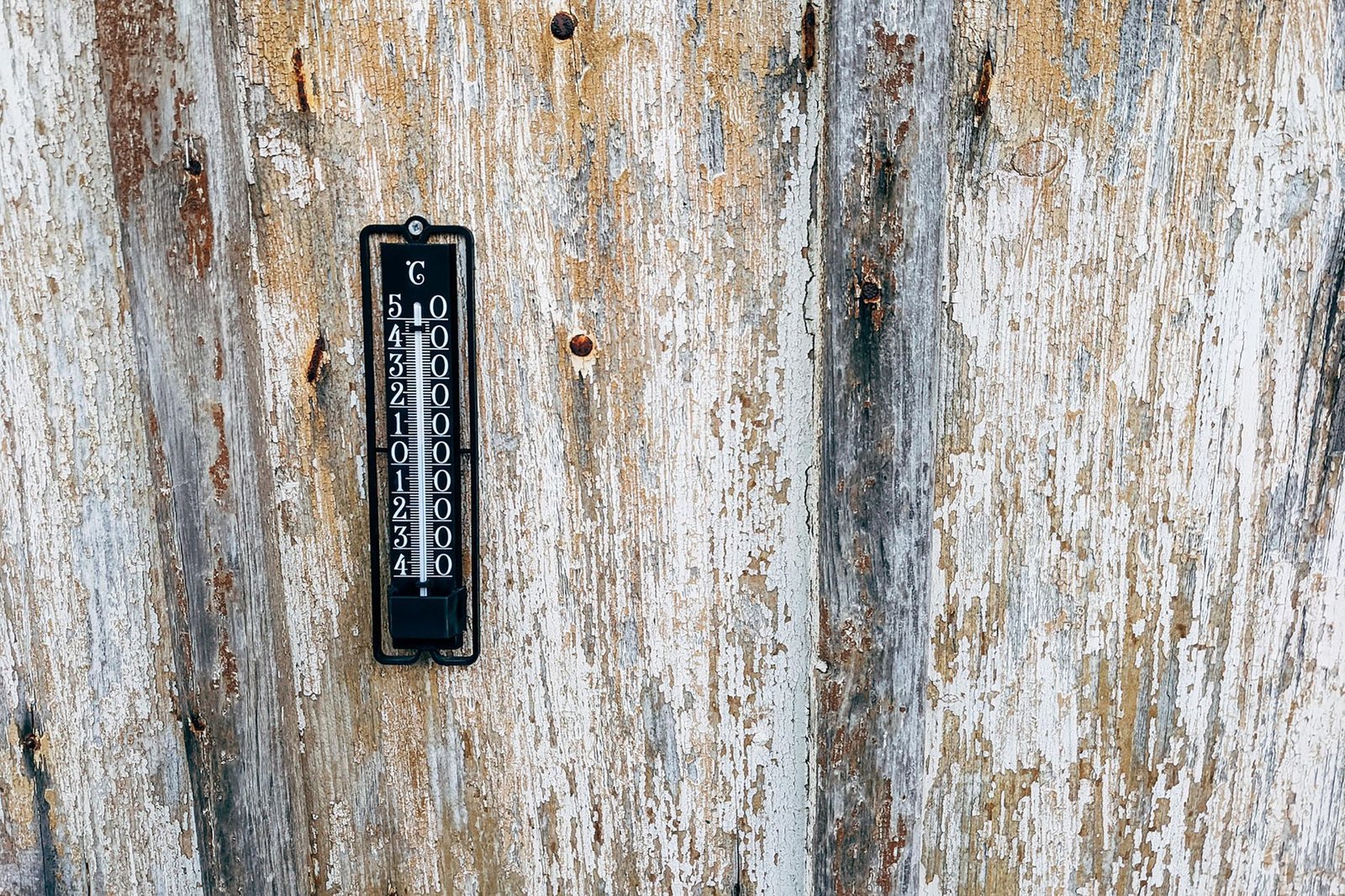
So in a winter house, the places cold enough to be damp are also warm enough for mould. An outside-facing corner at 12°C is still a perfectly good temperature for it. If you want to see the mechanism on real furniture, mould behind furniture and mould around windows cover the usual spots. An air thermometer will not show you this, because it reads the air, not the surface.
Does humidity matter more than temperature?
Yes, and there is a small piece of research that points the same way. In a 2022 study in the Journal of Fungi, Temperature versus Relative Humidity: Which Is More Important for Indoor Mold Prevention?, the researchers tested spores of a common indoor mould, Cladosporium cladosporioides, at 19°C and 28°C with different humidities during dry periods. At the same humidity the two temperatures gave similar results; the humidity changed the outcome far more. The authors concluded that moisture plays “a more important role” than temperature.
Be careful with what that does and does not show. It tested one species, in a lab, at two temperatures, and measured how well spores survived wet-dry cycles rather than how fast a patch grows on your wall. It is a hint, not a rule. But it agrees with the building guidance. The surface humidity threshold, and why 60% on a room hygrometer is a ceiling rather than a start, are in what humidity does mold grow at, which I will not repeat here.
For how long visible growth actually takes once conditions are right, and why “24-48 hours” is a drying deadline for wet materials rather than a mould timer, see how long it takes for mould to grow.
If mould covers more than about 10 square feet (roughly 1 square metre), the EPA treats it as a bigger job than a household clean. Fix the water source first. This page is about prevention, not about health effects or removal.
Which temperature habits help and which do not
- Keep the heating low and steady rather than off. A cold house means cold walls. Steady, modest heat keeps surfaces nearer the room’s temperature and so drier. That is my judgement from the condensation mechanism above, not a measured result.
- Leave a gap behind furniture on outside walls. NDSU advises moving furniture away from walls and opening closet doors for air circulation, and insulation and thermal-pane windows to keep walls warm.
- Do not chase a low number. Turning the thermostat down will not make a damp room mould-proof.
- Lower the humidity instead. Vent the kitchen and bathroom outside, stop drying washing indoors where you can, and use a dehumidifier for what is left. How to prevent mould in a house has the full list.
Mould ignores your thermostat, so aim at the water instead
Three things to keep from this page. First, household moulds grow across roughly 0-35°C, so the temperature of a lived-in room is inside the range. Second, cold does not make a place safe, it makes the surface damp. Third, humidity and liquid water decide the outcome far more than degrees. Set the heating for comfort, keep it steady, and put your effort into the moisture.
FAQ
What is the ideal temperature for mold to grow?
Roughly 25-30°C (77-86°F), according to NDSU Extension. Other sites quote 60-80°F. The difference is mostly down to how species are lumped together, and in practice both ranges describe an ordinary warm room.
Can mold grow in cold temperatures?
Yes, more slowly. NDSU puts the lower limit at about freezing, and the National Park Service notes that some microorganisms grow at significantly lower temperatures than its recommended range. A cold, damp room is not a safe one.
Does mold grow at 20 degrees Celsius?
Yes. 20°C (68°F) is a normal living-room temperature and sits comfortably inside the growth range. Whether it actually grows depends on moisture, a food source and time.
At what temperature does mold stop growing?
Growth slows towards freezing and is limited at the top end above roughly 35°C, per NDSU’s range. The cut-off varies by species, and stopping growth is not the same as killing it.
Will a hot room or a cold room stop mold?
Neither reliably. Heat above the growth range is impractical in a home, and cold only slows growth while making walls more prone to condensation. Controlling moisture works where temperature does not.

