
Last Updated on October 24, 2026 by Umar Farooq
How to stop mould on a mattress: let air reach the underside, keep the bed a few centimetres off any cold outside wall, and hold the room’s humidity under 60%. A mattress that can dry out between nights does not go mouldy, and one that cannot, sooner or later does.
Most advice online starts with the spray bottle. I would rather start with the reason a perfectly good mattress turned damp, because that is the only part that decides whether the spots come back.

Where the damp in a mattress comes from
A mattress is a thick, absorbent pad that sits in the warmest, most humid spot in the house for about eight hours a night. It takes in moisture from three places.
- You. Breath and sweat put moisture into the air around the bed and into the top of the mattress every night. I have not found a published figure for how much a sleeper adds, so I will not quote one. The point is that it is a daily input, not a one-off.
- The air. If the room is humid, the mattress slowly takes on that moisture too. Bedroom humidity is the background level your mattress lives in.
- Cold surfaces. Warm, moist air that meets a cold wall or a cold floor cools, and the surface ends up wet. A mattress pressed against that surface sits in it.
None of that is a problem if the moisture can leave again. The trouble starts when the underside and the wall-facing edge have no air moving past them.
Why a mattress on the floor or a solid base fails first
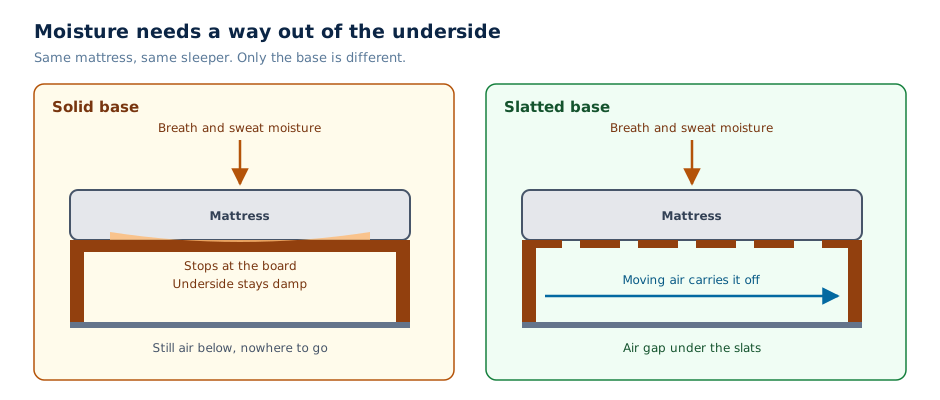
A solid bed base, a divan with a closed top or a mattress laid straight on the floor all share one flaw: the underside is sealed against a surface and the air under it is still. Moisture that works its way down into the mattress gets as far as the board and stops. The underside stays damp while the top feels fine, which is why people find mould there only when they lift the mattress.
The floor adds a second problem. Floors, especially ground floors and those over unheated spaces, are often the coldest surface in the room, so a mattress on one sits against a cold surface all night. I would not put a mattress on a bare floor in a room that already smells damp.
A bed pushed hard against an outside wall has the same issue at the head or side. The mould behind furniture guide covers why that cold, still pocket forms.
How to stop mould on a mattress: five habits
None of these needs a gadget, and each deals with a cause above rather than a symptom.
- Use a slatted base or a raised frame. Slats with gaps between them let air reach the underside. A solid platform does not. If you are stuck with a divan, lift the mattress and stand it on its edge for a few hours now and then.
- Leave a gap at cold walls. My working figure is about 5 cm / 2 inches on an outside wall, more on a visibly cold one. That is my judgement, not a published standard, and it is enough for air to move.
- Air the bed. Pull the covers right back for an hour or two on a dry day, and open the window if the air outside is drier than the air in. Do it more in winter, when rooms are shut up.
- Keep the room’s humidity under 60%. The EPA says to keep indoor humidity below 60 percent, ideally between 30 and 50 percent. A cheap hygrometer at bed height tells you where you are. If it reads high, reducing humidity in a bedroom starts with the biggest source, usually drying washing indoors.
- Keep liquids and wet things off it. Damp towels, wet hair on a pillow edge and spilt drinks all add water in one spot. Blot a spill, then let the area dry in moving air.

A word on mattress protectors. A fully waterproof one stops spills but can also seal the top of the mattress, so check that it is breathable. I am not recommending a brand, because the airflow underneath matters far more than the cover.
When a mattress already has mould spots
If you clean mould, do it outdoors or with the window open, and wear gloves and a mask. Do not mix cleaning products. Fix the water source first, or the cleaning is wasted.
The EPA says absorbent or porous materials, such as ceiling tiles and carpet, may have to be thrown away if they become mouldy, because mould can settle into the gaps and be hard to remove fully. A mattress is a thick, porous, padded object, so the same logic applies, though the EPA page does not mention mattresses by name. That is my reading, not theirs.
In practice:
- A few small surface spots, caught early on the cover: brush or vacuum them off outdoors, wipe lightly with a barely damp cloth, and dry the mattress properly in moving air before it goes back on a bed.
- Spots that have gone into the mattress, a musty smell that returns, or growth across a large area: the mattress is usually discarded. Scrubbing a mattress wet makes the inside damper, which is the opposite of what you want.
- The slatted base or bed frame: wood and metal can be cleaned and dried. Replace the base only if it is soft or heavily stained.
Whatever you decide, find out why it got wet before the replacement arrives. How long mould takes to appear varies; this guide on how long mould takes to grow explains the range.
Mould on a mattress mostly means the bed had nowhere to dry
The pattern is the same in nearly every case: a damp room, a cold wall or floor, and an underside that never got any air. Lift the mattress, fit slats or a gap, pull the bed off the wall and watch the humidity, and the mattress usually stays clean. Do that before you buy a new one, because a new mattress on the same base in the same room will do the same thing. If the room is mouldy as well, mould in a bedroom covers the wider fix.
FAQ
Can a mattress get mouldy from sleeping on it?
Yes, over time. Breath and sweat add moisture every night, and if the bed has no airflow underneath or sits against a cold wall, that moisture does not leave. It tends to show first on the underside or the wall-facing edge.
Should I put my mattress on the floor?
I would not in a damp or cold room. The floor is often the coldest surface and gives the underside no airflow. If you do, lift the mattress regularly and stand it on its edge to dry.
How often should I air a mattress?
There is no official interval. A couple of hours with the covers back on a dry day, weekly or so in winter, is my habit. Do it more often if the room reads above 60% humidity.
Can you save a mouldy mattress?
Light surface spots caught early sometimes can be cleaned and dried. A mattress with growth inside, a lingering musty smell or large patches is usually discarded, because mould can settle into porous material.
What humidity stops mould on a mattress?
The EPA advises keeping indoor humidity below 60 percent, ideally 30 to 50 percent. A cheap hygrometer at bed height will show you where the room sits.

