
Last Updated on October 24, 2026 by Umar Farooq
A dehumidifier for car use works on a small job: a reusable silica bag or calcium chloride tub will take the edge off morning mist and a musty cabin, but none of them will dry a wet carpet or fix a leak. They hold a limited amount of water, and a wet footwell holds far more than that.
I’ll be straight about the odds. If your car is damp from breath and wet coats, a bag is a sensible, cheap tool. If water is getting in, a bag is a nice way to feel like you’ve done something.
What a dehumidifier for car use can and can’t do, type by type
There are really three types sold for cars, plus a fourth that people try. Capacities vary by brand and I’m not going to quote a number I can’t trace to a manufacturer’s own label, so the table sticks to what the mechanism allows.
| Type | How it works | What it’s good for | Its limit |
|---|---|---|---|
| Reusable silica gel bag | Beads adsorb moisture from the air, then you dry them out to reuse them | Light, regular condensation, a stored car, the glovebox and boot | Holds a fixed amount, then stops until recharged. Does nothing for liquid water |
| Calcium chloride tub or bag | Crystals pull moisture in and turn to liquid brine, up to about three times their own weight in water according to one supplier | A car left standing for weeks, a boot with a damp smell | The brine is a liquid in a vehicle. Tip it and it stains, and I’d keep it away from bare metal |
| 12V plug-in unit | A small electric element runs off the socket | Gentle air drying while you are driving or the engine is on | Small, and left on with the engine off it can flatten the battery. Treat claimed capacities with suspicion |
| Mains dehumidifier (the household kind) | A normal compressor unit, run next to the car | Drying a genuinely soaked car, in a garage, with the doors open | Needs mains power safely, and a space to put it |
The honest summary is that desiccants are maintenance, not rescue. The reusable bag is the one I’d buy first. It never produces liquid, and you can see when it is full because the indicator beads change colour on most designs.
Recharge a silica bag only the way the pack says. Some are made for the microwave, with a stated time, and some are not. One UK retailer describes a roughly six-minute microwave recharge for its bag, but that applies to that product only. If the pack does not say microwave, do not guess.
A mains unit is the right tool for a really wet car. Do not run a mains lead through a door gap and leave it unattended: put the car in a garage, keep the cable route dry, and use an RCD-protected socket. For how small units behave in general, see do mini dehumidifiers work.
Why the inside of a car gets damp
The damp comes in two ways, and each wants a different fix.
Your own breath and wet things. A cabin is a very small box. People breathing, a wet umbrella, a coat that has been in the rain and a pair of damp trainers all add water that has nowhere to go. In winter the glass is the coldest surface, so warm, humid cabin air meets cold glass and fogs it, which is the same mechanism as condensation on a house window.
Water coming in. Blocked drains, a failed seal or a leaking heater core put liquid water into the carpet. That water evaporates slowly into the cabin air, and wet foam underlay keeps releasing it long after the leak stops. No bag keeps up with that.

Find the leak before you buy anything to absorb it
This is the part the “best car dehumidifier” pages skip. Press kitchen paper into the wet patch and see what comes out.
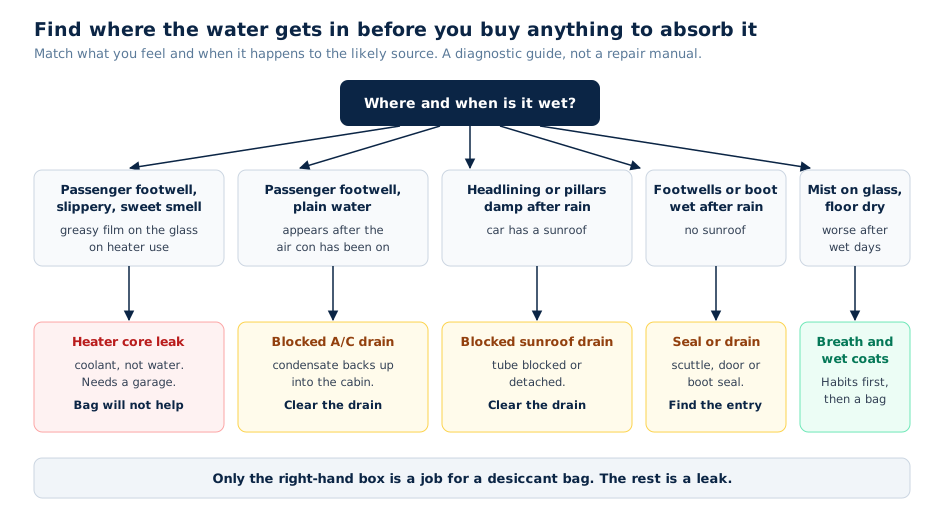
- Slippery, sweet-smelling, greasy film on the windscreen when the heater runs. That points to coolant from the heater core. Several workshop guides say the repair is usually a replacement and often means removing the dashboard, so this is a garage job, not a DIY one.
- Plain water on the passenger side after the air conditioning has been on. The usual suspect is a blocked air conditioning condensate drain, which lets the water back up into the cabin.
- Damp headlining or pillars after rain, in a car with a sunroof. The sunroof has its own drain tubes, and a sealed-looking roof still leaks if they block or come adrift behind the trim.
- Wet footwells or boot after rain, no sunroof. Look at the scuttle drains under the windscreen, the door drain holes at the bottom edge of the doors, and the door and boot seals.
These are shop-blog diagnostics, not a standard, so use them to narrow it down and ask a garage if unsure. Clearing a drain is often cheap, but go gently: a stiff wire can puncture the tube.
Drying a wet car carpet properly
If the carpet is wet, the bag is for after, not for now. You cannot dry carpet from the top down.
- Take out the mats and dry them separately, outside or in a warm room.
- Soak up standing water with towels, pressing down with your weight.
- If it is truly soaked, lift the carpet and let air move underneath it. A fan helps.
- Keep the doors open on a dry day, or use a mains dehumidifier in a garage.
- Only then fit a bag to hold the line.
On the mould question, I would not try to time it. Visible growth in studies takes days to weeks, not hours, which is covered in how long it takes mould to grow. The practical point is simply that wet carpet you leave wet is the risk, so get it dry and fix the water first.
Stop the everyday mist without any gadget
Most mornings of fog are not leaks at all, and the free fixes beat a bag.
- Turn recirculation off, so the system draws in outside air rather than reusing the humid air inside, as AAA’s guidance puts it.
- Aim the airflow at the glass and run the air conditioning, which also dries the air.
- Clean the inside of the glass. Dirt gives water something to cling to.
- Do not leave a wet coat or umbrella in the cabin overnight. Shake it and hang it in the house, as you would dry clothes indoors rather than in a small sealed space.
A bag holds the line, it doesn’t win the fight
My opinion, which I’ll stand behind: buy a reusable silica dehumidifier for car use only after you have proved the cabin has no leak. Put one under a seat, recharge it as the pack says, and expect it to cope with breath and damp coats. If the car still fogs or has a wet floor within a week of fitting one, water is getting in, and the answer is the drain, the seal or the garage.
FAQ
Do car dehumidifiers actually work?
Yes, for light moisture. A desiccant bag removes a limited amount of humidity from a small cabin and then needs recharging or replacing. It does not dry wet carpet or stop a leak.
Is silica gel or calcium chloride better for a car?
Silica gel is the safer choice for a cabin because it never turns to liquid and can be reused. Calcium chloride takes up more water, but it ends as brine, so it suits a stored car or boot better than a seat footwell.
Can I use a normal household dehumidifier in a car?
You can dry a soaked car with one, in a garage with the doors open, and with the mains cable and socket set up safely. Do not leave a lead trailing through a door gap in the rain, and see natural dehumidifier options for the non-electric alternatives.
Why is my car damp inside with no leak?
Breath, wet clothes and a cold morning are usually enough. The moisture condenses on the cold glass, and recirculation keeps the humid air inside the car.

