
Last Updated on October 23, 2026 by Umar Farooq
Do mini dehumidifiers work? Yes, but only in small, closed spaces: a typical Peltier mini is rated at about 250 ml (9 oz) of water a day, which is roughly one eightieth of what a full-size compressor machine pulls out at the same test point. That is enough for a wardrobe and nowhere near enough for a damp bedroom.
The adverts show a mini unit next to a dripping window and imply it will sort the lot. It will not, and the maths is short enough to do on the back of the box it came in.
Peltier plate or small compressor: what is inside the box
Most things sold as a “mini dehumidifier” use a Peltier module, a thermoelectric plate that gets cold on one face when a current passes through it. A fan pulls room air across the cold face, water condenses on it and drips into a tank. There is no compressor and no refrigerant. The maker of the PB-02 says so itself: its manual calls it “Peltier Technology (no compressor)”, “lightweight and quiet”.
The other kind is a small compressor dehumidifier, the same compressor-and-cold-coil mechanism as the big ones, with a smaller coil and a smaller price tag. A third kind, the silica-gel tub or cassette, has no moving parts at all and is its own topic (see disposable dehumidifiers).
The word “mini” tells you the size of the box. It tells you nothing about the mechanism, and the mechanism is what sets the output. I could not find a published, rated water figure for the smallest compressor units to quote, so the numbers below stick to the Peltier mini I could verify and the full-size machine I used for scale.
How much water is 250 ml a day, really?
Here is the only manufacturer rating I could open for a mini. The Pro Breeze PB-02 manual gives “approx 250ml (9oz) per day at 30°C (86°F), 80%” relative humidity, in a tank that holds 500 ml. For scale, Meaco’s own page for its 20L Low Energy compressor model lists 20.38 litres a day at the very same 30°C and 80% point, and 8.48 litres at 20°C (68°F) and 60%.
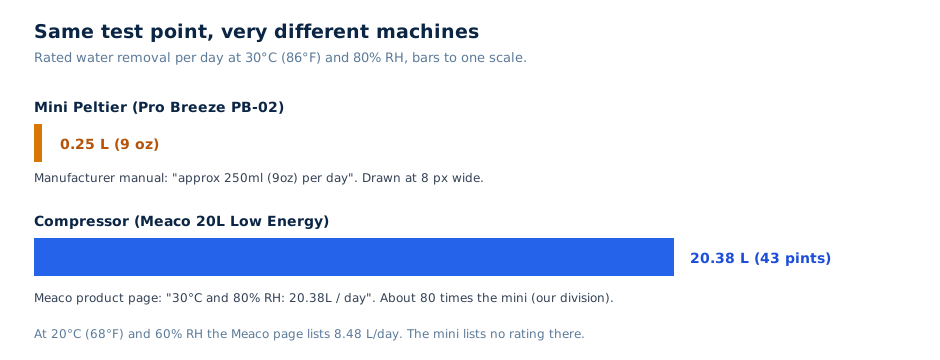
Dividing one by the other (my arithmetic, not a published ratio) gives about 80 times. And that comparison flatters the mini, because 30°C and 80% RH is a tropical day. The mini’s manual gives no figure for a cool room. The compressor page does.
For a sense of what a room needs, ENERGY STAR’s sizing table suggests 20-30 pints a day for a “slightly to moderately damp” space under 2,000 sq ft (about 186 m²). Converting, that is roughly 9.5-14 litres. A mini’s 0.25 litres is then about 2-3% of that (again, my arithmetic, and ENERGY STAR rates capacity on its own test conditions, so read it as scale, not a like-for-like comparison).
My one firm opinion: judge a mini on litres a day, never on tank size. A 500 ml tank holding 250 ml a day just means you empty it every other day. A “1,500 ml tank” on a unit that removes the same 250 ml simply means you empty it less often and it fills just as slowly.
Do mini dehumidifiers work in a wardrobe, caravan or bathroom?
They work where the air volume is small, the space is closed, and the moisture source is slow. The PB-02 manual lists its own sweet spot: “small rooms and poorly ventilated areas such as wardrobes, cabinets and storage rooms”. That is about right. Here is how I would sort the spaces.
| Space | Does a mini work? | Why |
|---|---|---|
| Wardrobe or cupboard | Yes, if it is warm and has a socket | Small closed volume; slow moisture source |
| Safe, tool chest, camera cabinet | Yes | Tiny volume; a mini is the right order of magnitude |
| Caravan or boat, used regularly | Yes, in a small space on mains | Small and mostly closed; the hook-up gives you power |
| Caravan or shed left cold all winter | Poorly | Cold air is the problem; see the temperature note below |
| Bathroom | No | Moisture arrives in minutes; a mini collects it over a day |
| Bedroom with window condensation | No | Breathing and washing add moisture every night; see the scale above |
| Laundry drying, basement, garage | No | Far beyond a fraction of a litre a day |

The bathroom row is reasoning, not data. I have not found a sourced figure for how much water a shower puts into the air, so I will not invent one. But a shower releases its moisture in a few minutes and a mini removes a fraction of a litre in a whole day, so the two simply do not meet. A bathroom needs ventilation first.
If the wardrobe is the real target, the closet guide goes through the four options in more detail.
The temperature catch nobody prints on the box
The PB-02 manual quotes its rating at 30°C. It publishes nothing for a cool room, and that silence is informative. Peltier plates move heat less efficiently as the room cools, and several buying guides put the working floor at about 15°C (59°F). I could not confirm that figure in a manual I was able to open, so treat it as a rule of thumb rather than a specification. The practical point stands either way: the wardrobes and sheds that most need drying are often the coldest, and that is where a mini disappoints.
Running cost: cheap per day, dear per litre
The PB-02’s power input is “DC9V 2.5A”, which multiplies out to 22.5 W at the adaptor’s rating (my arithmetic; the actual draw may be lower). Running flat out for 24 hours, that is 22.5 × 24 ÷ 1000 = 0.54 kWh. Multiply by your own tariff and you will find it is a few pence a day at most.
The honest metric is litres per kWh, the same one the running cost guide uses. At the rated point:
- Mini: 0.25 L ÷ 0.54 kWh is about 0.46 L/kWh.
- Meaco 20L: its page lists “just 219 watts rated power”. 219 W for 24 hours is 5.26 kWh, so 20.38 L ÷ 5.26 kWh is about 3.9 L/kWh.
Both figures are my arithmetic from rated numbers, and a real machine cycles on and off. Even so, the gap is about eightfold. A mini is cheap to leave on because it does so little with the electricity. If your problem needs several litres a day removed, the small unit is not the economical option; the big one is.
A two-minute check that a mini is helping
Water in the tank is weak evidence, because a mini in a damp room will always collect some. The better check is the humidity reading. Put a cheap hygrometer in the space, note the reading, shut the door, run the unit for 24 hours and read again. The EPA advises keeping indoor relative humidity below 60%, ideally 30-50% when possible. If the number has not moved towards that band, the mini is too small for the job or the space is leaking moisture in faster than it removes it. How humidity is measured explains why a cheap hygrometer is good enough here.
I have not run my own timed trials on a mini, so I will not tell you how many hours they take to work. The hygrometer will.
When to stop and buy something bigger
If you need to pick between a mini and a full-size machine, the dividing line is the size of the moisture source, not the size of the room. Visible mould on a wall, windows streaming every morning, a laundry room or a basement all call for a proper compressor unit; the sizing guide works out the litres you need. For a sealed box with a slow problem and no socket, a silica-gel tub is usually the more honest answer than a mini with a cable.
Mini dehumidifiers work on boxes, not on rooms
So do mini dehumidifiers work? For a wardrobe, a cabinet or a small caravan on mains, yes, and quietly. For anything you would describe as a damp room, no: the numbers above are not close. Buy the mini for the box, buy a real machine for the room, and keep the receipt in case you guess wrong. It happens to the best of us.
FAQ
Do mini dehumidifiers work in a bedroom?
Only a little. The mini I could verify is rated at about 250 ml a day at 30°C and 80% humidity, and a bedroom with condensation needs far more removed than that. A mini will take the edge off a small, closed, mildly damp room, but it will not stop streaming windows.
Are Peltier dehumidifiers any good in a cold room?
Poorly. The manual I opened gives its capacity only at 30°C, and buying guides typically put the practical floor near 15°C (59°F). In a cold wardrobe or an unheated caravan, expect even less than the rated figure.
Do mini dehumidifiers use a lot of electricity?
No. A Peltier mini rated at DC 9V 2.5A draws at most about 22.5 W, or 0.54 kWh over a full day (my arithmetic). The catch is that it removes very little water per kWh, so low consumption is not the same as good value.
How long does a mini dehumidifier take to work?
No manufacturer I could find publishes a time. Measure it: note the humidity reading, run the mini for 24 hours with the door shut, and compare. If the number has not dropped towards 50%, the unit is too small for the space.
Is a mini dehumidifier worth buying?
Worth it for a closed box with a socket nearby, such as a wardrobe, cabinet or small caravan. Not worth it as a cheaper version of a room dehumidifier, because the water it removes is a small fraction of what a room needs.

