
Last Updated on September 1, 2026 by Umar Farooq
A natural dehumidifier works, and it works well — in a wardrobe, a gun cabinet, a caravan over winter, or a toolbox. In a damp room, a basement or a garage, it will not make a measurable difference no matter how many tubs you put down, and you do not need to take my word for it. The maths is available to anyone with a set of kitchen scales.
There is also one method recommended all over the internet that does the exact opposite of what is claimed. That one is worth knowing about before you act on it.

The number nobody puts in these articles
You can settle the whole question with one observation, and it requires no testing.
A salt absorber cannot hold more water than the pot it sits in.
Every gram of water one of these things removes from the air ends up as liquid in the collection reservoir underneath. So whatever the packaging claims, the whole-life capacity of a tub is capped by the size of that tub — typically a few hundred millilitres, gathered over the month or more the manufacturer quotes.
Now put that next to a modest domestic dehumidifier: 12 litres a day, every day, indefinitely.
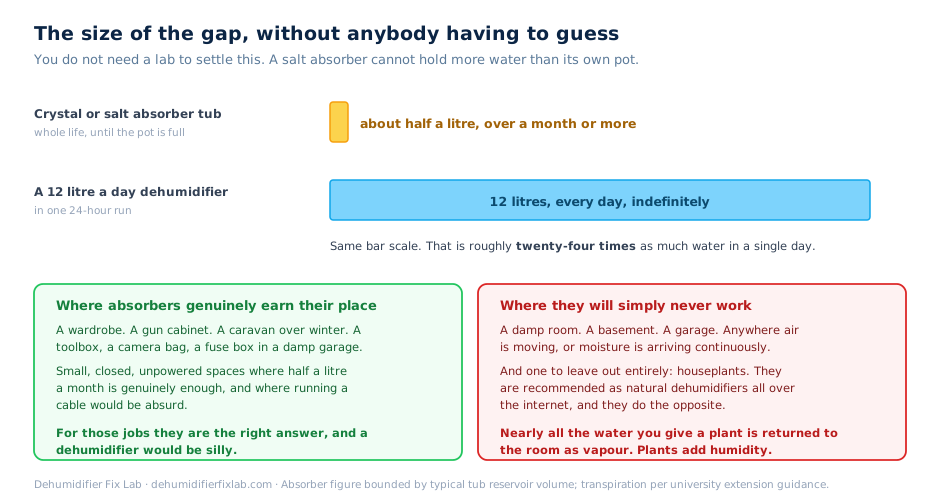
That is roughly twenty-four times as much water in a single day as the tub manages in its entire life. It is not a close comparison and no amount of careful placement closes it.
This is not an argument against absorbers. It is an argument about scale, and it tells you precisely which jobs they are right for.
The seven methods, honestly rated
1. Calcium chloride — the strongest of them. This is what commercial moisture-absorber tubs contain. It is genuinely deliquescent: it pulls water out of the air until it dissolves into a brine that drips into the reservoir. The most effective option on this list, and the only one I would rely on for anything I cared about. It is consumable — once the pot is full, it is done.
2. Rock salt. The classic two-bucket arrangement: drill holes in one bucket, fill with coarse rock salt, sit it inside a second bucket to catch the drips. Cheap, effective at its scale, and satisfying to watch. Slower than calcium chloride, and it needs a proper airflow around it.
3. Silica gel. Those little packets that come with electronics, available in bulk. Excellent for very small enclosed volumes — a camera bag, a document box, a safe. It can be dried out in a low oven and reused, which nothing else here can. Useless for anything room-sized.
4. Activated charcoal. Modest moisture absorption, genuinely good at odour. Worth using in a wardrobe where the smell is as much of a problem as the damp. Do not expect it to shift a hygrometer reading.
5. Baking soda. Works, weakly. It is at the bottom of the useful list, and there are far cheaper ways to buy sodium bicarbonate than as a dehumidifier. Fine in a cupboard, hopeless anywhere larger.
6. Non-dairy coffee creamer. This does appear on several published lists. It does absorb moisture. It is also more expensive than rock salt, attracts insects, and smells. I would not.
7. Ventilation — the one that genuinely scales. Not a product, and easily the most effective thing on this page. Opening a window when the outside air is drier than the inside air moves more moisture out of a house in twenty minutes than every tub in this list will manage in a month. It is free. The only trap is doing it when the outside air is wetter, which makes things worse.
The costly myth: houseplants
Here is the one worth stating plainly, because it appears on some very well-ranked pages and it is backwards.
Houseplants do not dehumidify a room. They humidify it.
A plant takes water up through its roots and releases the overwhelming majority of it back into the air as vapour through its leaves. That process is called transpiration, and it is how the water you pour into a pot ends up in your room’s air. Growers use groups of plants deliberately to raise humidity around them.
There is a partial excuse for the confusion. A few plants — bromeliads and some ferns — do take up moisture through their foliage. But they are also being watered, and the net effect in a normal room is still upward. If you have a damp room and someone tells you to buy more plants, you are being given advice that will make the reading worse, and you can verify that against any university horticulture extension you like.
Where a natural dehumidifier is genuinely the right answer
I am not dismissing these. For the right job they are better than an electric machine, and it would be silly to run a cable for any of the following:
- A wardrobe or a chest of drawers. Small, closed, no power, and a tub lasts months.
- A gun cabinet, a tool chest, or a camera bag. Silica gel, and nothing else needed.
- A caravan, boat or motorhome over winter. Unpowered, sealed, and the classic use case. Two or three tubs.
- A garage fuse box or an electrical enclosure. Small silica packs.
- A car left standing. A tub on the floor genuinely reduces morning misting.
The common thread: small, enclosed, unpowered, and slow. Half a litre a month is enough because nothing is generating moisture and nothing is bringing damp air back in.
Where they will never work
Equally plainly:
- A damp room, a basement or a garage. Too much air, too much moisture arriving, far too little capacity.
- Anywhere with air movement. An absorber only treats the air immediately around it. A draught replaces that air continuously and the tub cannot keep up.
- Anywhere with an active water source. A leak, rising damp or a failed seal will out-supply anything on this page, and would out-supply an electric machine too.
- As a way of drying washing. Not remotely. That job needs an actual dehumidifier.
If your room needs more than these can give, the honest next step is working out what size machine the space actually calls for rather than buying more tubs.
Free things that beat every tub on this list
Before spending anything at all, these cost nothing and work at room scale:
- Ventilate when the outside air is drier. Ten minutes of cross-ventilation, twice a day.
- Use the extractor fan during and for twenty minutes after every shower, and while cooking.
- Put lids on pans. An uncovered pot puts a startling amount of water into a kitchen.
- Vent the tumble dryer outside, or check the condenser tank is actually being emptied.
- Pull furniture 5 cm off outside walls so air can move behind it. This one prevents more mould than any appliance.
- Dry washing outdoors whenever the weather allows.
There is more on all of this in how to dehumidify a room, including the point at which the free options run out.
Frequently asked questions
Does a natural dehumidifier actually work?
Yes, at a small scale. Calcium chloride, rock salt and silica gel all genuinely absorb water from the air. The limit is capacity — a tub collects a few hundred millilitres over a month, where an electric machine removes ten to twenty litres a day.
What is the best natural dehumidifier?
Calcium chloride, which is what commercial absorber tubs use. It is the most aggressively hygroscopic of the practical options. Rock salt is the cheapest way to do the same thing yourself.
Does rock salt work as a dehumidifier?
It does. Coarse rock salt in a perforated bucket, sitting inside a second bucket to catch the brine, will visibly collect water in a closed space. It works slowly and it works locally, so keep it to cupboards, caravans and small stores.
Do houseplants reduce humidity?
No — they increase it. Nearly all the water a plant takes up is released back into the room as vapour through its leaves. Recommending them as natural dehumidifiers is one of the more persistent errors in this subject.
Can baking soda dehumidify a room?
Not a room. It will take a little moisture out of a cupboard or a small enclosed box, but its capacity is far too low to affect a room’s humidity reading in any measurable way.
Is DampRid better than a dehumidifier?
They are not competing for the same job. A calcium chloride tub is better for a wardrobe or an unpowered caravan; an electric dehumidifier is the only realistic option for a room. The gap in capacity is more than twentyfold per day.
How long does a moisture absorber tub last?
Typically a month or more in a small closed space, and until the reservoir is full. Once the crystals have dissolved and the pot has filled, the tub is spent and needs replacing.
Related guides: How to dehumidify a room · What size dehumidifier do I need? · Does a dehumidifier help with mould? · Dehumidifier for drying clothes
Sources
- Nebraska Extension — Success with houseplants and humidity — transpiration, and why houseplants raise indoor humidity rather than lowering it.
- EPA — A Brief Guide to Mold, Moisture and Your Home — ventilation and source control as the first line against indoor damp.
- ENERGY STAR — Dehumidifiers — the capacity figures an electric machine is rated at, and the 30–50% target band.
Where this guide and your appliance’s own manual disagree, follow the manual. And if you already have a cupboard full of tubs fighting a damp basement — keep them for the wardrobe. They were never going to win that particular argument.

