
Last Updated on September 7, 2026 by Umar Farooq
A humidifier dehumidifier combo makes sense in exactly one situation: a home whose humidity genuinely swings across the year, where there is nowhere to store the machine that is out of season. Everywhere else, two separate appliances used six months apart do both jobs better, for less money, with less to go wrong.
That is a narrower recommendation than most guides give, and it comes down to a question nobody asks first: does your house actually swing? A week with a hygrometer answers it, and for a lot of homes the answer is no — which makes the combo a solution to a problem they do not have.
Measure before you shop for a humidifier dehumidifier combo
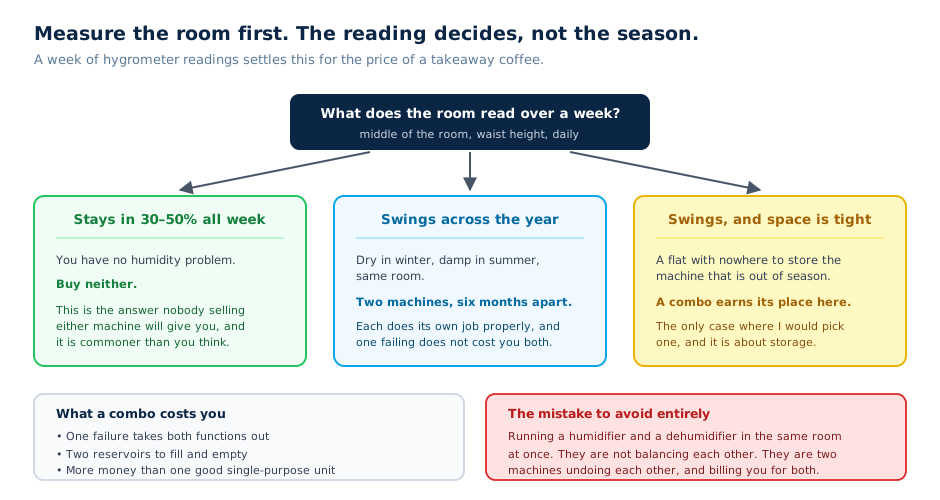
Put a hygrometer in the room for a week — middle of the room, waist height, read it daily. Then:
Stays inside 30–50% all week. You have no humidity problem, and the honest answer is to buy neither machine. This is commoner than the market would like, and it is the answer no retailer leads with. The 30–50% band is what ENERGY STAR and the EPA recommend for indoor air generally.
Sits above 60% and stays there. You need a dehumidifier, not a combo. Buying a machine that can also humidify is paying for a function you will never switch on.
Swings — dry in winter, damp in summer. Now the question is real, and the rest of this article is for you.
Reason 1: one failure takes out both functions
This is the plainest argument and it applies to every two-in-one appliance ever made.
A combo is a humidifier and a dehumidifier sharing a case, a control board and a power supply. When the board goes, or the fan goes, you lose both jobs at once — and you are holding a machine that is half useful and entirely unusable. With two separate units, a failure in January costs you the humidifier and leaves the dehumidifier sitting in the cupboard, ready for July.
Given that domestic portables run five to ten years, that is not a theoretical risk. It is a scheduled one.
Reason 2: they are mechanically opposite, and that costs something
A dehumidifier condenses water onto a cold coil and warms the air slightly on the way out. A humidifier evaporates or atomises water and cools the air slightly. Same box, opposite jobs, and the engineering to do both well is genuinely harder than doing either well.
The practical consequences show up in the specification rather than the marketing: combos tend to be larger, heavier and more expensive than a good single-purpose unit of the same capacity, because they are carrying two sets of hardware. If you compare a combo against one decent dehumidifier, you are usually comparing on price rather than on performance.
Reason 3: two reservoirs, both of which need attention
A combo has a tank you fill for the humidifier and a tank you empty for the dehumidifier. That is two things to remember rather than one, and they fail in opposite ways.
The dehumidifier side is fine — worst case it stops when the tank is full, and you can run a drain hose so it never does.
The humidifier side is the one worth caring about. A humidifier reservoir left standing grows biofilm, and unlike a dehumidifier tank — which collects water and sends it away — a humidifier’s job is to atomise that water back into the room you are breathing in. It needs cleaning far more diligently than most people give it, and burying it inside an appliance you think of as “the dehumidifier” is not a recipe for remembering.
Reason 4: you will not use both in the same room anyway
Here is the thing the two-in-one framing quietly obscures.
Humidity is not uniform across a house. A well-heated Victorian house in January might sit at 35% in the living room and 65% in the coldest back bedroom, on the same day. The room that needs humidifying and the room that needs drying are usually different rooms — which is exactly what a single combo cannot solve, however clever its automatic switching is.
And running a humidifier and a dehumidifier in the same room at once is not a balancing act. It is two machines undoing each other and billing you for both. The full comparison of the two appliances goes into why.
The one case where a combo genuinely wins
I said there was one, and I meant it.
A flat or a small home where your readings genuinely swing, and there is nowhere to store the out-of-season machine. If the choice is between one appliance in the corner and two appliances of which one lives in the hall for six months, the combo is the right call. That is a storage decision rather than a performance one, and it is a perfectly good reason.
A secondary case: a room you cannot easily get to — a holiday let, a second property, somewhere you visit monthly. One machine set to hold a band, switching itself between modes, beats swapping appliances twice a year on a drive you would rather not make.
If that is you, the specification to look at is the same one that matters on any dehumidifier: capacity for the space, a proper humidistat rather than a timer, and continuous drainage. Sizing for the room does not change because the machine has a second function.
What to set it to
The same numbers as anything else: 50% as the working target, and the machine switching modes around it. Not a narrow band — a combo hunting between 45% and 47% will run one mode against the other and wear both out.
Give it as wide a deadband as the controls allow. And if the controls do not let you set a deadband at all, that is a genuine mark against a particular model, because a combo without one is the appliance equivalent of steering with both feet.
Frequently asked questions
Is a humidifier dehumidifier combo worth it?
Only if your readings genuinely swing across the year and you have nowhere to store an out-of-season machine. Otherwise two separate units do both jobs better, cost less, and a failure in one does not take out the other.
Can one machine both humidify and dehumidify?
Yes, combo units exist and work. The compromise is engineering: carrying two sets of hardware makes them larger, pricier and more complex than a good single-purpose machine of the same capacity.
Do I need a humidifier and a dehumidifier?
Measure for a week first. Most homes need one or the other, or neither. If your readings sit inside 30–50% you have no humidity problem to solve at all.
Can I run a humidifier and dehumidifier at the same time?
There is no reason to, and it wastes money — they are actively undoing each other. In different rooms of the same house it can genuinely make sense, because humidity is not uniform.
What should I set a combo unit to?
Fifty per cent, with as wide a deadband as the controls allow. A narrow band makes the machine hunt between modes, which wears out both sides of it for no benefit.
Are combo units harder to maintain?
Slightly, and in one specific way: the humidifier reservoir atomises its water back into the room, so it needs cleaning far more diligently than a dehumidifier tank that simply collects and drains.
Is a combo cheaper than buying two machines?
Usually not for the quality you get. A combo at a given price is carrying two sets of hardware, so each side is generally weaker than a single-purpose unit at the same money.
Related guides: Difference between humidifier and dehumidifier · Dehumidifier settings · What size dehumidifier do I need? · Dehumidifier benefits
Sources
- ENERGY STAR — Dehumidifiers — the 30–50% recommended indoor band and capacity guidance.
- EPA — A Brief Guide to Mold, Moisture and Your Home — why humidity control rather than appliance count is what actually matters.
- EPA — Mold Course, Chapter 2 — the 60% threshold that decides whether you need the dehumidifying half at all.
Where this guide and your appliance’s own manual disagree, follow the manual. And if you are buying a combo because you are not sure which way your house goes — that is the one reason not to. Spend a fiver on a hygrometer, wait a week, and buy the machine you actually need.

