
Last Updated on September 7, 2026 by Umar Farooq
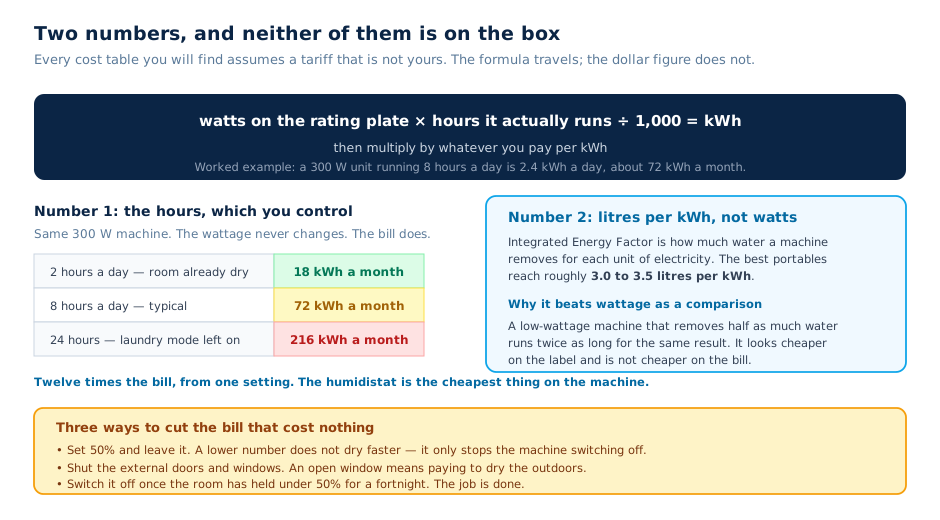
Dehumidifier running cost is one sum: watts on the rating plate, times hours it actually runs, divided by 1,000. That is your kWh. Multiply by whatever you pay. A 300 W unit running eight hours a day is 2.4 kWh a day, about 72 kWh a month.
I am not going to print a table of dollar figures, and I would be sceptical of anyone who does. Every one I found assumes a fixed rate — 13 cents, 15 cents, 17 cents — and electricity prices differ by country, by supplier and by year. The formula travels. A currency figure does not.
What follows is the two numbers that actually decide your dehumidifier running cost, and which of them is worth doing anything about.
Dehumidifier running cost: the sum, and where to find each part
Watts — on the rating plate, usually a sticker on the back or underneath. Domestic portables typically draw somewhere between 150 W and 900 W depending on capacity and type. Do not use the figure from the box; use the plate.
Hours it actually runs — not hours it is switched on. A machine on a humidistat is running only when the room is above your setting, which in a room already under control might be two or three hours out of twelve. If you want the real number, most units have a runtime counter, or a cheap plug-in energy monitor will tell you exactly.
Divide by 1,000 to get kWh, then apply your own tariff.
That is the whole calculation, and the honest version of it.
Number 1: the hours, which you control completely
Here is the thing that surprises people. Take one 300 W machine — the wattage never changes — and vary only how long it runs:
| How it runs | Monthly |
|---|---|
| 2 hours a day, room already dry | 18 kWh |
| 8 hours a day, typical | 72 kWh |
| 24 hours, laundry mode left on | 216 kWh |
Twelve times the bill, from one setting. The humidistat is the cheapest component on the machine and it has more effect on your electricity than the model you bought.
Which leads to the single most useful piece of advice in this article: set it to 50% and leave it alone. The setpoint decides when the machine stops, not how hard it works — so 35% does not dry the room any faster, it only guarantees the unit never switches off. The settings guide covers where the exceptions are, and there are only a few.
The other half of that: laundry or continuous mode switches the humidistat out of the circuit entirely. It runs flat out until you stop it. That is exactly right for drying a load of washing and exactly wrong as a permanent setting, and it is how people end up with a bill they cannot explain.
Number 2: litres per kWh, not watts
The comparison people make in the shop is wattage. It is the wrong one.
Since 2019, efficiency is reported as Integrated Energy Factor — litres of water removed per kilowatt-hour. The best portable units reach roughly 3.0 to 3.5 L/kWh.
Why that beats wattage: a low-wattage machine that removes half as much water per hour has to run twice as long for the same result. It looks cheaper on the label and costs the same or more on the bill. You are not buying watts, you are buying litres removed — so the number that matters is how many of them each unit of electricity gets you.
This is also why the pint rating on the box is a poor guide to cost. And a related trap worth knowing if you are buying second-hand: the DOE changed the capacity test conditions in 2019, so a pre-2019 “70-pint” machine is roughly a modern 50-pint. The full explanation.
What actually drives the hours
If the hours are what cost you money, these are what set the hours:
How damp the room is. A room at 75% has far more work ahead of it than one at 58%. That first fortnight is not representative of anything — the air dries in hours, the building takes weeks.
Whether external doors and windows are shut. An open window means paying to dehumidify the outdoors, which is a job with no end.
Room temperature. Below about 18°C / 65°F a compressor unit’s output falls sharply, so it runs longer for less water. Below 5°C / 41°F frost forms faster than it can clear it and it is drawing power to achieve almost nothing. That is the most expensive way to run one.
Whether the tank stops it. A full tank halts the machine, so a unit on tank-only in a damp room does less work than you think — and then has to catch up. A drain hose is a cost improvement as well as a convenience.
Whether the filter is clean. A blocked filter starves the coil, which ices, which sends the machine into defrost. It draws the same power and collects nothing while it does. Five minutes a month.
Desiccant versus compressor, on cost
Worth being precise, because the usual framing is misleading.
A desiccant unit draws more watts — roughly 250–550 W against 150–260 W for a comparable compressor machine — so in a warm room it is the more expensive option per litre removed, and it is not close.
In a cold room the comparison inverts, because a compressor unit’s output collapses and it spends its time defrosting. It draws less power and gets almost no water for it. Cost per litre, not watts, is the only fair comparison, and in an unheated garage in February the desiccant wins outright by being the only one still collecting anything. The full comparison.
The context most articles leave out
Two figures worth having in your head.
A dehumidifier running heavily can account for roughly 9% of a home’s electricity use, at around 1,000 kWh a year. That is a real line on a bill rather than a rounding error.
And the gap between an average machine and a best-in-class one is worth roughly $30–$60 a year in electricity. Which is a useful sense of scale in both directions: it is enough to justify buying the efficient model, and it is far less than the difference between running yours eight hours a day and leaving it in laundry mode.
The behaviour is worth more than the badge. If you only change one thing, change the setting, not the machine.
Six ways to cut your dehumidifier running cost, in order of effect
- Set 50% and leave it. Biggest single lever, costs nothing.
- Never leave it in laundry or continuous mode. Switch it back afterwards.
- Shut external doors and windows while it runs, and ventilate when the outside air is drier instead.
- Fit a drain hose so a full tank never stops it mid-job.
- Clean the filter every 250 running hours. A starved machine draws full power for reduced output.
- Switch it off once the room has held under 50% for a fortnight. The job is finished; check weekly.
Notice that five of the six are free, and none of them involves buying a different machine.
Frequently asked questions
How much does it cost to run a dehumidifier?
Take the wattage from the rating plate, multiply by the hours it actually runs, divide by 1,000 for kWh, then apply your own tariff. A 300 W unit at eight hours a day is about 72 kWh a month. Any fixed currency figure you see online assumes a rate that probably is not yours.
How many watts does a dehumidifier use?
Domestic portables typically draw 150–900 W depending on capacity and type. Compressor units sit at the lower end, desiccant units noticeably higher. Use the rating plate rather than the box.
Is it cheaper to run a dehumidifier all day or in bursts?
Neither, if it is on a humidistat — it runs only when the room needs it either way. What genuinely costs money is laundry or continuous mode, which ignores the humidistat and runs flat out until you stop it.
Does a lower humidity setting cost more?
Yes, considerably. The setpoint decides when the machine stops, not how hard it works. Setting 35% instead of 50% does not dry the room faster; it just means it almost never switches off.
Are desiccant dehumidifiers expensive to run?
In a warm room, yes — they draw roughly 250–550 W against 150–260 W for a comparable compressor unit. In a cold room the comparison reverses, because a compressor machine collapses to almost no output while still drawing power.
What is a good dehumidifier efficiency rating?
Compare Integrated Energy Factor — litres removed per kWh — rather than wattage. The best portables reach about 3.0–3.5 L/kWh. A low-wattage machine that removes half as much water is not the cheaper one.
Does a dehumidifier use more electricity than an air conditioner?
No, considerably less, because it is doing far less work — it moves heat around inside one room rather than exporting it from the building. Drier air is also cheaper to cool, so the two help each other when used in separate rooms.
Related guides: How long should a dehumidifier run? · Dehumidifier settings · Desiccant vs compressor dehumidifiers · Dehumidifier benefits
Sources
- ENERGY STAR — Dehumidifiers — Integrated Energy Factor, current efficiency standards and the 30–50% target band.
- US Department of Energy — Dehumidifier standards — the federal test procedure behind IEF and the capacity rating.
- GE Appliances — Dehumidifier: Ideal Operating Conditions — the low-temperature limits that make a cold room the most expensive place to run one.
- Energy Vanguard — The confusing world of dehumidifier capacity — the 2019 test-condition change and why pint ratings mislead.
Where this guide and your appliance’s own manual disagree, follow the manual. And if you came here hoping for a number — get a plug-in energy monitor instead. It costs less than a month of running the machine badly, and it is the only figure in this article that will actually be yours.

