
Last Updated on September 7, 2026 by Umar Farooq
A dehumidifier black mold strategy works in one direction only: it stops the mould coming back, and it will not remove the patch you are looking at right now. Drying a colony makes it dormant, not dead — and a dormant colony on a wall is still a colony on a wall. You clean it off with a cloth, then you fix the moisture so it does not return, and the machine is the second half of that sentence.
That distinction sounds pedantic until you notice how much content blurs it, and who writes most of it. Below: the three things a dehumidifier genuinely does about black mould, the one claim that costs people money, and the line the EPA actually draws between a job you do yourself and one you do not.
Truth 1: a dehumidifier black mold fix removes the one thing it needs
Mould needs three things — spores, something organic to eat, and moisture. Spores are already in your house and always will be; the organic material is your plaster, paper and dust. Moisture is the only one of the three you can actually take away, which is why humidity control is the whole game.
Above 60% relative humidity, mould can establish on a suitable surface within 24 to 48 hours. Hold the room in the 30–50% band and you have removed the condition, permanently, without touching a spore.
That is a genuinely powerful thing for a machine to do. It is just not the same thing as cleaning.
Truth 2: the wall is at a different humidity from the room
Here is the mechanism that explains why mould appears in the same three places every time, and why a machine set to 50% sometimes is not enough.
Relative humidity is relative to temperature. Air at 20°C and 50% RH that touches a wall at 12°C gets cooled at that surface, and cooler air holds less. At the wall it is sitting at roughly 84% humidity — deep into mould territory — while your hygrometer in the middle of the room reads a perfectly respectable 50%.
So the pattern is never random. It is the window reveal, the ceiling corner, the outside wall behind the wardrobe: the coldest surfaces with the least air movement. That gives two practical rules:
- Where walls are cold to the touch, set 45% rather than 50%. Same logic as a bare-block basement.
- Pull furniture 5 cm off outside walls. Free, and it fixes more mould than any appliance, because still air against a cold surface is exactly the condition you are trying to break.
Truth 3: it stops it coming back, which is the part that matters
Cleaning mould off a wall takes ten minutes. Cleaning it off the same wall every three months for four years is the actual problem, and that is the one a dehumidifier solves.
This is worth being clear about because it inverts the usual framing. The machine is not the emergency response. It is the thing that means there is no next emergency. Clean the patch, then hold the room under 50%, and you have finished rather than paused.
If the smell is what you are chasing rather than the sight of it, that lags behind — soft furnishings and plaster dry over weeks, not hours, so give it a fortnight before judging. Where a musty smell actually lives.
The costly myth: that “black mold” is a species you must identify
This is the one that sells test kits, inspections and emergency call-outs.
You cannot identify a mould species by looking at it, and neither can the person quoting you. Plenty of harmless moulds are black. Stachybotrys chartarum — the one people mean — is one genus among many, and colour is not a diagnostic.
More usefully, the EPA is direct about whether you should test at all:
“In most cases, if visible mold growth is present, sampling is unnecessary.”
And on what to do about it, the guidance does not branch by species: there are many types of mould, and none of them grows without moisture. The response is the same either way — remove it, and fix the water.
So if someone is selling you a test before they will quote for the work, you are paying for information that will not change what happens next. My honest position: spend that money on a hygrometer and a tube of sealant instead.
What a dehumidifier black mold plan will never do
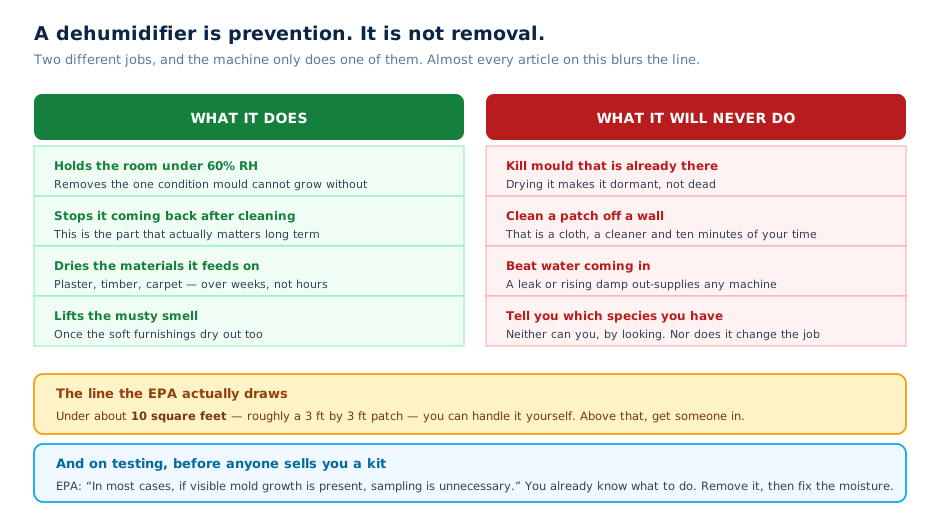
Kill what is already growing. Drying makes a colony dormant. It stops spreading, it stops smelling as much, and it starts again the moment conditions return.
Clean a patch off a wall. That is a cloth, a cleaner and ten minutes.
Beat water that is actively getting in. A leaking gutter, a failed damp-proof course or a cracked render out-supplies any machine. It will run permanently, cost you a fortune, and never win. Find the water first — that boundary is the same one that decides whether a dehumidifier helps with mould at all.
Tell you what species you have. Nor does it need to.
The line the EPA draws
Useful, specific, and almost nobody quotes it:
Under about 10 square feet — roughly a 3 ft by 3 ft patch — you can handle the job yourself. Above that, get someone in.
That is the honest threshold. Below it, you are looking at a bucket, a cloth and an afternoon. Above it, or if the mould is inside a wall cavity, in the HVAC system, or the result of sewage or flood water, it stops being a DIY job.
Do not dry-brush or sand mould. That aerosolises spores into the room you are standing in. Wipe with a damp cloth and detergent, bag the cloth, and ventilate while you work. If anyone in the house has asthma or is immunocompromised, they should not be in the room, and the EPA’s guidance is worth reading in full before you start.
The order to do it in
- Find and fix the water. Gutters, downpipes, ground levels, seals, a failed glazing unit. Nothing else matters until this is done.
- Clean the patch. Damp cloth and detergent, under 10 sq ft. Bag the cloths.
- Warm the cold surface if you can. Insulation, or just moving furniture off the wall.
- Then run the dehumidifier at 50%, or 45% where surfaces are cold.
- Ventilate the moisture at source — extractor during and after showers, lids on pans, tumble dryer vented outside.
- Watch a hygrometer for a fortnight rather than watching the wall.
Doing this in the wrong order is why people buy a machine, run it for a month, and conclude it did not work. It did not work because step one had not happened.
Frequently asked questions
Will a dehumidifier get rid of black mold?
No. It removes the humidity that lets mould grow, which stops it spreading and stops it coming back — but the patch already on your wall has to be physically cleaned off. Drying a colony makes it dormant, not dead.
Does a dehumidifier kill mold spores?
No, and nothing sold for domestic use reliably does. Spores are always present in indoor air. What you control is whether they find enough moisture to settle and grow.
What humidity kills black mold?
None — humidity control prevents rather than kills. Below 60% mould cannot establish, and 30–50% is the recommended band. Getting there stops growth; it does not remove what is there.
How can I tell if it is really black mold?
You cannot, by looking, and neither can anyone quoting you for removal. Many harmless moulds are black. The EPA says sampling is usually unnecessary when growth is visible, because the response is the same regardless of species.
How much mould can I clean myself?
The EPA’s line is about 10 square feet — roughly a 3 ft by 3 ft patch. Above that, or if it is inside a wall cavity, in ductwork, or from flood or sewage water, get a professional.
Why does mould keep coming back after I clean it?
Because the moisture is still there. Either the surface is cold enough to condense water out of the room air, or water is actively getting in. Cleaning without fixing one of those is a maintenance schedule rather than a repair.
What should I set my dehumidifier to for mould?
Fifty per cent for a normal room, 45% where walls are cold to the touch. Lower does not help faster — the setpoint decides when the machine stops, not how hard it works.
Related guides: Does a dehumidifier help with mould? · What humidity should a basement be? · Dehumidifier settings · Dehumidifier smells like mildew
Sources
- EPA — Mold Cleanup in Your Home — the 10 square foot threshold and safe cleaning practice.
- EPA — A Brief Guide to Mold, Moisture and Your Home — the guidance on sampling, and that no mould grows without moisture.
- EPA — Mold Course, Chapter 2 — the 60% threshold and the 24–48 hour growth window.
- ENERGY STAR — Dehumidifiers — the 30–50% recommended indoor band.
Where this guide and your appliance’s own manual disagree, follow the manual. And if you have been quoted for a test before anyone will quote for the work — ask what they would do differently depending on the result. In my experience that question ends the conversation fairly quickly.

