
Last Updated on September 7, 2026 by Umar Farooq
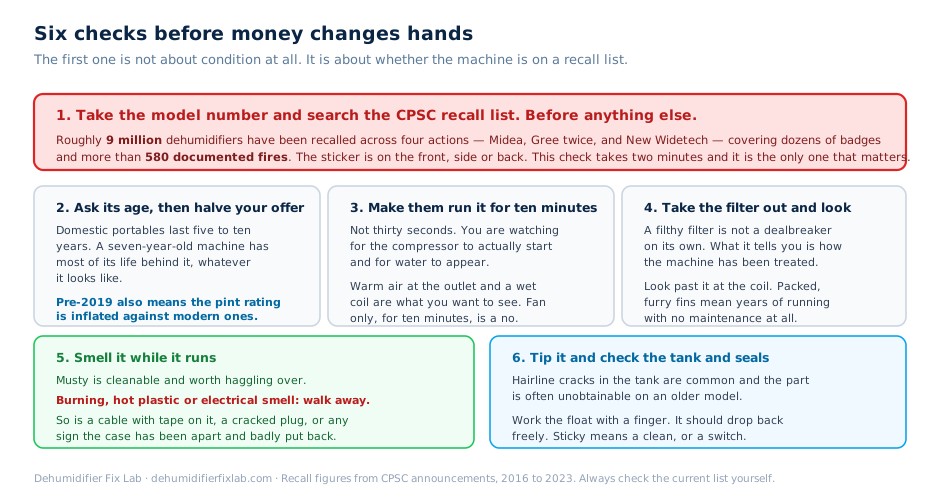
Before you look at the condition of a used dehumidifier, take the model number off the sticker and search it on the recall list. Four recalls across Midea, Gree — twice — and New Widetech cover roughly 9 million units and more than 580 documented fires. That check takes two minutes on a phone, and it is the only one on this page that can matter more than the price.
Once it clears, the rest is straightforward. Five more checks, all doable standing in someone’s hallway, and a specific number to knock off the asking price if it is more than a few years old.
Check 1: the recall list, before anything else
The model number is on a sticker on the front, side or back of the machine. Search it against the CPSC’s dehumidifier recall list.
The scale is worth spelling out, because it is the strongest evidence I know of that the badge tells you nothing:
- Midea, 2016 — about 3.4 million US units plus 850,000 in Canada, 38 reports of smoke and fire, roughly $4.8 million in property damage. The recall covered more than fifty brand names.
- Gree, reannounced 2016/2017 — more than 2.2 million units across thirteen badges, more than 450 fires, over $19 million in damage.
- New Widetech, 2021 — about 2 million units, 107 reports of overheating or fire, roughly $17 million in damage. Badges included AeonAir, Amana, ArcticAire, Danby, De’Longhi, EdgeStar, Friedrich, Haier, Honeywell, Idylis, Whirlpool and Whynter.
- Gree again, 2023 — a further 1.56 million units after at least 23 fires. In the same year CPSC warned that four deaths may be tied to earlier recalled units people had never returned.
Those are brands that look like competitors on a shelf. Several of them are names people buy because they trust them. If the machine is on a list, it is not a bargain at any price — and the manufacturer may owe the current owner a refund.
The five condition checks
2. Ask its age, then adjust what you are willing to pay
Domestic portables last five to ten years, with most failing around six or seven. A seven-year-old machine has most of its life behind it however clean it looks, because what wears out is compressor cycles rather than plastic.
There is a second, sharper reason to ask. A pre-2019 machine’s pint rating is inflated against a modern one. The US Department of Energy changed the test conditions in 2019 to a cooler, drier point, so a modern 50-pint unit removes roughly what a pre-2019 70-pint unit did. Someone selling a “70-pint” from 2015 is, in current terms, selling you a 50-pint machine that is already several years old. The full explanation.
3. Make them run it for ten minutes
Not thirty seconds. You need long enough for the compressor to start, and long enough to see water.
What you want: the fan starts, the compressor cuts in within a few minutes, the outlet air goes warm, and after ten minutes there is condensate on the coil or in the tank. Warm air plus a wet coil is a working machine.
What is a no: fan only for ten minutes with nothing warming up. That means the compressor is not running, and on a portable that is usually the end of it.
Bear in mind the room matters. In a cold garage a healthy machine will produce very little, so judge it somewhere warm if you can. Cold rooms make good machines look broken.
4. Take the filter out and look past it
The filter itself is not the point — it washes. What it tells you is how the machine has been treated.
Look past it at the coil. Fins packed with grey felt mean years of running with no maintenance at all, and a coil in that state has been forcing the compressor to work hot for a long time. That is a machine with less life left than its age suggests.
A filthy filter with clean fins behind it is fine. Clean filter, packed fins, is the one to walk away from.
5. Smell it while it runs
Musty is cleanable and worth haggling over — it is a tank, a filter or biofilm on the coil, and there is a proper diagnostic for it.
Burning, hot plastic, or an electrical smell is a walk-away, immediately and without negotiating. Same for a cable with tape on it, a cracked or scorched plug, or any sign the case has been apart and badly reassembled.
6. Tip it up and work the float
Two things people never check and both are expensive to discover later.
The tank. Hairline cracks form around the handle and base corners with age. On an older model a replacement tank is frequently unobtainable, which is a genuinely annoying way to lose an otherwise sound machine.
The float. That hinged plastic part in the tank should drop back freely under its own weight. Sticky means a clean — or a switch, which is the fault behind a full-bucket light on an empty tank.
While it is tipped, look underneath for water staining. A machine that has been leaking has usually been leaking for a while.
What a used one is actually worth
My honest position, and it is a view rather than a measurement.
Under three years old, clean, running, not recalled — a genuine bargain, and the best value in this whole category. These are machines people bought for a specific damp problem, solved it, and no longer need.
Three to six years — worth having at a real discount, knowing you are buying the back half of its life.
Over six years — I would not, unless it is nearly free and you can afford for it to fail. You are buying a compressor with most of its cycles behind it, in a machine whose tank and board are equally old and equally unobtainable.
And a used machine has no warranty, which matters more here than with most appliances: sealed systems often carry a longer term than the rest of the unit, and that is precisely the failure that ends a portable.
The bits that are cheap to put right
Do not be put off by these — they are haggling points, not dealbreakers:
- A filthy or missing filter — washable, or a few pounds.
- A musty smell — a clean, provided the coil fins are not packed.
- No drain hose — a garden hose fits most units’ ¾-inch port. Setting it up.
- A sticky float — usually just biofilm.
The expensive ones are the compressor, the sealed system and the control board. All three are more than a used machine is worth, and all three are what you are testing for in the ten-minute run.
Frequently asked questions
Is it worth buying a used dehumidifier?
Under three years old, clean and not on a recall list, yes — it is good value. Over six years old you are buying the back half of a compressor’s life with no warranty, and I would only do it if the price were close to nothing.
How do I check if a used dehumidifier has been recalled?
Take the model number from the sticker on the front, side or back and search it on the CPSC recall list. Four recalls cover roughly 9 million units across dozens of brand names, so this is not a rare situation.
How long does a used dehumidifier last?
Domestic portables run five to ten years in total, with most failing around six or seven. Subtract the age from that and you have a realistic estimate of what is left.
What should I test before buying a second-hand dehumidifier?
Run it for ten minutes. You want the compressor to cut in, the outlet air to go warm, and condensate to appear. Fan-only for ten minutes with nothing warming up means the compressor is not running.
Is an old 70-pint dehumidifier better value than a new 50-pint?
No. The DOE changed the test conditions in 2019, so a modern 50-pint removes roughly what a pre-2019 70-pint did. The old one is the same capacity, several years older, and out of warranty.
What are the warning signs on a used dehumidifier?
A burning or electrical smell, a taped or scorched cable, coil fins packed with dust behind a clean filter, water staining underneath, and a case that has clearly been apart. Any of those and I would walk.
Can I still get parts for an old dehumidifier?
Small parts like filters and hoses, usually. Tanks and control boards on models more than a few years old are frequently unobtainable, which is what actually ends most of these machines.
Related guides: How long do dehumidifiers last? · 50 pint dehumidifier · Dehumidifier not turning on · How to clean a dehumidifier
Sources
- CPSC — Dehumidifier recalls — the current list to check a model number against.
- CPSC — Two million dehumidifiers recalled, manufactured by New Widetech (2021) — the unit count, incident figures and the twelve brand names.
- CPSC — Warning: stop using recalled Gree dehumidifiers, four deaths may be tied to recalled units (2023) — the 2023 warning quoted above.
- Energy Vanguard — The confusing world of dehumidifier capacity — the 2019 test-condition change behind the pint-rating point.
Where this guide and your appliance’s own manual disagree, follow the manual. And if the seller cannot find the model number — that is your answer. Two minutes of searching is the difference between a bargain and something the manufacturer has been trying to get back for years.

