
Last Updated on September 7, 2026 by Umar Farooq
A dehumidifier not turning on is far more often a plug, a tank or a float than it is a dead control board. Four of the six checks below cost nothing and take about ten minutes between them. Only the last two involve buying anything, and by then you will know exactly what you are buying.
The order matters when a dehumidifier is not turning on. Almost every guide on this gives you a list of parts in no particular sequence, which is the same as giving you none — a list does not tell you what to check first.
Dehumidifier not turning on: the four free checks
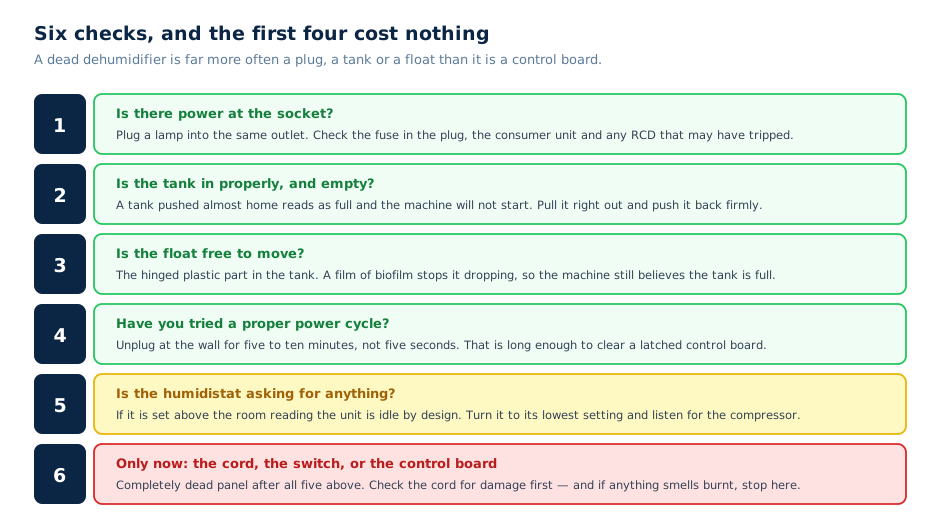
1. Is there actually power at the socket?
Plug a lamp into the same outlet. It sounds obvious and it is the single most common answer, particularly in a garage or a cellar where a circuit may have tripped weeks ago without anyone noticing.
While you are there, check three things: the fuse in the plug if you are in the UK, the consumer unit or breaker panel, and any RCD that may have tripped. A dehumidifier in a damp space is exactly the sort of appliance an RCD will trip on.
Also look at the lead itself. A cable that has been trapped under the machine, chewed, or run over by a door will fail internally where you cannot see it.
2. Is the tank in properly, and empty?
Every unit has a float switch that stops the machine when the tank is full — and a tank pushed almost home reads as full. The machine will not start at all, and the panel may show nothing.
Pull the tank right out and push it back until it stops. Check nothing has fallen down behind it.
3. Can the float move freely?
The float is the hinged plastic part sitting in the tank. Biofilm builds on it over a season and stops it dropping back, so the machine believes the tank is still full.
Wash the tank with dish soap, or a solution of roughly 10 parts water to 1 part bleach if there is mildew, rinse it well, and work the float with a finger. It should fall back under its own weight.
If the full-bucket light is on with a clean, empty, properly seated tank, that specific fault has its own guide — the machine reads a switch position, not a water level.
4. Have you power-cycled it properly?
Not five seconds. Unplug at the wall for five to ten minutes, then plug back in.
Control boards latch on a previous fault state and stay latched, and a brief interruption is not long enough for the board to lose power and clear. This is the closest thing to a reset button most portable dehumidifiers have — there is almost never an actual one, whatever the internet tells you.
Worth doing once. Pointless twice.
The two that cost something
5. Is the humidistat asking for anything?
Not strictly a fault, but it belongs here because it looks exactly like one.
If the humidistat is set above the room’s actual humidity, the machine is idle by design. The panel lights up, the display works, and nothing happens — which reads as broken.
Turn it to its lowest setting and listen. If the compressor starts within a few minutes, there was never a problem. Then set it back to 50%, because a lower setting does not dry the room faster — it only means the machine never stops.
If the panel responds but the compressor never runs at any setting, the humidistat itself may have failed. It is a cheap part on most units.
6. Now the cord, the switch, or the control board
Completely dead panel, nothing at all, after every check above.
- The cord or plug — the cheapest and most common of the three, and the one to look at first. Damage is usually at the strain relief where the cable enters the machine.
- The power switch — a mechanical part that wears.
- The control board — the expensive one, and frequently unobtainable on an older model, which effectively ends the machine.
Before spending anything, weigh it against the age. Domestic portables run five to ten years, and a board on a seven-year-old unit is most of the price of a new machine fitted into something whose other components are exactly as old as the one that just failed.
Do not open the case to test components unless you know how to discharge a run capacitor safely — it holds a charge after the plug is out and can give you a serious shock. If the machine smells of burning, has a scorched plug, or has been wet inside, stop here and do not switch it on again. Millions of dehumidifiers have been recalled for fire risk; a burning smell is never something to work through methodically.
A dehumidifier not turning on is worth checking against the recall list
Genuinely worth two minutes if the machine is more than a few years old.
Four recalls across Midea, Gree (twice) and New Widetech cover roughly 9 million units and more than 580 documented fires, under dozens of badges that look like competitors on the shelf. The model number is on a sticker on the front, side or back. Search it on the CPSC list.
A machine that will not turn on is a machine you are about to spend money on or take apart. Find out first whether the manufacturer already owes you a refund.
Frequently asked questions
Why will my dehumidifier not turn on?
Most often no power at the socket, a tank that is not fully seated, or a float held up by biofilm. All three are free to check. Only after those, and a proper ten-minute power cycle, is it worth suspecting the cord, switch or control board.
Is there a reset button on a dehumidifier?
Almost never. Unplugging at the wall for five to ten minutes does the same job by letting the control board lose power and clear a latched fault. A five-second unplug is not long enough.
Why does my dehumidifier have power but not run?
Usually because the humidistat is set above the room’s current humidity, so the machine is idle by design. Turn it to the lowest setting and listen for the compressor. If nothing happens at any setting, suspect the humidistat.
Can a full tank stop a dehumidifier turning on?
Yes — and so can an empty tank that is not pushed fully home, or a float that cannot drop back. The machine reads a switch position rather than a water level, so all three look identical to it.
My dehumidifier tripped the breaker and now will not start. What now?
Reset the breaker once and watch. If it trips again immediately, stop using the machine — a repeat trip means a genuine electrical fault, and that is not something to keep resetting.
Is it worth repairing a dehumidifier that will not turn on?
Depends entirely on the part. A plug, a fuse, a float or a humidistat is cheap and worth doing at almost any age. A control board on a machine over five years old rarely is, and is often unobtainable anyway.
How do I know if my dehumidifier control board has failed?
By elimination rather than by testing: confirmed power at the socket, an intact cord, a seated tank, a free float, a full ten-minute power cycle, and still a completely dead panel. That combination points at the board or the switch.
Related guides: Dehumidifier says the bucket is full when it’s empty · Dehumidifier keeps shutting off · Dehumidifier not collecting water · How long do dehumidifiers last?
Sources
- CPSC — Dehumidifier recalls — the current recall list to check a model number against.
- GE Appliances — Dehumidifier: Cleaning and Maintenance — tank and float cleaning, and the bleach solution quoted above.
- GE Appliances — Dehumidifier: Ideal Operating Conditions — why a unit can sit idle without being faulty.
Where this guide and your appliance’s own manual disagree, follow the manual. And if you have already ordered a control board — keep the receipt and plug a lamp into that socket first. It is the least satisfying fix in this article and it is the one that works most often.

