
Last Updated on September 1, 2026 by Umar Farooq
If your dehumidifier smells like mildew, something inside it is staying wet between runs — and there are only three candidates: the tank, the filter, or the coil. Work through them in that order and you will find it, usually in under ten minutes, without buying anything.
The order matters more than it sounds. Almost every guide on this gives you a list of six possible causes with no way to tell them apart, which is the same as giving you none. What follows is a sequence of tests, each one free, and each one ruling out a whole category before you move on.
Why a dehumidifier smells like mildew in the first place
A dehumidifier is, mechanically, a warm damp box with a fan in it. The evaporator coil is wet the entire time the machine runs and only partly dries between cycles. The tank holds standing water at room temperature. The filter catches every bit of organic dust in the room and then sits in humid air.
That is three ideal habitats in one appliance. Mould needs moisture, a surface and something organic to eat, and above 60% humidity it can establish on a suitable surface within 24 to 48 hours. Inside a running dehumidifier, humidity at the coil is effectively 100%.
So a dehumidifier that smells like mildew is not a defective one. It is a sign it has been doing its job without being cleaned.
Test 1: empty and dry the tank, then run it for an hour
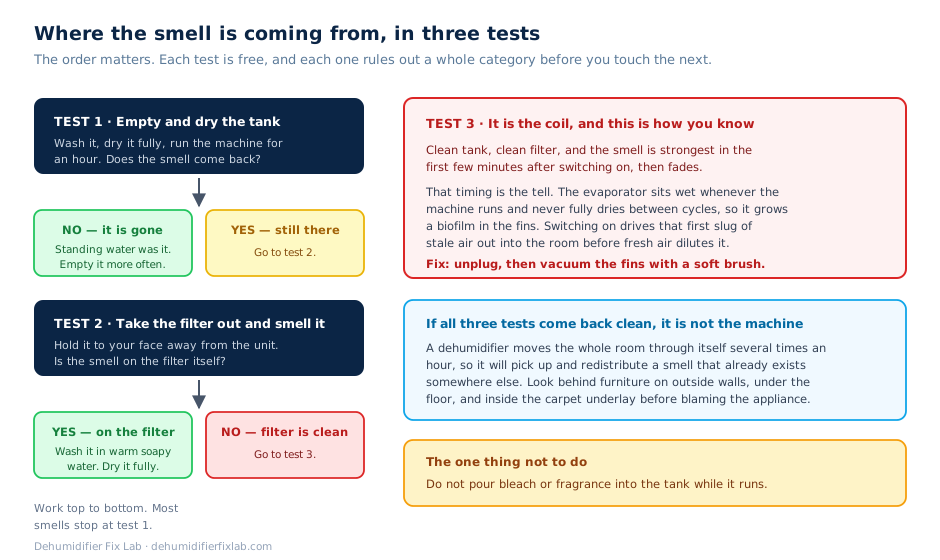
Take the tank out, wash it with dish soap and warm water, and dry it properly with a cloth — not left to air-dry with a film of water in the bottom. Pay attention to the float, the hinged plastic part that tells the machine when to stop; biofilm collects on it.
Then run the machine for an hour and put your nose near the outlet.
Smell gone? Standing water was the whole problem. The fix is behavioural rather than mechanical: empty the tank more often, or better, set up continuous drainage through a hose so water never sits in the machine at all. That single change eliminates this cause permanently and it is twenty minutes of work.
Smell still there? Go to test 2.
Test 2: take the filter out and smell it directly
Pull the filter and hold it up to your face, away from the machine. This is a more useful test than looking at it, because a filter can look grey and be fine, or look acceptable and smell like a pond.
The smell is on the filter? Wash it in warm soapy water — never hot water, never chemical cleaners — rinse thoroughly, and dry it completely before it goes back. Half an hour flat on a towel. A damp filter refitted is how the smell comes back within days, and it is the single most common reason people think cleaning “didn’t work”. The filter guide covers intervals properly.
The filter smells of nothing much? Go to test 3.
Test 3: it is the coil, and here is how you know
Clean tank, clean filter, smell persists. There is one part left, and there is a specific tell that confirms it.
Switch the machine off for a few hours, then switch it on and stand next to it. If the smell is strongest in the first few minutes and then fades as the machine keeps running, that is the coil.
The timing is the diagnostic. The evaporator sits wet whenever the machine runs and never fully dries between cycles, so it grows a biofilm down in the fins where nothing reaches. When you switch on, the fan drives that first slug of stale, saturated air straight out into the room before fresh air starts diluting it. A tank or filter smell is steady; a coil smell arrives in a wave and settles.
The fix: unplug it, take the filter out, and vacuum the exposed fins with a soft brush attachment, working along the fins rather than across them. They bend easily. Do not spray anything on them — an evaporator inside a cabinet cannot be rinsed, so whatever you spray stays there and becomes the next problem. The full cleaning routine has the rest of the detail.
If all three come back clean, it is not the machine
This is the possibility most articles skip entirely, and in my experience it accounts for a decent share of these complaints.
A dehumidifier pulls the whole room through itself several times an hour. If something in that room smells, the machine will find it, concentrate it, and blow it back out at you — and because the smell now appears to come from the appliance, the appliance gets blamed.
If your dehumidifier smells like mildew but all three parts came back clean, go and check these, in this order:
- Behind furniture standing against an outside wall. Restricted air, cold surface, classic spot.
- Inside cupboards and wardrobes on outside walls, particularly ones that are never opened.
- Under and behind the machine itself. If it has been sitting on carpet with a slow drip, the underlay beneath it is the smell.
- The carpet and underlay generally, if the room has ever flooded, even years ago.
The honest position here: a dehumidifier does not remove smells, it removes humidity. Where the smell is caused by damp, drying the room genuinely fixes it, but that takes days to weeks rather than an evening — because the air dries far faster than the materials do. Where the smell has another source, no amount of running will touch it.
The one thing not to do
Do not pour bleach, disinfectant or scented anything into the tank of a running machine.
The reasoning people apply is understandable — the tank smells, so put something in the tank. But the tank is downstream of the airflow. Anything volatile you put in it gets picked up and distributed round the room by the fan, which is how you swap a musty room for a chemical one. Worse, some cleaners will attack the plastics and seals over time.
Clean the tank, empty it, rinse it. A 10 parts water to 1 part bleach solution is fine for a mildewed tank if it is swished round, tipped out and rinsed thoroughly with plain water — that is what the manufacturers themselves recommend. It is not something to leave sitting in there while the machine runs.
Stopping it coming back
- Run continuous drainage if the machine is unattended. No standing water, no tank smell, ever.
- Empty the tank daily if you are not using a hose. Yes, daily.
- Clean the filter every 250 running hours — about monthly at eight hours a day.
- Vacuum the coil once a season, unplugged.
- Give it 30 cm / 12 inches of clear space so it is not re-breathing its own outlet air.
- Empty and dry it completely before storage. A dehumidifier that smells like mildew every spring is usually one that was put away wet. Water left standing for a winter is how a permanent smell gets started.
Frequently asked questions
Why does my dehumidifier smell like mildew?
Because something inside it is staying wet between runs — most often standing water in the tank, then a damp filter, then biofilm on the evaporator coil. All three are ideal conditions for mould, and all three are free to check in that order.
How do I get the musty smell out of my dehumidifier?
Wash and dry the tank, wash and fully dry the filter, then vacuum the coil fins with a soft brush while unplugged. Do the tank first: it fixes the majority of cases on its own.
Can a dehumidifier make a room smell worse?
Yes, temporarily. It moves the whole room’s air through itself repeatedly, so it will find and redistribute a smell that exists elsewhere in the room. It will also blow out its own smell if the coil or tank is dirty.
Will a dehumidifier get rid of a musty smell in a room?
If the smell is caused by damp, yes — but over days to weeks, not overnight, because soft furnishings and plaster dry far more slowly than the air. If the smell has another source, drying the room will not touch it.
Is a smelly dehumidifier dangerous?
A musty smell is unpleasant rather than hazardous, and cleaning resolves it. A burning or electrical smell is a different matter entirely: unplug the machine at the wall and stop using it. That is not something to work through methodically.
Why does my dehumidifier smell only when it first starts?
That timing points at the coil. The fan pushes the stale, saturated air that has been sitting around the wet evaporator straight out into the room, then fresh air dilutes it. A steady smell is more likely the tank or filter.
How often should I clean my dehumidifier to stop it smelling?
Tank every two weeks, filter every 250 running hours, coil once a season. Running a drain hose instead of using the tank removes the most common cause altogether.
Related guides: How to clean a dehumidifier · Dehumidifier filters · Does a dehumidifier help with mould? · Dehumidifier drain hose setup
Sources
- EPA — Mold Course, Chapter 2 — the moisture and surface conditions mould needs, and the 24–48 hour figure.
- EPA — Mold Cleanup in Your Home — sensible practice for cleaning mould off hard surfaces and when a job is beyond a cloth.
- GE Appliances — Dehumidifier: Cleaning and Maintenance — the tank cleaning solution, filter washing instructions, and the warning against running without a filter.
Where this guide and your appliance’s own manual disagree, follow the manual. And if you have already bought a bottle of something to pour in the tank — take it back. The tank was almost certainly the problem, and washing-up liquid was always going to be enough.

