
Last Updated on September 7, 2026 by Umar Farooq
If your dehumidifier keeps shutting off, time it before you diagnose it. How long it runs before stopping is the single measurement that separates a machine working exactly as designed from one tripping its own protection — and the three possible answers barely overlap.
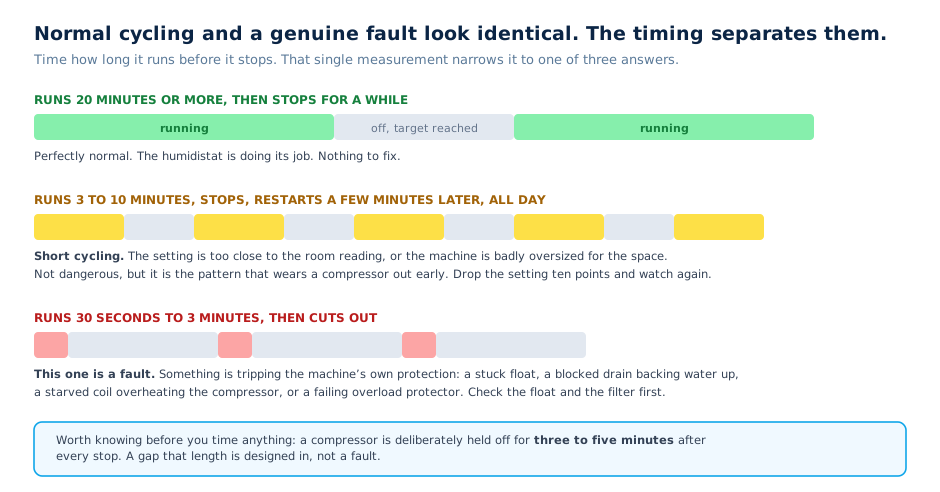
When a dehumidifier keeps shutting off after twenty minutes or more, followed by a long pause, that is the humidistat doing its job and there is nothing to fix. Three to ten minutes, over and over: that is short cycling, which is not dangerous but is wearing the compressor out early. Under three minutes, repeatedly: that one is a fault, and it has a short list of causes.
If your dehumidifier keeps shutting off, time it first
Sit with it for half an hour with a phone timer. Write down how long it runs and how long it stays off.
One thing to know before you start, because it accounts for a lot of confusion: a compressor is deliberately held off for three to five minutes after every stop. That delay stops it restarting against system pressure, and it is designed in. A gap of that length is not a fault, and no amount of pressing buttons will shorten it.
Reason 1: it has reached your setting — not a fault
This is the answer most of the time, and it is the machine succeeding rather than failing.
A dehumidifier runs until the room hits the humidity you set, then the humidistat switches the compressor off. If you have it on 60% and the room is sitting at 58%, it will run for a moment, decide it is done, and stop. Then drift up a point, run briefly, stop again.
The test: turn the setting down ten points and watch. If it starts and keeps running, there was never anything wrong.
Then put it back to 50% — a lower setting does not dry the room any faster, it only means the machine never switches off.
Reason 2: short cycling from a setting or a size mismatch
Runs five minutes, stops, restarts a few minutes later, all day. Nothing is broken, but this is the pattern worth fixing.
Two causes:
The setpoint is sitting right on the room’s actual humidity. The machine crosses the threshold, stops, drifts back over it, starts again. Move the setting further from where the room actually sits.
The machine is badly oversized for the space. A 50-pint unit in a small bedroom hits the target almost immediately and then spends its life starting and stopping. This is the argument against the widely-repeated advice to oversize by a tier: compressors tolerate steady running far better than repeated starts, and short cycling is one of the ways a machine dies at year four instead of year eight. Sizing it properly is the fix.
Reason 3: the tank or the float is stopping it
Free to check, and very common.
Every unit has a float switch that cuts the machine when the tank is full. A tank pushed almost home reads as full. So does a float with a film of biofilm on it that stops it dropping back.
The test: pull the tank right out, wash it, dry it, work the float with a finger — it should fall back freely — and push the tank firmly home.
If the full-bucket light is on with an empty, properly-seated tank, that has its own guide, because the fault is a switch position rather than a measurement.
Reason 4: a blocked drain backing water up
Only if you run continuous drainage, and then it is the first thing to check.
A silted, kinked or uphill hose means water cannot leave. It backs up into the reservoir, the float rises, and the machine shuts down believing the tank is full — which, from its point of view, it is.
The test: disconnect the hose and refit the tank. If it runs normally, the hose is your answer. Five reasons a hose stops draining.
Reason 5: the machine is protecting itself — this one is a fault
Runs thirty seconds to three minutes, cuts out, tries again. This is the pattern that means something is genuinely wrong.
The unit has thermal and overload protection that trips when the compressor gets too hot or draws too much current. In order of likelihood:
A starved coil overheating the compressor. Blocked filter, packed coil fins, or the unit shoved against a wall. Restricted airflow makes everything run hotter than designed. Free to check and by far the most likely.
A room too cold for it. Below about 5°C / 41°F, frost forms faster than the machine can clear it, and some units simply shut down rather than cycle endlessly. Put a thermometer in the room — a compressor unit in an unheated garage in February is the wrong machine, not a broken one.
A long, thin extension lead. Voltage drop during the compressor’s inrush current causes failed starts, and repeated failed starts are exactly what destroys an overload protector. Plug it into the wall.
A failing run capacitor or overload protector. Both are cheap parts. You will usually hear it: a hum or a click as the compressor tries to start and fails. The fan-runs-but-compressor-doesn’t guide works through the electrical side.
A run capacitor holds a charge after the plug is out and can give you a serious shock. If you are not confident discharging one safely, stop at the free checks. Sealed refrigerant work needs a licence in most countries and is not a home repair. And if the machine smells of burning, unplug it at the wall and do not switch it on again.
What is not the cause
“It needs a reset.” There is no reset button on almost any portable dehumidifier. The equivalent is unplugging at the wall for five to ten minutes, which clears a latched control board — worth doing once, pointless twice.
“The humidity sensor is broken.” Possible, but it is far down the list. A sensor reading a few points out is normal — domestic humidistats are accurate to a few percent, not to a decimal place. Rule out the setting, the tank and the filter first.
Frequently asked questions
Why does my dehumidifier keep turning on and off?
Usually because it has reached the humidity you set, which is the humidistat working correctly. If the on-off cycle is only a few minutes long, the setpoint is sitting too close to the room’s actual reading, or the machine is oversized for the space.
How long should a dehumidifier run before shutting off?
In a room already near your target, twenty minutes to a couple of hours is normal, followed by a long pause. Runs of under three minutes, repeating, point at the machine tripping its own protection rather than reaching a target.
Is short cycling bad for a dehumidifier?
It is not dangerous, but it is what wears compressors out early. Steady running is easier on the machine than repeated starts, which is why a right-sized unit lasts longer than an oversized one.
Why does my dehumidifier shut off after a few minutes?
That short a run points at protection tripping: a blocked filter starving the coil, a room too cold, a long extension lead causing failed starts, or a failing capacitor or overload protector. Check the filter and the room temperature first.
Does a full tank make a dehumidifier shut off?
Yes, and so does a tank that is only almost pushed home, or a float coated in biofilm that cannot drop back. All three are free to rule out.
Why does my dehumidifier stop when the drain hose is connected?
Because the hose is not clearing. A kink, a rise or silt backs water up into the reservoir, the float rises, and the machine shuts down thinking the tank is full. Disconnect the hose to confirm, then flush and re-route it.
Is there a reset button on a dehumidifier?
Almost never. Unplugging at the wall for five to ten minutes is the equivalent and will clear a latched control board. If the fault returns immediately, a reset was never the answer.
Related guides: Dehumidifier not collecting water · Dehumidifier says the bucket is full when it’s empty · Dehumidifier settings · How long should a dehumidifier run?
Sources
- GE Appliances — Dehumidifier: Ideal Operating Conditions — restart delays, low-temperature limits and defrost behaviour.
- GE Appliances — Dehumidifier: Fan Stays On, Will Not Shut Off — the manufacturer’s account of normal fan and compressor behaviour between cycles.
- ENERGY STAR — Dehumidifiers — the 30–50% target band and capacity guidance behind the oversizing point.
Where this guide and your appliance’s own manual disagree, follow the manual. And if you have been standing over it pressing buttons for twenty minutes — set a timer instead, and go and do something else. The pattern is the diagnosis.

