
Last Updated on September 7, 2026 by Umar Farooq
A dehumidifier leaking water has let the condensate escape somewhere along a very short path: coil, drip tray, tank or hose. Four of the five causes below cost nothing to fix, and one simple observation — when the puddle appears — narrows it down before you move the machine at all.
A dehumidifier leaking water has not invented a new route. Every drop it makes follows the same one. A leak means it left that route at a point you can find in about five minutes.
Unplug the machine at the wall before mopping around it or tipping it up. Water and a live mains appliance on a hard floor is the one combination in this article that can actually hurt you.
The path the water takes
Worth twenty seconds, because it turns a mystery into a list of four places.
Air passes over the cold coil and water condenses on the fins. It runs down into a drip tray moulded into the base, which channels it either into the tank or out through the drain port if you have a hose fitted. That is the whole journey.
So a leak is water leaving at the coil, the tray, the tank, or the hose. Nothing else in the machine holds liquid.
Dehumidifier leaking water: the five causes, ranked
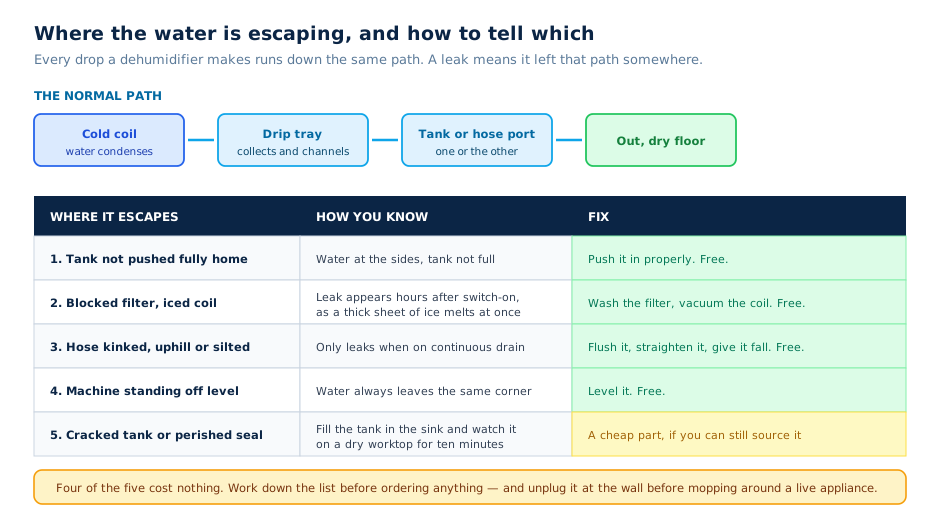
1. The tank is not pushed fully home
The most common cause and the least believed. A tank seated almost correctly leaves a gap where the drip tray hands water over, and the water goes down the side of the tank rather than into it.
The tell: the tank is not full, but there is water underneath and around the base.
The fix: pull it right out and push it back until it stops. Check nothing has fallen behind it. Free, and I have taken the front off a machine before noticing this. Twice.
2. A blocked filter, and an iced coil
This is the one with the distinctive timing, and it catches people out because the leak appears hours after the machine seems fine.
A blocked filter starves the coil of air, so the coil runs colder than intended and frosts over instead of dripping. Water stops arriving in the tank, which looks like a different fault entirely. Then the machine switches off, or defrosts, and a thick sheet of ice melts all at once — far faster than the drip tray was designed to handle. It overflows the tray and runs out of the base.
The tell: the leak appears in a burst after the unit stops, rather than steadily while it runs. Often overnight.
The fix: wash the filter in warm soapy water and dry it fully, then vacuum the coil fins with a soft brush. The cleaning routine covers it, and icing has its own guide if the coil is genuinely freezing.
3. The drain hose is kinked, uphill or silted
Only applies if you run continuous drainage, and then it is the first suspect.
A gravity hose needs a continuous fall of about ¼ inch per foot with no dips. One loop of slack on the floor is a trap that fills, holds, and backs water up into the machine until the tray overflows. A silted hose does the same thing more slowly. So does an outlet end sitting in water in a sump.
The tell: it only leaks when the hose is connected. Reconnect the tank and it behaves.
The fix: lay the hose out flat and look along it, flush it through with water, and lift the outlet clear of any standing water. Setting the hose up properly covers all five failure modes.
4. The machine is standing off level
An uneven floor tips the drip tray, and the tray only has a centimetre or so of freeboard. Water goes over the low edge instead of down the channel.
The tell: the water always appears at the same corner, and the same one every time.
The fix: level it, or put it on a flat board. Free.
5. A cracked tank or a perished seal
Now we are into parts, and this is genuinely last on the list rather than first.
Tanks develop hairline cracks with age, particularly around the handle and the base corners, and the rubber grommet in the drain port hardens and shrinks over the years.
The test: take the tank out, fill it in the sink, dry the outside, and stand it on a dry worktop for ten minutes. If a ring appears, that is your leak and you have found it without touching the machine.
The fix: a replacement tank, if you can still source one for the model. On an older unit that part is frequently unobtainable, which is a genuinely annoying way to lose an otherwise sound machine.
The one that is not a leak at all
Worth mentioning, because it sends people looking for a fault that is not there.
Condensation on the outside of the machine. In a very humid room, the casing near the cold coil can drop below the dew point of the room air and bead up on the outside, exactly like a cold drink. The water then runs down the case and pools underneath.
The tell is that the water is on the outer casing itself, and the tank is filling normally at the same time. It stops as the room dries out. Nothing is broken; the room is simply very wet.
Stopping it coming back
- Empty the tank before it is full, or better, run a hose so water never stands.
- Clean the filter every 250 running hours — this alone prevents the ice-melt leak, which is the messiest of the five.
- Flush the drain hose once a season. Silt builds slowly and the first symptom is a puddle.
- Check it sits level whenever you move it.
- Do not put it on carpet if it uses a hose. A slow leak into underlay is a smell you will never fully get out, and by the time you notice, the damage is done.
- Empty and dry the tank before storing it. Water left standing for a winter is how seals perish and floats seize.
If the machine is old enough that you are weighing a new tank against a new unit, how long dehumidifiers last has the repair-or-replace arithmetic.
Frequently asked questions
Why is my dehumidifier leaking water from the bottom?
Most often the tank is not pushed fully home, so water runs down the side instead of into it. After that: a blocked filter icing the coil and then melting all at once, a kinked or silted drain hose, an uneven floor, or a cracked tank.
Why does my dehumidifier leak only at night?
That timing points at ice. A starved coil frosts while the machine runs, then a thick sheet melts faster than the drip tray can cope with once it stops or defrosts. Clean the filter and the coil.
Can a dirty filter make a dehumidifier leak?
Yes, and it is one of the most common causes. Restricted airflow makes the coil run colder than designed, so water freezes on it rather than draining away, and the melt overwhelms the tray.
How do I know if my dehumidifier tank is cracked?
Take it out, fill it in the sink, dry the outside and stand it on a dry worktop for ten minutes. A ring of water means a crack or a perished seal, and you have confirmed it without dismantling anything.
Is a leaking dehumidifier dangerous?
The water itself is condensate rather than anything nasty, but water around a mains appliance is a real hazard. Unplug it at the wall before mopping or moving it, and never leave it leaking onto a socket, an extension lead or a carpet.
Why is my dehumidifier leaking when I use the drain hose?
Almost always the hose: a rise or a kink somewhere in the run, an outlet sitting in standing water, or silt narrowing the bore. Disconnect it, lay it flat, and flush it through.
Should I put a tray under my dehumidifier?
A shallow tray is sensible insurance on a wood floor or carpet, but it treats the symptom. Work through the five causes first — four of them cost nothing.
Related guides: Dehumidifier not draining through hose · How to clean a dehumidifier · Dehumidifier freezing up · Dehumidifier drain hose setup
Sources
- Frigidaire — Dehumidifier: Not Draining — manufacturer guidance on blocked drain lines and hose routing.
- GE Appliances — Dehumidifier: Drain Hose Issues — the fall requirement and common hose faults.
- GE Appliances — Dehumidifier: Cleaning and Maintenance — filter intervals and tank cleaning, which prevent the two messiest causes.
Where this guide and your appliance’s own manual disagree, follow the manual. And if you have already ordered a replacement tank — do the sink test first. It takes ten minutes and it has saved a few people a part they did not need.

