
Last Updated on September 1, 2026 by Umar Farooq
Choosing a dehumidifier for basement damp comes down to four things: how damp it actually is, the ceiling height, whether you can drain it, and whether the space is warm enough for a compressor unit at all. Floor area, which is what almost every sizing chart leads with, is the least useful of the five inputs.
For most domestic basements the right dehumidifier for basement conditions is a 30–50 pint unit set to 50%, running on a hose to a floor drain. But the reason that is the answer matters, because the basements where it isn’t the answer are the ones that eat machines.
Rule 1: size a dehumidifier for basement damp, not square footage
Two basements of identical floor area can need completely different machines, because the variable that matters is how much water is arriving.
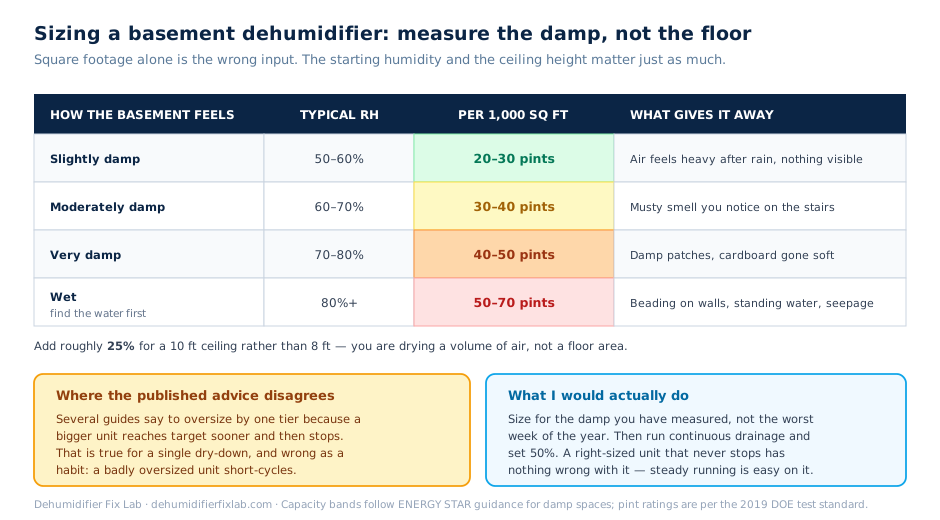
| How the basement feels | Typical RH | Per 1,000 sq ft |
|---|---|---|
| Slightly damp — heavy air after rain | 50–60% | 20–30 pints |
| Moderately damp — musty on the stairs | 60–70% | 30–40 pints |
| Very damp — patches, soft cardboard | 70–80% | 40–50 pints |
| Wet — beading walls, seepage | 80%+ | 50–70 pints |
Put a hygrometer down for a week before you buy anything. A dehumidifier for basement use is sized off that reading and nothing else. A basement that reads 58% needs a fraction of the machine that one at 78% does, and you cannot tell the difference by standing in it.
Rule 2: add for ceiling height
This is the one that catches people out, and it is simple arithmetic. A dehumidifier dries a volume of air, not a floor.
A 1,000 sq ft basement with a 10 ft ceiling holds 25% more air than the same footprint at 8 ft. Add roughly 25% to the capacity. Old houses with high cellars, and converted basements with the ceiling opened up, both land here.
Rule 3: the setting is the same 50% as everywhere else
A great deal of published advice gives basements their own number, usually 40% or 45%. I think that is a good instinct applied to the wrong variable.
A basement is not damper because it is a basement. It is damper because its walls and floor are colder than the rest of the house — and the surface temperature, not the postcode, is what decides where mould grows.
Air at 20°C and 50% RH landing on a wall at 12°C sits at roughly 84% humidity at that surface, which is well into mould territory while your hygrometer in the middle of the room reads a perfectly respectable 50%. That is the actual mechanism, and it gives a cleaner rule:
- Insulated, reasonably warm basement: 50%.
- Bare block or stone walls that are cold to the touch: 45%.
- Mould already showing: 45%, and find out why the wall is that cold.
Not “basements need 45%”. Cold surfaces need 45%, and that includes a freezing north-facing bedroom upstairs.
Rule 4: put it on a drain before you do anything else
A basement dehumidifier on tank-only is a machine that works until Tuesday and then sits there.
In a genuinely damp cellar a 50-pint unit can fill its tank overnight. Every hour after that, it is off. So the single highest-value thing you can do — higher than buying a bigger machine — is run continuous drainage.
Three ways, in order of preference:
- Gravity to a floor drain or sump. Free, silent, nothing to fail. Needs a fall of about ¼ inch per foot the whole way, with no dips. Setting the hose up properly takes twenty minutes.
- Stand the unit on a plinth. A concrete block or a small stand often converts an impossible run into a gravity one.
- A pump, built-in or external, if the only drain is a sink or a window above the machine. Worth it in specific cases, and unnecessary in most.
Where published advice disagrees, and what I would do
Several respectable guides recommend oversizing by one capacity tier, on the grounds that a bigger unit reaches target faster and then switches off, using less energy than a smaller one grinding away continuously.
That is true for a single dry-down, and I think it is wrong as a habit. A badly oversized machine in a small basement hits the setpoint quickly, stops, drifts up, restarts a few minutes later, and does that all day. Compressors dislike start-stop cycling considerably more than they dislike running. It is one of the ways a machine dies at year four instead of year eight.
So: size for the damp you measured, not for the worst week of the year. Run continuous drainage. Set 50%. A right-sized unit that runs most of the day has nothing wrong with it — steady running is the easy life for a compressor.
The temperature problem nobody mentions
Before any of the above, check what the basement actually runs at in February.
A compressor dehumidifier’s output falls sharply below about 18°C / 65°F, and below 5°C / 41°F GE’s own documentation says frost forms faster than the machine can clear it — so the compressor cuts out and the fan runs on. An unheated cellar in a cold climate will spend the winter defrosting rather than collecting.
If that describes yours, a bigger compressor unit will not help. A desiccant machine works down to a few degrees above freezing because it uses an absorbent rotor rather than a cold surface. It costs more to run in a warm room, which is exactly the trade you are making.
When the dehumidifier is the wrong purchase entirely
This is the honest bit, and it is the reason I would not sell you a machine before asking:
A dehumidifier manages humidity. It does not stop water coming in. If your basement has a failed damp-proof course, a leaking gutter discharging against the wall, hydrostatic pressure through the slab, or a cracked render, the machine will run permanently, cost you a great deal, and never win. It is removing water at exactly the rate the wall is supplying it.
The tell is a unit that has run for weeks with no downward trend at all, and one specific area that stays wet. Go outside and look at the ground levels, the gutters and the downpipes first. Then size a dehumidifier for whatever humidity is left, which is usually a much smaller job than you feared.
Equally, if the basement smells but reads 55%, the smell is probably in the carpet and the underlay rather than in the air, and drying will take weeks rather than an evening.
Placement in a basement
- Central, not in the wettest corner. Cornering it gives you one dry corner and an unchanged room.
- Raised off the slab if the floor ever gets wet — a block or a small stand.
- 30 cm / 12 inches clear at the intake and exhaust, or the sensor reads its own outlet air and stops early.
- Away from the stairs, unless you want the warm dry air heading straight upstairs.
More on all of that in where to put a dehumidifier.
Frequently asked questions
What size dehumidifier do I need for a basement?
Size by dampness, not floor area. Roughly 20–30 pints per 1,000 sq ft for a slightly damp basement, 30–40 for moderately damp, and 40–50 for very damp. Add about 25% for a 10 ft ceiling rather than 8 ft.
What should I set a basement dehumidifier to?
Fifty per cent in an insulated, reasonably warm basement. Drop to 45% if the walls are cold to the touch or mould has appeared — cold surfaces sit at a much higher humidity than the room reading suggests.
Should a basement dehumidifier run all the time?
On a humidistat, effectively yes. It will cycle itself on and off around your setting. What you want to avoid is a full tank stopping it, which is why continuous drainage matters more in a basement than anywhere else.
Is it worth oversizing a basement dehumidifier?
Not as a habit. A slightly oversized unit reaches target faster, but a badly oversized one short-cycles, and compressors tolerate steady running far better than repeated starts. Size for the humidity you actually measured.
Will a dehumidifier fix a wet basement?
No. It manages humidity in the air; it cannot beat water actively entering through walls or a slab. Fix the source first — ground levels, gutters, downpipes, damp-proofing — then size a machine for what is left.
Do I need a dehumidifier in a finished basement?
Often a smaller one than you would expect. Finished basements are warmer and better sealed, so the humidity is usually lower. Measure for a week; if it holds below 55%, you may not need one at all.
Can I run a basement dehumidifier in winter?
Only if the space stays above about 5°C. Below that a compressor unit spends its time defrosting rather than collecting. A desiccant model is the answer for a genuinely cold cellar.
Related guides: What size dehumidifier do I need? · Dehumidifier drain hose setup · Dehumidifier settings · Where to put a dehumidifier
Sources
- ENERGY STAR — Dehumidifiers — capacity guidance for damp spaces and the 30–50% target band.
- GE Appliances — Dehumidifier: Ideal Operating Conditions — the low-temperature limits behind winter defrost problems.
- EPA — A Brief Guide to Mold, Moisture and Your Home — why finding and fixing the water source has to come before any equipment.
Where this guide and your appliance’s own manual disagree, follow the manual. And if you are about to buy the biggest unit the shop sells because the basement smells — put a hygrometer down for a week first. It is a fiver, and it has talked more people out of the wrong machine than anything else I write.

