
Last Updated on September 1, 2026 by Umar Farooq
For most closets the right dehumidifier for closet damp is a calcium chloride absorber tub or a rechargeable desiccant brick — not a machine with a plug on it. A wardrobe is a small, sealed, unpowered space, which is exactly the job those things are good at and exactly the job a compressor unit is wrong for.
There is also a free check worth doing first, because a surprising share of damp closets are not really closet problems at all.
Do this before you buy anything
Pull the contents away from the back wall and look at it.
If the closet backs onto an outside wall, that wall is colder than the room. Air at 20°C and 50% humidity landing on a surface at 12°C sits at roughly 84% humidity at that surface — well into the range where mould gets going within 24 to 48 hours, while your hygrometer in the middle of the bedroom reads a perfectly civilised 50%.
Clothes packed tight against that wall block the only air movement there was. So:
- Pull everything 5 cm off the back wall.
- Leave the door ajar, or fit a vented door, so air can exchange.
- Take out anything that went in damp. One barely-dry towel will hold a small closet at 80% for days.
That is free, it takes ten minutes, and it fixes a good share of these before any dehumidifier for closet damp is needed at all. If the smell comes back after a fortnight, then buy something.
Four kinds of dehumidifier for closet use, honestly rated
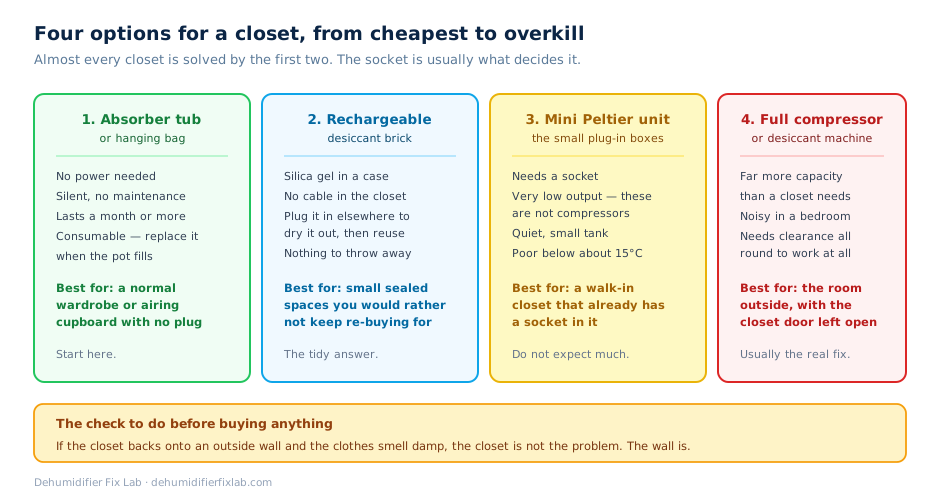
1. Absorber tub or hanging bag — start here. Calcium chloride crystals pull water out of the air until they dissolve into a brine that collects in the pot. No power, no noise, no maintenance, and a tub lasts a month or more in a normal wardrobe. It is consumable: when the reservoir fills, it is spent.
The honest limitation is capacity. A tub’s whole-life output is capped by the size of its own pot — a few hundred millilitres. In a wardrobe that is plenty. In a room it is nothing, which is the whole argument about natural dehumidifiers.
2. Rechargeable desiccant brick — the tidy version. Silica gel in a plastic case. You plug it in somewhere else for a few hours to drive the moisture back out, then put it back. Nothing to throw away and nothing to re-buy. Best for small sealed spaces — a gun cabinet, a safe, a camera bag, a wardrobe you would rather not keep buying tubs for.
3. Mini Peltier unit — the small plug-in boxes. These use a thermoelectric plate rather than a compressor, and their output is genuinely low. They also work poorly below about 15°C, which is a problem given the closets that need help are usually the cold ones. Fine in a walk-in that already has a socket. Do not expect much.
4. A full compressor or desiccant machine — but outside the closet. These have far more capacity than a closet needs, they are noisy in a bedroom, and they need 30 cm of clearance all round to work properly, which a wardrobe does not have. The right way to use one is in the room, with the closet door left open. That is usually the real fix for a whole bedroom that is damp.
Which one for which closet
| Your closet | What to use |
|---|---|
| Ordinary wardrobe, no socket | Absorber tub or hanging bag |
| Airing cupboard | Absorber tub, and check the tank overflow |
| Walk-in closet with a socket | Rechargeable brick, or a mini unit if you want a display |
| Closet inside an already-damp room | Machine in the room, closet door open |
| Gun cabinet, safe, camera store | Silica gel, nothing else |
| Caravan or boat wardrobe over winter | Two or three absorber tubs |
Signs a dehumidifier for closet damp is treating the wrong thing
The whole room reads above 60%. Then the closet is just the first place you noticed it, and a tub inside the wardrobe is treating a symptom. Put a proper machine in the room. How to dehumidify a room covers it.
Only one wall is affected. That is a cold-bridge or an ingress problem, not a humidity problem. Look at the outside of that wall — gutters, downpipes, ground levels, pointing.
The smell survives after the clothes are washed and the closet is dry. Then it is in the carpet, the underlay or the plaster, and it will take weeks to lift rather than days.
Clothes are going in damp. No absorber in the world keeps up with that. Dry things properly before they go away — a dehumidifier in the room is far better at drying washing than a wardrobe is at recovering from it.
Keeping a closet dry once it is dry
- Air gaps. Do not pack the rail solid. Air needs to move between garments.
- Nothing against the back wall. The 5 cm rule again.
- Leave the door open for an hour after you have been in and out.
- Cedar blocks or activated charcoal for smell — neither removes meaningful moisture, but both help with odour, and it is worth being clear which job each is doing.
- Replace the tub when the pot fills, not when you remember. A full absorber is doing nothing.
- Keep the bedroom at 50%. The closet cannot be drier than the room it opens onto.
Frequently asked questions
What is the best dehumidifier for a closet?
For an ordinary wardrobe, a calcium chloride absorber tub or a rechargeable desiccant brick. Both are silent, need no socket, and match the very small amount of water a closet actually generates. Electric units are usually more machine than the space needs.
Do mini closet dehumidifiers actually work?
Peltier units work, but slowly and at low capacity, and they perform poorly below about 15°C. In a warm walk-in closet with a socket they are reasonable. In a cold wardrobe they will disappoint.
How do I stop my wardrobe smelling musty?
Pull the contents 5 cm off the back wall, leave the door ajar, remove anything that went in damp, and put an absorber tub in. If the smell persists after a fortnight the problem is the room or the wall, not the wardrobe.
Can I put a normal dehumidifier in a closet?
Not inside it. It needs about 30 cm of clearance at intake and exhaust or it re-breathes its own air and shuts off early. Put it in the room with the closet door open instead.
How long does an absorber tub last in a closet?
Typically a month or more, and until the collection pot fills. Once the crystals have dissolved and the reservoir is full, it has stopped working and needs replacing.
Will a dehumidifier stop mould on clothes?
It stops the humidity that feeds it, which is most cases. It will not clean mould that has already grown on fabric — that needs washing, and anything badly affected may not recover.
Does a closet need its own dehumidifier if the room has one?
Usually not, provided the closet door is left open often enough for air to exchange. A closed door is a wall as far as the machine is concerned.
Related guides: Natural dehumidifier methods · Where to put a dehumidifier · Does a dehumidifier help with mould? · How to dehumidify a room
Sources
- EPA — Mold Course, Chapter 2 — the surface humidity conditions mould needs, and the 24–48 hour figure.
- EPA — A Brief Guide to Mold, Moisture and Your Home — airflow behind furniture and against outside walls as mould control.
- ENERGY STAR — Dehumidifiers — the 30–50% target band and why capacity should match the space.
Where this guide and your appliance’s own manual disagree, follow the manual. And if you have already ordered a mini unit for a cold wardrobe on an outside wall — send it back and move the clothes off the wall first. That one costs nothing and works more often than the machine would have.

