
Last Updated on October 24, 2026 by Umar Farooq
Why does my bathroom stay damp all day? Because the fan, if you have one, only removes the steam in the air, while cold tiles and glass, wet towels, a closed door and porous grout keep holding water and hand it back to the room for hours. The shower is rarely the problem. What happens in the hour after it usually is.
I find this one oddly reassuring, because a bathroom that stays damp is almost never mysterious. It is a room that gets a great deal of water in a short time and has been given no good way to get rid of it. Each of the six causes below has a separate fix, and the order you try them in matters.
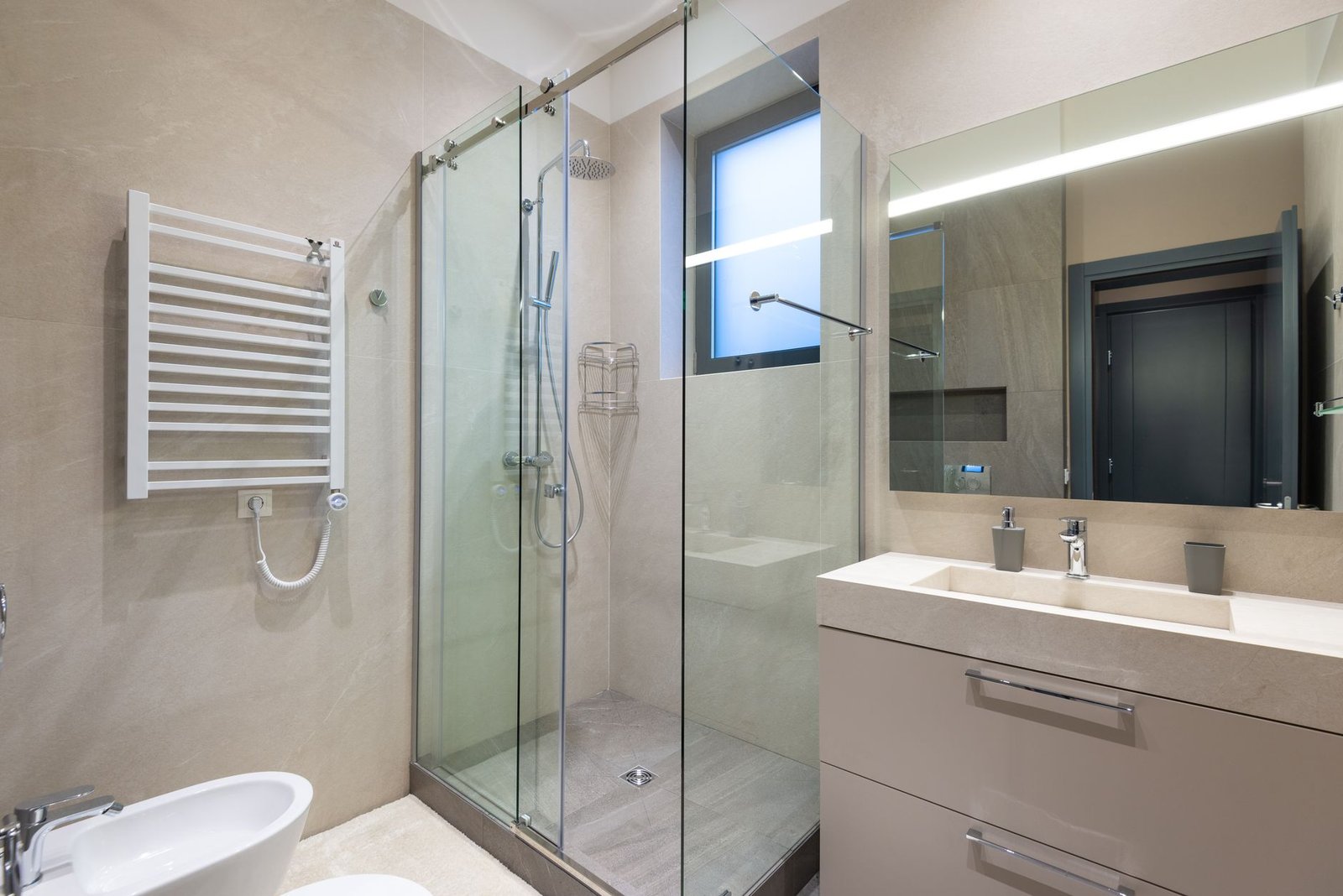
Why does my bathroom stay damp all day when the fan works?
Because there is more than one place for the water to be. Steam is only the part you can see. After a shower the moisture is spread across four stores: the air itself, a film of water on cold glass and tile, soaked towels and mats, and the water held in grout and sealant. A fan empties the first one. The other three release water back into the air as the room warms, so the humidity creeps up again after the fan switches off.
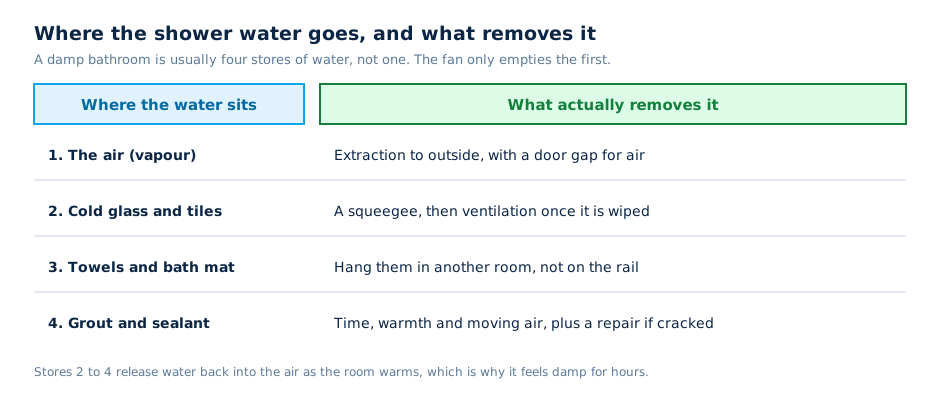
That is why the usual advice (run the fan longer) sometimes fails. If you want the run-time detail, how long to run a bathroom extractor fan covers it. This article is about what is left once the fan has done its bit.
Six reasons a bathroom stays wet for hours
1. The extraction is weak, or it stops too soon
A fan that is undersized, clogged, or ducted into the loft instead of outside will leave most of the steam where it is. A timer that gives you five minutes is the other common version. The Building America resource guide from PNNL recommends leaving a bathroom fan running for an hour after a shower and ducting it outside, not into an attic, crawlspace or garage. An hour is the upper end of what I would ask of a household, but it shows how far a five-minute switch-off is from the recommendation.
A rough test of my own, not from any standard: hold a single sheet of toilet paper against the grille with the fan on. If it does not stay put, the fan is moving very little air.
2. The door is shut and nothing can replace the air
A fan can only push out as much air as can get in. Close the bathroom door tight, with a draught-proofed frame and no gap, and the fan has to fight for replacement air, so it moves less. Leave a gap at the bottom of the door, or open it slightly once the fan has been running for a few minutes, and extraction improves. The flip side is that an open door lets steam drift onto the landing and into the bedrooms, so the answer is a gap with the fan running, not a wide-open door with no fan.
3. Cold surfaces keep the water as a film
Steam turns back into liquid wherever it meets a surface cooler than its dew point. In a bathroom that means the window, the mirror, tiles on an outside wall, the ceiling and anything metal. The water then sits as a thin film, and a film on cold glass evaporates slowly because the surface stays cold. This is why the window and the outside wall are still wet an hour later while the air feels fine. If the wet is mainly overhead, bathroom ceiling condensation has the checks for telling it apart from a leak.
4. Towels and the bath mat are the biggest slow store
A wet bath towel holds a lot of water, and a thick cotton one on a rail in a closed room can take most of the day to dry. The same goes for a bath mat on the floor. I cannot give you a precise figure for how much water they release, because it depends on the towel, the room and the temperature, but the effect is easy to check: take the towels and the mat out of the room after you have used them and see how the room feels three hours later. Most people notice.
5. Grout and sealant hold water in their pores
Tile is largely waterproof. Grout is not. Unsealed or old grout is porous and soaks up splashes, and sealant that has cracked or pulled away from the bath edge lets water in behind and keeps it there. That water is released slowly, which is what gives a bathroom its permanently damp feel even when the visible surfaces are dry. If the grout stays dark long after the rest has dried, or the sealant at the bath edge has gaps, that is your cause, not the ventilation.
6. The window is no help, or makes things worse
A window that does not open, or only tilts a few centimetres, moves very little air. A window opened on a mild, humid day brings in air that already holds a lot of water, so the room cannot dry into it. The PNNL guide above says operable windows should not be relied on for consistent bathroom ventilation. A window helps on a cold, dry day and does little in a muggy week.
Six fixes for a bathroom that will not dry, in the order that works
Do these one at a time, in this order, because each one removes something the next step would otherwise have to cope with.
- Run the fan during the shower and keep it running afterwards. Give it at least 15 minutes and keep going until the mirror is clear and the walls no longer feel damp to the touch. If you cannot remember to switch it off, fit a run-on timer. Check first that it vents outside.
- Set the door position. With the fan running, leave a gap at the bottom or crack the door for air. Close it again if the steam is drifting into other rooms.
- Squeegee the glass and tiles, then ventilate. Wipe the shower screen and the tiles down with a squeegee, then the window sill and the mirror. This takes the film of water off before it can evaporate back, and it takes a minute or two.
- Hang the towels and the mat somewhere else. A bedroom radiator or a rack in a warm hall will dry them faster than a bathroom that is full of the steam they are about to absorb.
- Seal or replace what leaks. Re-seal cracked silicone at the bath and the shower tray, and re-grout where it has crumbled. Do this on a dry surface, as the sealant will not stick otherwise.
- Then, and only then, consider a dehumidifier.
When a dehumidifier earns its place in a damp bathroom
A dehumidifier belongs at the end of the list for one reason: it copes with a room that still has a moisture problem rather than fixing the source. If the bathroom is internal, with no window and a weak duct that you cannot upgrade, and it is still damp after steps 1 to 5, a machine just outside the door (never in the wet zone) can help. The practical questions about where to put one and what is safe are in using a dehumidifier in a bathroom. If the bathroom has an outside wall and a window, I would fix the extraction first and expect to find a machine unnecessary.
Signs the damp is turning into mould
Persistent damp is a mould risk, and the signs tend to arrive in a rough order. A musty smell that is there even when nobody has showered comes first. Then grout that darkens in the corners, then black or grey speckling on the ceiling or in the sealant, then paint that bubbles or peels. A single sign is worth watching. Several together mean the moisture has been sitting for a long time.
The point for the cause is to fix the water first. The EPA’s guide to mould and moisture advises running the bathroom fan or opening the window when showering, keeping indoor humidity below 60 percent (ideally 30 to 50 percent), and drying water-damaged items within 24 to 48 hours. That last figure is a drying deadline for materials that got properly wet, not a measure of how fast growth starts. For how long growth actually takes, see how long it takes for mould to grow, and for cleaning an existing patch see bathroom shower mould.
A damp bathroom is usually missing one of four things
It is rarely a single big failure. In my experience a bathroom that stays damp all day is missing one of four things: extraction that runs long enough, air that can get in, a wipe-down of the cold surfaces, and towels that dry somewhere else. Fix those in that order, check the sealant and grout while you are at it, and most bathrooms should be dry within a couple of hours of the shower. If yours is not, and the damp comes back with nobody showering, look for a leak.
FAQ
Why does my bathroom stay humid even with the fan on?
The fan only removes the moisture in the air. Wet towels, a film of water on cold surfaces and damp grout keep adding it back. The fan may also be weak, clogged or ducted into the loft, or it may be switched off too soon.
Is it normal for a bathroom to be damp all day?
A bathroom should be wet for a short while after a shower, not for the whole day. If surfaces are still wet or the air feels clammy hours later, the room is not getting rid of its moisture and the cause is worth finding.
Should I leave the bathroom door open after a shower?
Leave a gap while the fan is running so that replacement air can get in. Once the fan has done its job, an open door helps the room dry into the rest of the house, as long as the rest of the house is not already damp.
Does a damp bathroom mean I have a leak?
Not usually. Condensation appears during and after showers and dries once the room is ventilated. A leak stays wet or keeps spreading when nobody has used the shower. If the damp is in one spot, with a ring-shaped stain, have it checked.
Can a dehumidifier fix a damp bathroom?
It can help an internal bathroom that stays damp after the extraction is sorted. It does not replace a fan, and it should sit outside the wet zone.

