
Last Updated on October 24, 2026 by Umar Farooq
How long to run a bathroom extractor fan: at least 15 minutes after you leave the room, and then until the mirror is clear and the walls are dry. Fifteen is the regulatory minimum for a bathroom with no window in England, not a magic number, so the bathroom gets the final say.
Most people switch the fan off with the light, which is a bit like leaving a party as the music starts. The steam is still in the room, and it will find the coldest wall on its way out.

How long to run a bathroom extractor fan: the 15-minute floor and the realistic range
The only hard number I could trace to a rulebook is 15 minutes. In England, Approved Document F (paragraph 1.51) says a room with no openable window should have an intermittent extract fan with controls that keep it running for at least 15 minutes after the room is vacated. Paragraph 4.6 then tells installers to check that any run-on timers are set to at least that. I covered the wider rules in dehumidifier vs extractor fan, so I will not repeat them here.
That is a minimum for one kind of room. For everything else, advice differs by source, and it differs a lot:
| Source | What it says | Notes |
|---|---|---|
| Approved Document F (England) | At least 15 minutes after leaving, for a room with no openable window | A building regulation, not a comfort target |
| Holmes Services (NZ installer) | About 15 to 20 minutes after showering | A general guide, from a ventilation firm |
| House Digest | 15 to 30 minutes, at least 30 for a large bathroom or hot water | A consumer article, no primary source given |
| Building America Solution Center (US DOE programme) | One hour after a shower, using a timer switch | Written for tight American homes |
So the honest range is 15 minutes to an hour, and the spread is mostly about how steamy your bathroom gets and how good your fan is. My own view, and it is a judgement rather than a measurement: if you have to pick a fixed time, 20 to 30 minutes covers most ordinary showers, and a fan that needs a full hour is telling you something about the fan.
Fixed timer, humidity sensor or your own memory
You have three ways to decide when the fan stops, and they are not equally reliable.
Your own memory is the worst. It works for a week, then someone showers at 7am in a hurry and the fan is off before the kettle is.
An overrun (run-on) timer keeps the fan going after the light switch goes off. It is the setup Approved Document F describes, and it is the right choice for a windowless room. Set it for the longest your showers need, not the shortest. Running a little longer costs a few pence of electricity, and a bathroom that stays steamy costs a good deal more in repainting.
A humidity-sensing fan switches on when the air gets damp and off when it dries. It copes with different showers without you thinking about it, and it reacts to steam you did not plan for. Two cautions. Approved Document F says automatic controls like these should have a manual override (paragraph 1.50), so check yours does. And a sensor only reads the air around the fan, so a cold wall in the far corner can still be wet when the fan decides it is finished.
Keep the door shut and the window out of it
While the fan runs, keep the bathroom door closed. Holmes Services makes the same point: contain the steam so the fan is extracting it, not letting it wander into the landing and the bedroom. A fan only helps the air it can reach.
An open window is the common mistake here, and it cuts both ways. In summer it adds airflow and does no harm. In winter, cold outside air chills the walls, and cold surfaces are exactly where steam condenses. If the fan is working, shut the window until the mirror clears.
Check the bathroom, not the clock
Run time is a proxy. What you actually want is for the moisture to be gone, and you can test that without any equipment.
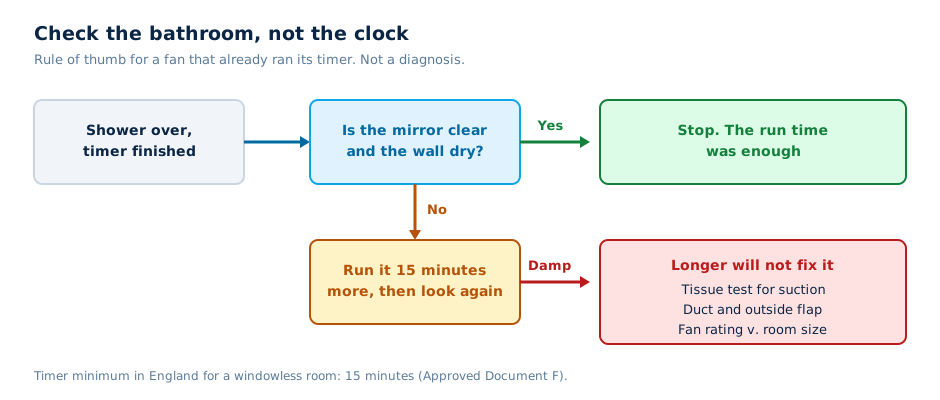
- Mirror clear. Wipe a patch if you have to, then watch whether it fogs again.
- Walls and ceiling dry. Put a hand on the cold outside wall and the ceiling above the shower. Beads of water mean the fan has not finished.
- Hygrometer back to baseline. If you own a hygrometer, note the reading before the shower, and run the fan until it returns close to that number. A cheap one will do, because you are comparing it with itself. I would not put a figure on the exact target: it depends on the weather and the rest of the house, and I have no measurement that says otherwise.
If the mirror is still fogged when the timer ends, run the fan another 15 minutes and look again. That is my rule of thumb, not a standard. If it is still fogged after that, stop adding time.
When running longer will not help
This is the part the quick answers skip. Extra minutes only help a fan that is moving air out of the building. If it is not, an hour is just an hour of noise.
Turn the fan off at the wall or isolator before you take a grille off or look inside it. A bathroom is a wet room and the fan is wired to the mains.
Three faults account for most “the fan runs but nothing changes” cases:
- Weak suction. The Building America guide gives a simple test: a bathroom fan should have enough suction to hold a tissue against the grille. If the tissue drops off, dust on the impeller or a squashed duct is the likely cause.
- A duct that does not go outside. The same guide says to exhaust outdoors, not into an attic, crawlspace, garage or wall cavity, and to keep ducts short and gently bent with sealed joints. A fan that blows into the loft is moving the steam about, not removing it.
- An undersized fan. A fan rated for a toilet will not clear a steam-filled shower room in the time you would like. The Building America page also notes that ducting and installation can cut airflow below the factory rating. That is the sort of fault I would measure rather than guess at, and a fan that is simply too small has to be replaced.
If all of that checks out and the room still stays wet, the moisture load is bigger than a fan can handle alone. At that point a dehumidifier on the landing, with the bathroom door open, finishes the job. Where to put a dehumidifier covers that, and what size dehumidifier do I need helps you choose one.
If you are already seeing black spots, the fan timing is not the only fix, so read bathroom shower mould as well.
Twenty minutes and a clear mirror is the answer for most bathrooms
So, how long to run a bathroom extractor fan comes down to this. Set the overrun for at least 15 minutes, because that is the minimum for a windowless room. I would set it to 20 to 30, then use the mirror, the walls and a hygrometer to decide if that is enough for your bathroom. If a fan can never get there, stop adding time and fix the suction, the duct or the size.
And if you were wondering whether you need one in the first place, do I need a bathroom extractor fan is the place to start.
FAQ
Should I leave my bathroom extractor fan on all the time?
Not for an ordinary intermittent fan. Holmes Services says running it all day is usually unnecessary, since 15 to 20 minutes is enough for most homes. The exception is a fan designed for continuous low-speed running, and that is a different product.
How long should a bathroom fan run after a bath?
A bath puts out a lot of steam and keeps the room warm and wet for longer than a shower. I would use the long end of the range, 30 minutes, and check the mirror and the walls. The test matters more than the number.
Can you run a bathroom extractor fan too long?
The sources disagree. House Digest warns that running for hours wastes electricity, pulls heated air out of the house and wears the motor. I could not find a primary source for the motor and fire claims, so I would not put weight on them. An hour is about as long as any guidance I opened asks for.
Do humidity-sensing extractor fans need a timer too?
Many have both: the sensor switches the fan on, and a run-on timer keeps it going afterwards. The regulations say a room with no opening window needs the 15-minute run-on, so check what your model does after the humidity falls.
Is it better to open the window or run the fan?
The fan, when it works. It moves a known amount of air out of the building every time. A window depends on the weather and may chill the walls, which is the opposite of what you want while the room is steamy.
Why is my bathroom still wet after the fan has run for an hour?
Usually the fan is not moving enough air. Check the tissue test, the duct route and the outside flap, and compare the fan’s rating with the room size. A run time that never gets there is a fault, not a setting.

