
Last Updated on October 24, 2026 by Umar Farooq
How to get rid of mold in bathroom areas: fix the moisture first, scrub a small patch (under about 10 square feet / 1 square metre) off hard surfaces with detergent and water, dry it completely, and replace any silicone the mould has grown into. The cleaning is the easy half. The half that decides whether you are back with a brush in March is what the room does with steam.
Why mould shows up in the same four places
A hot shower puts a lot of water vapour into a small room very quickly, and warm air holds more of it than cold air does. The vapour spreads, meets a surface cooler than the air, and turns back into water. That is condensation, and it is why a bathroom can feel dry on the room’s humidity reading and still have a streaming outside wall.
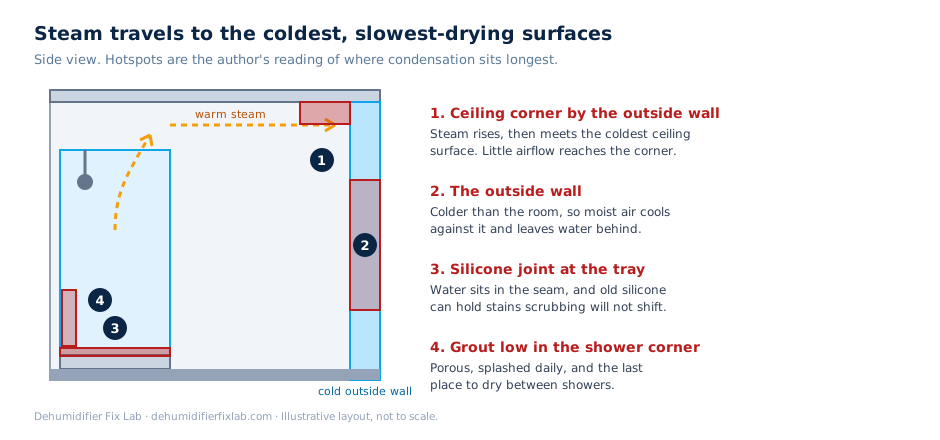
The pattern repeats from house to house, and the diagram above is my reading of it rather than a measured survey:
- Ceiling corner by the outside wall. Coldest surface, least airflow.
- The outside wall itself. Colder than the room, so moist air cools against it.
- Silicone joints at the tray, bath and tiles. Water sits in the seam.
- Grout low in the shower corner. Porous, splashed daily, and last to dry.
Mould around windows follows exactly the same logic, just with glass instead of tile. If you are unsure what you are looking at, the guide to what black mould looks like helps tell mould from soap scum.
Check for a leak, then clean a small patch
Open the window and wear gloves and eye protection before you scrub. Never mix cleaning products with each other: some combinations release harmful fumes. Do not scrub or brush dry mould, because that throws it into the air.
Before anything touches the mould, look for where water is getting in. The EPA’s guidance on cleaning mould is blunt about the order: fix plumbing leaks and other water problems as soon as possible, and dry everything completely. A dripping shower valve or a failed tray seal will beat any amount of scrubbing.
If it is a small patch on tile or grout, the EPA’s approach is deliberately plain: scrub mould off hard surfaces with detergent and water, and dry completely. It treats patches of less than about 10 square feet (roughly 1 square metre) as a job you can usually handle yourself. Bigger areas, or any significant water damage, are a different category, covered in the last section.

Rinse the cloth often, then dry the surface with a towel or squeegee rather than leaving it to air-dry. Wet is what you are trying to remove, not just the stain. How fast mould re-establishes on a damp surface is why I would never leave a scrubbed grout line damp overnight.
Cut out black silicone rather than scrubbing it
Grout can usually be cleaned. Silicone is another matter. It is flexible rather than porous in the grout sense, but old, cracked or stained silicone can hold dark marks that no amount of scrubbing shifts. My judgement, not a tested result, is that recutting it is cheaper than a fifth round of scrubbing.
The order matters:
- Cut the old bead out with a sealant tool or sharp blade, and pull away every strand.
- Clean and dry the joint fully, ideally for a day.
- Apply new sanitary silicone and smooth it.
The EPA’s own advice is the reason for step 2: do not paint or caulk over mouldy surfaces. Seal a damp, mouldy joint and you have simply built a warm little greenhouse behind a white bead.
Get the steam out faster than it settles
This is where I have a firm opinion: wiping the glass and tiles down after a shower does more than any product you can buy. The mechanism is simple. Water you remove by hand cannot evaporate back into the air or sit on grout, and the EPA advises acting quickly to dry wet surfaces when you see condensation. Thirty seconds with a squeegee is the highest-return habit in the house.
After that, move the air:
- Open the window or run the fan during and after the shower. The EPA’s advice is to run the bathroom fan or open the window when showering. Recommended run times vary between sources, from a few minutes to twenty, and I would rather give you a proper answer than a guess: do you need a bathroom extractor fan deals with that.
- Leave the door open afterwards so the steam does not sit in a closed box.
- Keep the room’s humidity reasonable. The EPA’s brief guide recommends indoor humidity below 60%, ideally 30 to 50%, and a cheap hygrometer is how you know.
A dehumidifier is a back-up, not a substitute, and in a bathroom it belongs on the landing rather than next to the bath. That is covered here.
When it is not a surface problem
Some bathroom mould is telling you something other than “wipe more”.
- It keeps returning in the same spot within days. Look for a slow leak, a failed seal or a cold bridge.
- Grout that is soft, crumbling or hollow-sounding. Water is probably getting behind the tiles.
- Ceiling plasterboard or paint that is stained, bubbling or soft. Absorbent and porous materials can lodge mould in their gaps, and the EPA says they may have to be thrown away.
- More than about 10 square feet / 1 square metre. That is past the small-area guidance, and the EPA points larger areas to its remediation guidance.
This guide sticks to prevention and small-patch cleaning. For anything bigger, ask someone who can inspect the building.
How to get rid of mold in bathroom for good: dry it faster than it forms
Mould in a bathroom is a drying problem that looks like a cleaning problem. Scrub the patch, replace the silicone that will not come clean, then spend the thirty seconds with the squeegee and open the window. Do that and the spotted grout stays a one-off. If your bathroom has lived with black corners for years and you have just bought a new spray, I am sorry to say the spray was never the issue.
FAQ
Does vinegar or bleach kill mold in a bathroom?
Both are popular, but the EPA’s guidance for small patches on hard surfaces is detergent and water, scrubbed off and then dried completely, and its cleanup page does not mention bleach. I have not tested either product, so I would not claim one beats the other. What matters more is that the surface is dry afterwards.
Why does mold keep coming back in my shower?
Usually because the surface is still going wet faster than it dries, or because the water source was never fixed. Check for leaks, wipe down after showers, ventilate, and replace any silicone that stays stained.
Can you clean mold off shower silicone?
Sometimes, if it is only surface marks. Stained or cracked silicone often cannot be cleaned, and replacing it is more reliable. Clean and dry the joint fully before applying new silicone.
How long should I run the bathroom fan after a shower?
Published advice runs from about 5 to 20 minutes, and I know of no single measured standard. The point is to clear the steam before it settles, which is why leaving the door open afterwards also helps.
Related guides: Mould around windows · Dehumidifier in bathroom · How long mould takes to grow

