
Last Updated on October 24, 2026 by Umar Farooq
A humidity sensor extractor fan switches itself on when the air at the fan gets damper than its trigger point, either a fixed humidity level or a quick jump above where the room was a few minutes ago, and switches off again once the air has dried. No one has to remember a switch, which is the whole selling point and also the whole risk.
It is a clever bit of kit, and at heart it is the same idea as the humidistat in a dehumidifier. The difference is that a fan can only react to what reaches it, so its sensor has more ways to be fooled than you might expect.
How a humidity sensor extractor fan decides when to run
Inside the fan housing there is a small sensor that reads relative humidity, and a controller that compares the reading with a trigger. When the reading passes the trigger, the fan starts; when it falls back, an overrun timer lets the fan finish the job before it stops.
Manufacturer instructions are blunt about it. The Manrose CF range manual says that with the humidity model, if the room “reaches about 75%”, which “will happen if the shower is run”, the fan switches on and keeps running until humidity has dropped to a normal level, “about 65%”, and it notes that the sensor is adjustable (Manrose CF100/200/400 installation instructions).
Vent-Axia’s humidistat-timer model works the same way: factory set to switch on at about 70% RH, with a set point adjustable between 65% and 95% RH (Vent-Axia 443176A instructions).
Fixed set-point or rapid-rise: two different jobs for the sensor
Not every humidity fan uses a fixed number. Some also watch how fast humidity is climbing, and that matters if your bathroom never reaches the headline trigger.
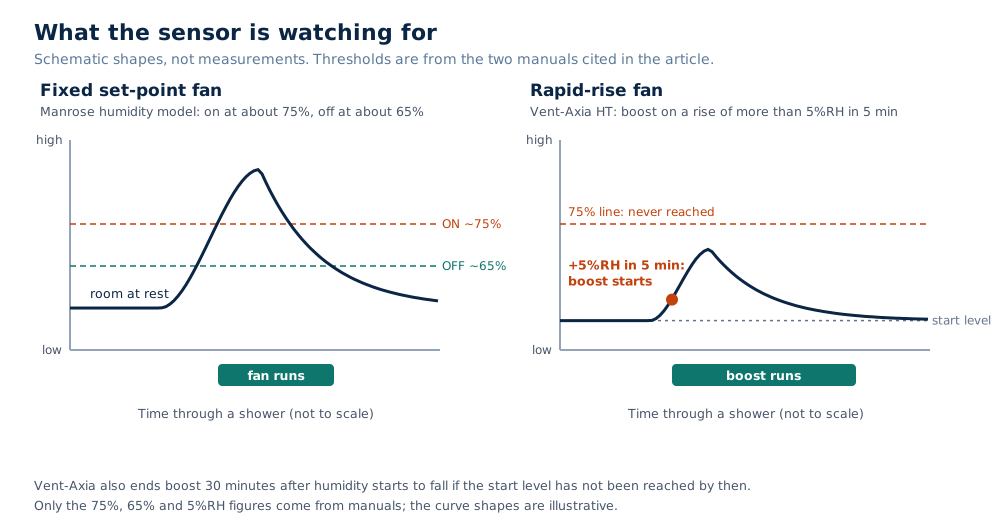
The Vent-Axia NBR dMEV C HT instructions describe both. It speeds up proportionally between its trickle and boost rates between 75% and 85% RH. It also has rapid-rise detection: if humidity climbs by more than 5% RH compared with five minutes earlier, the fan goes to boost, and stays there until humidity falls back to the earlier level or for a further 30 minutes once it starts falling, whichever is sooner. On the HT models those settings are fixed and cannot be adjusted (Vent-Axia NBR dMEV C instructions).
That fan is a continuously running one, which is a different animal from a standard bathroom fan that sits off until needed. The principle carries over, though: a baseline comparison catches a shower that a single fixed number would miss.
How it differs from a timer or pull-cord fan
A timer fan runs for a set time after you flick a switch, whether the room needs it or not. A pull-cord fan runs until someone pulls the cord again, or for its overrun. Both depend on a person remembering, and on that person guessing the duration right.
A humidity sensor fan replaces the memory and the guess with a measurement. It will run after a shower you forgot to ventilate, and it will leave a dry room alone. If you want the timing side of the argument, how long to run a bathroom extractor fan covers how long is enough, and do I need a bathroom extractor fan covers whether you need one at all.
Many humidity models keep a timer anyway. The Manrose manual’s timer maxes out at 30 minutes, so the sensor starts the fan and the overrun decides how long it keeps going once the sensor is satisfied.
Four limits of a humidity sensor extractor fan
These are the ways it lets you down. The first three are my reading of how the manuals’ thresholds behave, not claims the manuals make; the fourth is straight from the Manrose dial instructions.
- A fixed trigger can sit above your shower. If your bathroom peaks at, say, 70% RH and the fan triggers at 75%, it never starts. The Vent-Axia factory setting is about 70% and the Manrose on-point about 75%, so check what yours does.
- The sensor only reads the air at the fan. Manrose says its fan should be fitted as high on the wall as possible, or on the ceiling. Wet air next to a cold outside wall or the window can sit damp while the air at the fan reads fine.
- A damp house raises the starting line. On a muggy day the whole house can sit near the trigger, so a set-point fan either runs on and on or never gets a clear rise to react to. Neither is a fault; the sensor is doing exactly what it was told.
- Sensitivity cuts both ways. Manrose says turning the dial anticlockwise increases sensitivity, and gives an example: the fan “will stay on most of time (45-50%Rh)”. Turn it clockwise and the fan “will not switch on until humidity is very high (90-100%Rh)”.
That last point is why a fan that runs all day and a fan that never starts can be the same model, set differently.
How to tell whether yours is working
Take a normal hot shower with the door shut, as you usually would, and watch the fan rather than the mirror.
Do not open the fan or turn the adjuster dials yourself while it is connected. Vent-Axia states the humidistat should only be adjusted before or during installation, and with the mains supply switched off. If the fan needs adjusting, have a qualified electrician do it.
What a healthy fan does: it starts before the mirror is fully fogged, runs while the room is steamy, and stops some minutes after the mirror clears. If it starts only when the room is dripping, the trigger is too high. If it starts when the bathroom is dry, it is too sensitive or the room is simply humid for another reason.
A cheap hygrometer in the bathroom turns a guess into a number. Read it before the shower, at the moment the fan starts, and when it stops; how to calibrate a hygrometer is worth ten minutes first, because an inaccurate reading will make you blame the wrong thing.
A humidity sensor extractor fan reacts to showers, not to a damp house
The sensor fan is good at the job it was built for: clearing a burst of steam without you remembering. It is not a cure for a house that is damp all day, because it only sees the air at the fan and only reacts above its trigger.
If your bathroom is damp in the afternoon and the fan has been silent for hours, the sensor is probably behaving. The damp is coming from somewhere it cannot see, and that is a ventilation or moisture-source problem, not a fan setting.
FAQ
Do humidity sensor extractor fans run all the time?
Some do and some do not. A standard humidity sensor fan stays off until the trigger is reached, then runs through its overrun. A continuously running fan, such as the Vent-Axia NBR dMEV C, runs at a low trickle all the time and boosts when the sensor says so.
Why does my humidity sensor fan keep running?
Either the room really is that humid, for example on a muggy day, or the sensitivity is set too high. Manrose gives an example where the fan stays on most of the time at 45-50% RH on its most sensitive setting. Any adjustment should be made with the mains off by a qualified person.
Why does my humidity sensor fan never come on?
The trigger may be higher than your shower ever reaches. Manrose’s least sensitive setting only switches the fan on when humidity is very high, 90-100% RH. The sensor could also be faulty, which is a job for an electrician rather than a screwdriver.
Can I adjust the sensitivity myself?
I would not. The Vent-Axia manual says the humidistat should only be adjusted before or during installation, with the mains supply switched off. Some models have fixed settings that cannot be adjusted at all.
Is a humidity sensor fan better than a timer fan?
For a bathroom used at unpredictable times, yes, because it does not rely on you remembering. It is not better if the trigger is set too high for your room, which is when a simple timer starts to look sensible.

