
Last Updated on October 25, 2026 by Umar Farooq
What does a thermo hygrometer do? It measures air temperature and relative humidity in one unit and shows both on a single display. That is the whole device, and the reason it is the sensible default over a hygrometer on its own.
The temperature half is not there to be helpful. It is there because relative humidity cannot be understood without it, which is the one idea worth taking from this page.
What does a thermo hygrometer do? The two readings, and why they come as a pair
The National Physical Laboratory’s Beginner’s Guide to Humidity Measurement explains the link. The capacity of air to hold water vapour depends on its temperature, and the higher the temperature, the more it can contain. Relative humidity is how saturated the air is, usually written %rh. Because the “relative” part is relative to temperature, NPL says relative humidity instruments generally have integral temperature sensors.
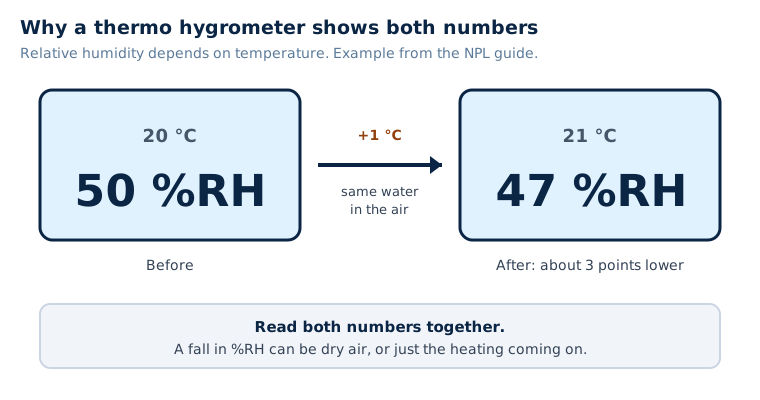
The practical consequence is NPL’s own example: at 50 %rh, a rise from 20 °C to 21 °C makes the relative humidity fall by about 3 %rh. So the humidity number on its own is half a story. The temperature next to it tells you whether a fall is dry air arriving or just the heating coming on.
RS Components lists digital models among its hygrometer types, including digital thermo hygrometers that measure both, and notes some store minimum and maximum values. There are old-fashioned glass-bulb versions too, which compare two thermometers and use a chart.
Use 1: judging whether a room is too humid
The ordinary use. Read the humidity, compare it with the 30 to 50 per cent target and the 60 per cent ceiling in the EPA’s brief guide to mould and moisture, and glance at the temperature to see why it is where it is. How to read a hygrometer goes through the detail.
The temperature turns a bare number into a diagnosis. A bedroom at 66% and 12 °C is a cold, damp room; at 66% and 21 °C it is a warm room with a lot of moisture in it. Those are different problems with different fixes, and a hygrometer without a thermometer cannot distinguish them.
Use 2: working out when condensation is likely
A common feature on better thermo hygrometers is a dew point reading. NPL defines dew point as the temperature at which condensation would occur if a gas were cooled, and says it tells you what temperature to keep a gas to prevent condensation. In a house, that means any surface colder than the dew point may collect water.
Not every unit shows dew point. If yours does not, it is worth remembering the principle, not the calculation: the higher the humidity and temperature, the higher the dew point, and the more surfaces count as “cold”. Condensation on windows is the place to see the principle at work.
I would not use the dew point number to the decimal. It is calculated from two readings that each carry error, and how accurate hygrometers are explains how big that error can be.
Use 3: seeing what happened while you were out
The minimum and maximum readings, where the unit has them, are the best feature on a cheap thermo hygrometer and the least used. A single glance is a snapshot. The overnight maximum tells you what the room did when nobody was watching: the bedroom after a night’s breathing, the bathroom after a shower, the kitchen after dinner.
If you want to go further, how to log humidity at home shows a simple record that turns these highs and lows into a pattern.
What a thermo hygrometer does not do
Three limits, so that you do not ask too much of it.
- It does not measure wall dampness. It reads the air around it, not the material. For walls you need a moisture meter or an inspection.
- It does not control anything. It reports, and does not switch a dehumidifier or fan. A humidistat does that.
- It reads one spot. NPL warns that measuring at a cold spot can over-estimate the typical humidity in a room, so position matters.
A thermometer and a hygrometer in one box is the cheapest useful damp tool
A thermo hygrometer tells you how damp the air is, how warm it is, and sometimes when condensation is likely. That is enough to decide whether you have a moisture problem, which is the question most of us start with. Put it away from radiators and cold walls, read it at the same times each day, and let the pattern do the talking.
FAQ
What does a thermo hygrometer measure?
Air temperature and relative humidity, usually shown together on one display. Some also show dew point and store minimum and maximum values.
Is a thermo hygrometer the same as a hygrometer?
A hygrometer measures humidity. A thermo hygrometer adds a thermometer, so it shows both. Because relative humidity depends on temperature, most digital humidity units include a temperature sensor anyway.
What is a thermo hygrograph?
A chart recorder that measures and records both temperature and humidity, according to Wikipedia. It is a recording instrument rather than a household display.
What humidity should a thermo hygrometer show at home?
The EPA advises keeping indoor humidity below 60 per cent, ideally between 30 and 50 per cent.
Where should I put a thermo hygrometer?
Away from radiators, direct sun, windows and cold external walls, at about eye level in the room you want to know about. The reasons are in where to put a hygrometer.

