
Last Updated on October 25, 2026 by Umar Farooq
How accurate are hygrometers? A decent digital one is usually within about 2 to 5 percentage points of the true humidity when new, a cheap dial is often looser, and every type drifts as it ages. That range is my reading of the sources below, not a figure any one of them gives for your particular gadget.
The good news is that a damp-house decision rarely needs better. The less good news is that the number on the display has more decimal places than evidence behind it.
Error one: the datasheet figure describes the chip, not your unit
The best published numbers come from sensor makers. Sensirion’s SHT4x datasheet lists a typical relative humidity accuracy of 1.8 %RH at 25 °C for its SHT40 chip, and a long-term drift of typically less than 0.2 %RH a year. That is a good sensor measured under controlled conditions against a traceable reference.
Three things stop you carrying that figure home:
- It is a typical value for one chip at one temperature. The datasheet gives separate, wider tolerance charts away from 25 °C.
- Your hygrometer is a chip plus a case, a placement and a firmware choice. Heat from a battery or screen next to the sensor changes the temperature it sees, and relative humidity moves with temperature.
- Rotronic’s technical note Humidity Accuracy Demystified points out that an accuracy specification compares a unit with a reference on the day. It does not include the reference’s own uncertainty or later drift.
I have not tested a batch of consumer units, and I am not going to pretend a datasheet for a lab-grade part is a promise about a £10 one.
Error two: cheap units are sold with wider tolerances, and they mean it
Budget figures are looser, and the sources that quote them are mostly sellers, so read them as claims. A cigar-humidor maker’s FAQ says most digital hygrometers are accurate to about ±5 to 7 %RH. A calibration-instrument seller says analogue dials are typically within about 5% and digital ones within 1 to 2%. Those two vendors disagree about digital, which is itself informative.
What “±5” means is easy to misread. NPL’s Beginner’s Guide to Humidity Measurement spells it out with an example: 50 %rh ± 3 %rh at a 95 per cent level of confidence means you are 95 per cent sure the true value is between 47 and 53. Note the confidence level. A claimed ±5 is a boundary most readings should fall inside, not a guarantee that every one does.
Digital is not automatically better. A dial is a mechanical sensor that can be set well or badly, and a cheap digital unit with no adjustment can be wrong in a fixed way for ever. What the screen shows is resolution, not accuracy; a display that reads to 0.1 tells you nothing about how close that tenth is.
Error three: drift, and who ever checks it
A hygrometer that was right in the box is not necessarily right after two winters. NPL says hygrometers can suffer from bias and long-term drift, from conditions of use or just sensor ageing, and that relative humidity instruments might be calibrated every 6 to 12 months, more often if harshly treated. That advice is for instruments people rely on for measurement. Nobody does it for a gauge on a bookshelf, and I would not either.
The honest compromise for a home is a check, not a calibration programme. Rotronic notes that few datasheets list long-term drift at all, so for a household unit you will probably not find the figure. How to calibrate a hygrometer covers the salt test; once a year, before the damp season, is a reasonable habit and my own judgement rather than a published rule for consumer gear.
How accurate are hygrometers in a damp room?
Less than the box says, which is awkward, because damp rooms are where you use them. Sensirion’s datasheet states that long exposure outside its recommended 20 to 80 %RH range, especially at high humidity, may temporarily offset the reading, for example by +3 %RH after 60 hours above 80 %RH. It adds that the sensor recovers to within specification by itself once back in the normal range.
Two practical consequences, one sourced and one mine:
- A hygrometer left in a bathroom, a cellar or a steamed-up kitchen may read a little high for a while after. The +3 is from one manufacturer’s chip. Others will differ, and I have not measured it.
- Where it sits matters nearly as much as which one you buy, because a spot beside a cold wall or a radiator reads the air there, not the room. See where to put a hygrometer for that.
Does a few points either way change what you do?
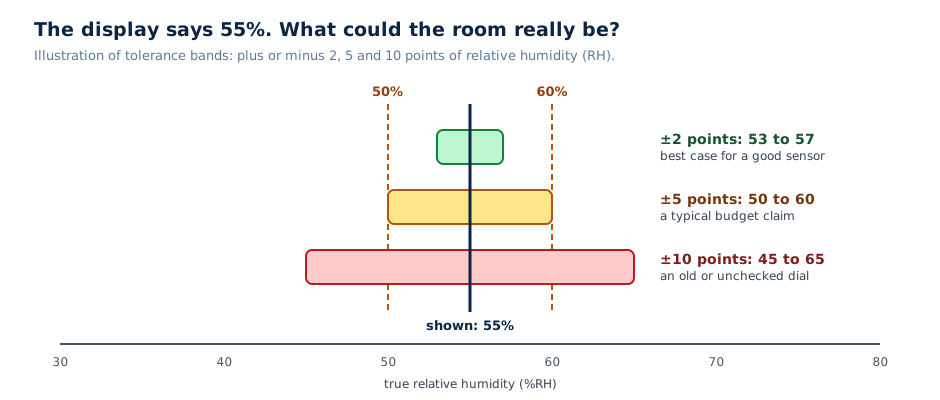
Mostly not. Indoor humidity advice is itself given as bands, not exact values: the usual guidance is to keep a home below about 60 per cent, with 30 to 50 per cent as a comfortable target, as set out in what indoor humidity should be. Compare the error bands in the diagram with those lines:
| What the display says | Error you might have | What it means in practice |
|---|---|---|
| 40% | ±5 | Somewhere between 35 and 45. Comfortable either way. |
| 55% | ±5 | Between 50 and 60. Fine, but near the top of the target. |
| 62% | ±5 | Between 57 and 67. Probably above 60; act on it. |
| 58% | ±10 | Between 48 and 68. Check with a second reading before you decide. |
The last two rows show where accuracy does bite: when the reading sits within one error band of a line you are acting on. Then the cheap fix is not a better hygrometer but a longer record. A week of readings that stay between 60 and 65 is information that no single ±5 can wash out. For the line itself, is 60% humidity too high in a house goes through what changes at that point.
Trust the trend, check the unit once a year, and stop worrying about the decimal
Hygrometers are accurate enough for the job they are bought for. For a damp house the decision is coarse: is the room mostly in the 40s and 50s, or living in the 60s and 70s? Any working unit, even one a few points out, separates those. Where it misleads is the middle, and a log beats a single reading there.
Buy on tolerance, not on display resolution. Check what you own against a salt reference once a year. Move it away from walls and heat. Then stop treating the decimal as evidence.
FAQ
How accurate are hygrometers for home use?
A reasonable digital hygrometer is usually good to within a few percentage points of relative humidity when new, and budget units are commonly sold with a ±5 tolerance. Sellers’ figures vary, and the true error of a given unit is unknown without a reference check. For checking a house against the 30 to 50 per cent target, that is usually enough.
Are digital hygrometers more accurate than analogue ones?
Not automatically. Vendors quote tighter tolerances for digital units, but a cheap digital with no adjustment can be consistently wrong, and a dial can be set against a reference. Digital does make the readings easier to log and compare, which helps more than the extra decimal.
How often should a hygrometer be replaced or recalibrated?
NPL says relative humidity instruments might be calibrated every 6 to 12 months, or sooner if harshly treated. For a household unit I would check it once a year and replace it if it is a long way out, since many cheap ones cannot be adjusted.
Do hygrometers read worse at high humidity?
They can. One manufacturer’s datasheet reports a temporary offset of about +3 %RH after 60 hours above 80 %RH, with recovery afterwards. Treat readings taken straight after a long spell in saturated air with caution.
How much error is too much for a hygrometer?
For deciding whether a house is damp, more than about 5 points off a reference is worth fixing or replacing. That threshold is my judgement, not a published standard.

