
Last Updated on October 25, 2026 by Umar Farooq
Where is the highest humidity in a house? The bathroom has the biggest spikes, but the highest relative humidity at any moment is at the coldest surfaces: corners of outside walls, window glass, and the basement floor. That is because colder air holds less moisture, so the same water vapour reads as a higher percentage the colder it gets.
Most articles list rooms: bathroom, kitchen, basement. That is a fair guess, but it leaves out the more useful answer. A single room has several humidities at once, and the one that causes mould is the one at the cold wall, not the one on the shelf where the hygrometer lives.
Why humidity is highest where it is coldest
Relative humidity is a percentage of how much moisture the air could hold at its current temperature. The US National Weather Service puts it this way: air will have a higher relative humidity if the air is cooler, and a lower relative humidity if the air is warmer. Same water, cooler air, higher reading.
Here is my own arithmetic (using the standard Magnus approximation for saturation vapour pressure, not a measurement). Take room air at 20°C (68°F) and 50% relative humidity, and cool it without adding or removing any water:
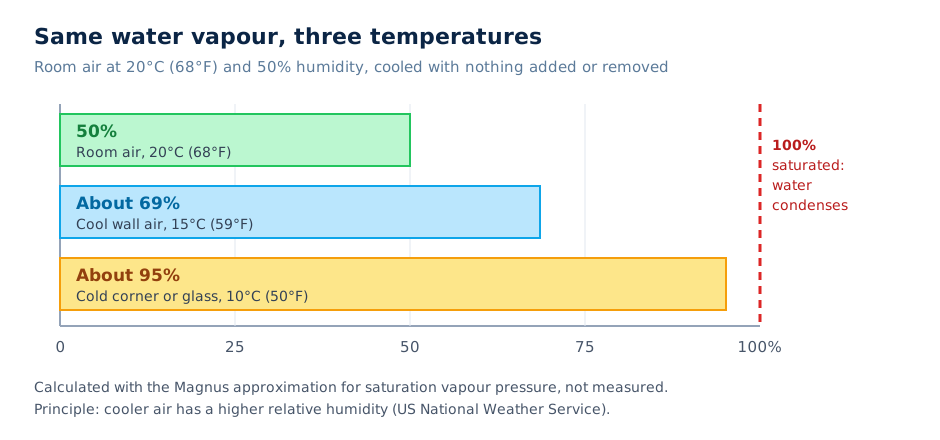
That is why a wall that is only a few degrees colder than the room is where condensation and mould start. The EPA notes that mould is frequently found on walls in cold corners behind furniture, where condensation forms. The room average looks fine, and the corner is quietly near the top of the scale.
Where is the highest humidity in a house? Six places, ranked

1. The bathroom, during and after a shower. The biggest short spike in the house, and normally the quickest to recover if the fan works. Normal bathroom humidity is about the recovery, not the peak.
2. The kitchen, while you cook. Boiling and steaming put water straight into the air. Usually a shorter peak than the bathroom, unless the hob has no extraction.
3. The utility room or any room with drying laundry. An airer of wet washing releases its water over hours, not minutes, so these rooms run damp for longer than a bathroom.
4. The coldest bedroom, overnight. People breathe out water vapour all night, and a bedroom with the door shut and a cold outside wall can read highest first thing in the morning.
5. Cold corners, behind furniture and inside wardrobes. Still air against a cool wall. The room reading is fine and the corner is the problem.
6. Basements, cellars and ground-floor concrete. These sit against the ground, stay cool, and are often damp from the structure itself. Why a basement is humid in summer covers the summer case, when warm air meets a cold slab.
How to find the highest humidity in your own house
You do not need to guess. Two cheap hygrometers and an evening will tell you more than a list.
- Put one hygrometer in the middle of a room at about head height, as where to put a hygrometer suggests, and note the reading.
- Put the second in the suspect spot, such as the cold corner or behind the wardrobe, and leave it for an hour so it settles.
- Compare. A gap of several points between the two is your cold spot telling you something.
- Repeat first thing in the morning, when bedrooms and cold walls are at their worst.
Cheap units can disagree with each other, so swap their positions to see whether the gap follows the spot or follows the gadget.
For a wall you cannot get a hygrometer to, finding cold spots on walls shows how to locate them.
What to do about the highest-humidity spot
The fix depends on which type of spot you have, and it is rarely “buy a bigger machine”.
- Spike spots (bathroom, kitchen): Extract the steam at source, and keep doors shut while you cook or shower so it does not wander.
- Cold spots (corners, wardrobes, behind furniture): Warm the wall or move the air. Pull furniture 5 to 10 cm off outside walls, leave wardrobe doors ajar, and keep the room at a steady, modest temperature.
- Ground spots (basement, slab): Look for the water source first, then dry the air. A dehumidifier earns its keep here.
Keep the overall house under the EPA’s guidance of below 60 percent, ideally 30 to 50 percent and the cold spots stop reaching the saturation point so easily.
The highest humidity is at the coldest surface, not the wettest room
The honest answer is that humidity in a house is uneven, and the readings that matter are at the coolest surfaces. Rooms give you the headline: the bathroom peaks highest, the kitchen next. But if mould keeps appearing in the same place, the cold spot there is probably reading far higher than the hygrometer on your shelf. Measure the spot, not the room.
FAQ
What room in the house has the most humidity?
Usually the bathroom during and after showering, followed by the kitchen while cooking. Basements and laundry rooms can stay damp for longer.
Why is humidity higher in some parts of a house?
Colder air holds less moisture, so cold corners and walls show a higher relative humidity than warmer air nearby, even though the water content is the same.
Does humidity rise upstairs or downstairs?
There is no fixed rule. Warm, moist air tends to rise, which can make upper floors and lofts the place where it meets cold surfaces, while ground floors and basements are damp from the ground. The cold spots matter more than the floor.
How do I find damp spots in my house?
Compare a hygrometer in the middle of the room with one in the suspect spot, and check cold external walls first thing in the morning. A damp meter confirms whether materials themselves are wet.
Is 70 percent humidity in one room a problem?
Briefly after a shower, no. If it stays at 70 percent for long periods, find the moisture source, because the EPA’s guidance is to keep indoor humidity below 60 percent.

