
Last Updated on October 25, 2026 by Umar Farooq
Normal bathroom humidity is a sharp spike while you shower that falls back to your home’s usual 30 to 50 percent within about an hour of the fan or window doing its job. There is no single “normal” number for a bathroom, because the reading changes by the minute. The recovery is what tells you whether yours is healthy.
Most guides give you a range and leave it there, which is a bit like telling you a kettle’s temperature should be “between cold and hot”. A bathroom is the wettest room in the house for twenty minutes a day and ought to be an ordinary room for the other twenty-three hours.
Three numbers that decide whether it is normal
Instead of hunting for one figure, watch three:
- The baseline. What the bathroom reads when nobody has used it for a few hours. The EPA advises keeping indoor relative humidity below 60 percent, ideally between 30 and 50 percent. That is the baseline you want to be at.
- The peak. What it reads in the middle of a shower. It will be high, and that is fine. I have not measured one across a range of bathrooms and I would not trust anyone quoting a precise peak figure, because it depends on water temperature, shower length, room size and how much air the room has.
- The recovery time. How long it takes to fall back to the baseline. This is the number that separates a healthy bathroom from a problem one.
A healthy bathroom spikes and recovers. A problem bathroom spikes and sits there.
Normal bathroom humidity readings: before, during and an hour after
Put a cheap hygrometer on an inside wall away from the shower, as where to put a hygrometer explains, and read it at three moments: before the shower, at the end of it, and an hour later.
| Reading moment | What is normal | What is a warning |
|---|---|---|
| Before showering | In line with the rest of the house, ideally 30-50% | Still well above the rest of the house |
| End of the shower | High, close to the top of the scale is common | n/a, this is expected |
| One hour later | Back near the baseline | Still high, or still above 60% |
The table is my own rule of thumb, built on the EPA’s under-60-percent guidance and on the idea of recovery. It is not a published standard for bathrooms, and I am not aware of one.
How fast bathroom humidity should drop
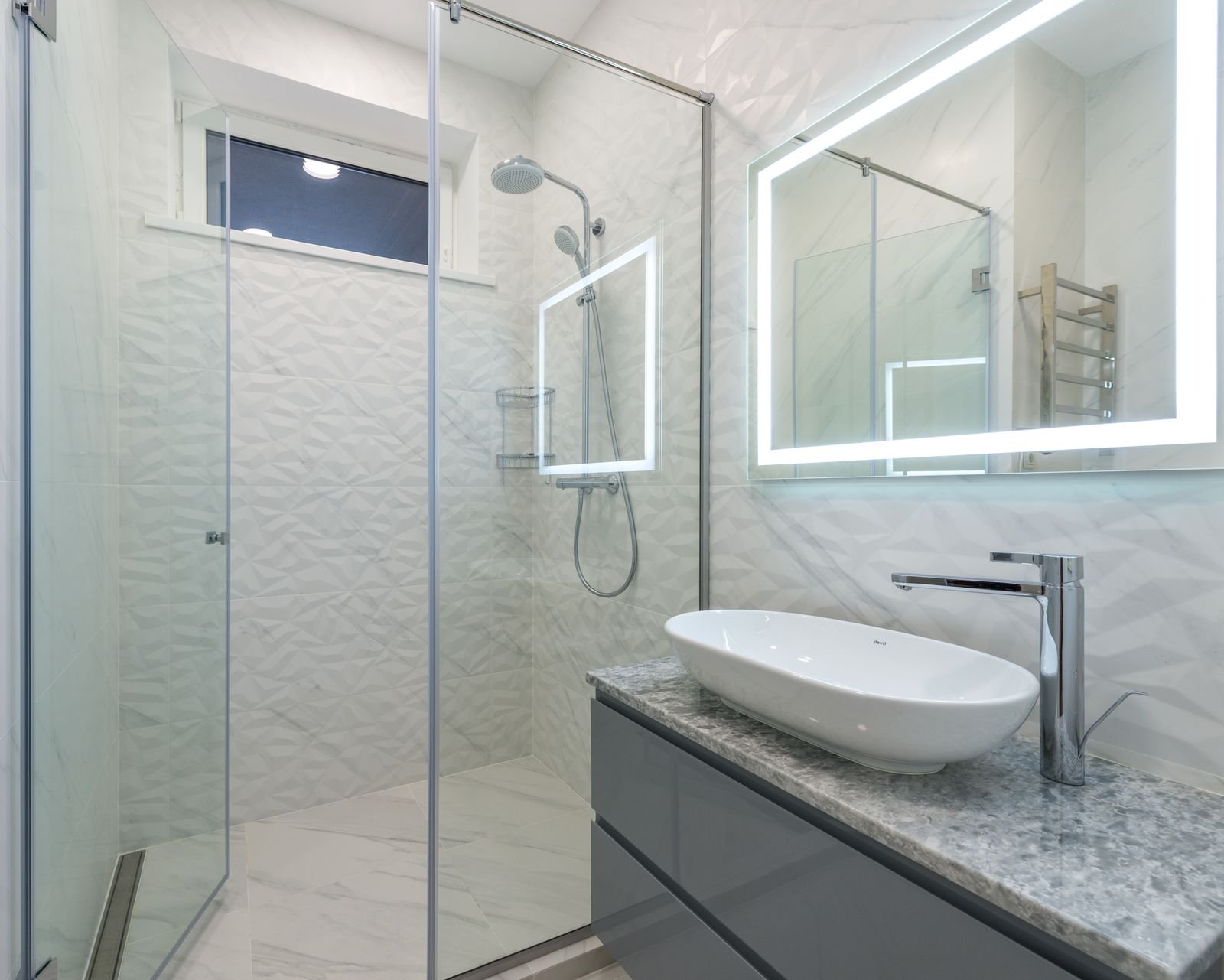
The best number I can point to is for extraction. The US Department of Energy’s PNNL building guidance recommends leaving the fan running for one hour after a shower for effective humidity control. That makes an hour a sensible target for the bathroom to return to normal, with a working fan and no towels hung in there to re-release the moisture.
If it takes much longer, check these before blaming the weather:
- The fan. Hold a sheet of toilet paper to the grille. If it does not hold, the fan is not extracting properly. Our guide to how long to run a bathroom extractor fan covers run-on timers.
- The door. Steam drifting onto the landing is not “normal bathroom humidity”, it is your bathroom humidity becoming somebody else’s problem. See whether to leave the bathroom door open or closed.
- The towels and mats. A wet towel is a slow evaporator.
- The surfaces. Cold external walls and a cold window stay wet longer than warm interior walls.
When normal turns into a problem
A spike is normal. These are not:
- Walls, ceiling or window still running wet hours after a shower.
- Black speckles along the sealant, grout or ceiling corners. Our guide to bathroom shower mould explains what to do when it shows.
- Peeling paint, bubbling plaster or a musty smell that returns.
- A hygrometer that sits above 60 percent for most of the day.
The EPA says that when warm, humid air contacts a cold surface, condensation may form, which is why the coldest part of the room, often the outside wall or window, is where the trouble starts. Condensation staying put on a surface is the hand-off from “humid air” to “damp wall”.
Is a dehumidifier worth it for a bathroom?
If the fan is working and the bathroom still stays damp, a small dehumidifier can help, but fix the airflow first. Why a bathroom stays damp all day is usually a fan, a door or a drying-wet-things problem, not a case for more machinery.
A normal bathroom spikes and recovers
My view: stop looking for the perfect percentage. Look at the recovery. If the room is back to your baseline roughly an hour after the shower, with no wet walls and no mould, your bathroom humidity is normal. If it takes three hours and the ceiling grows speckles, no number on the dial is going to make that acceptable.
FAQ
What is a normal humidity level in a bathroom?
It rises sharply during a shower and should fall back to the same level as the rest of the house, ideally 30 to 50 percent, within about an hour. The EPA’s indoor guidance is to stay below 60 percent.
Is 70 percent humidity in a bathroom normal?
During or just after a shower, it can be. If the reading stays at 70 percent hours later, the room is not drying properly and the cause is usually extraction or surface temperature.
How long does it take for bathroom humidity to go down?
About an hour with a working extractor fan is a reasonable target, based on PNNL’s one-hour run-on recommendation. Without a fan or with the door shut, it takes longer.
How do I check bathroom humidity?
Use a digital hygrometer on an inside wall away from the shower, and take readings before, straight after and an hour after you shower.
Does a bathroom need a dehumidifier?
Not usually. A working fan or an opened window is the cheaper fix, and a dehumidifier only helps once the airflow is sorted.

