
Last Updated on October 24, 2026 by Umar Farooq
How to get rid of mould on fabric: brush it off outdoors, wash the item as hot as its care label allows, dry it completely, and bin anything thick, porous or still musty afterwards. Washable cotton with light surface mould usually comes back fine; carpet underlay and mattresses usually do not.
The mould is rarely the real problem. The damp that let it grow is, and a clean shirt hung back in the same cupboard will be mouldy again by spring.
Why fabric goes mouldy in the first place
Mould spores are in every room. What they lack is a reason to start, and fabric supplies one in three parts: moisture, something to eat, and still air.
The Canadian Conservation Institute says mould on textiles needs relative humidity of roughly 65% and above, warmth and poor air circulation, and that growth is unlikely while humidity stays below 60% with decent airflow. It also notes that cotton, linen and rayon are the most vulnerable fibres, with wool and silk affected too, and that soiled synthetics can host it. Body oils, food splashes and old detergent residue are the meal.
In a house, that usually means one of four things: something went into the wardrobe still damp, the wardrobe sits against a cold outside wall, the door never opens, or the room runs humid all winter. How long growth takes in practice varies a lot; the detail is here.
Work out what is worth saving before you wash anything
This is the step the laundry guides skip, and it saves the most effort. The EPA says absorbent or porous materials such as ceiling tiles and carpet may have to be thrown away if they become mouldy, and that expensive or sentimental items are worth taking to a specialist. Everything else is judgement, and mine is below.
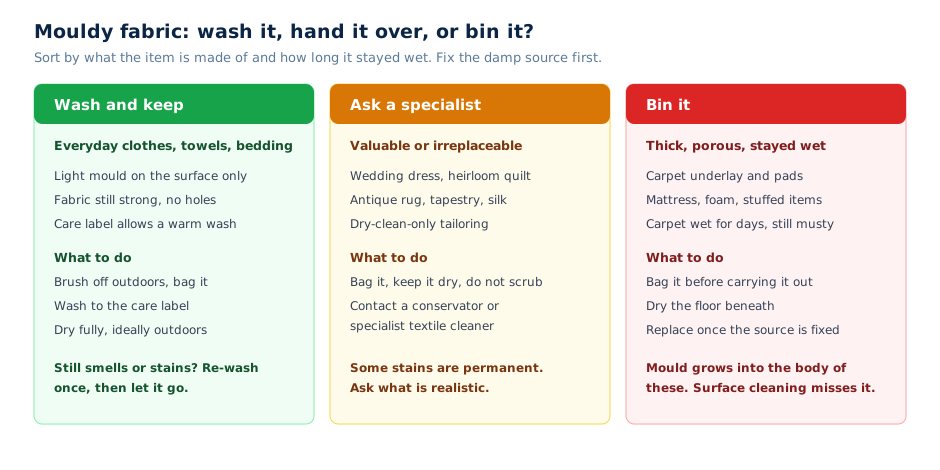
- Keep and wash: everyday clothes, towels and bedding with light surface mould, strong fabric, and a care label that allows a warm wash.
- Ask a specialist: a wedding dress, heirloom quilt, antique rug or dry-clean-only tailoring. The Conservation Institute advises consulting a conservator before washing or dry cleaning valuable textiles, and warns that some mould stains are permanent.
- Bin: carpet underlay, mattresses, foam cushions and stuffed toys that stayed wet for days, plus anything that still smells musty after a proper wash.
The smell test is mine, not a published standard. If an item has had two good washes and still smells of the cupboard, I stop. You are not rescuing a T-shirt; you are keeping a small source of the smell in your home.
How to get rid of mould on fabric you are keeping
Spores go airborne when mouldy fabric is shaken or brushed. Do the dry stages outdoors, wear gloves and a close-fitting mask (the Conservation Institute specifies an N95 respirator for small amounts), and never shake the item indoors. If anyone in the house has breathing problems, get someone else to do it.
- Bag it. Seal the item in a plastic bag where you found it and carry it out. This keeps spores out of the rest of the house.
- Dry brush outdoors. Brush loose growth off, away from open windows and washing lines. A HEPA-filter vacuum is the cleaner way for upholstery and anything that cannot go in the machine, with the nozzle held just above the fabric.
- Check the care label, then wash at the hottest temperature it permits. Heat and detergent do most of the work. White vinegar and oxygen bleach are widely recommended for pre-soaks, but I have found no tested comparison, so treat them as optional extras rather than guaranteed fixes. Test a hidden patch on coloured fabric first, and never mix vinegar with bleach.
- Inspect it wet. If a stain or smell remains, wash once more. Do not tumble dry until it is gone, as heat can set a stain.
- Dry it fully, ideally outdoors in daylight on a dry day. Fully means bone dry, including seams, pockets and waistbands.
If you cannot wash it straight away, keep the bag sealed and dry rather than leaving it to sit. Freezing a sealed item stops active growth, but the Conservation Institute is clear that spores survive it, so it buys time and nothing more.
Mould on carpet is a different problem
Carpet is thick, holds water and has a pad underneath, so a stain on top says little about what is happening beneath. The EPA lists the underside of carpets and pads as a typical hiding place for hidden mould.
My rule: if the carpet was wet for more than two days and smells musty, lift a corner and look underneath. The EPA says water-damaged items should be dried within 24 to 48 hours, which is a drying deadline, not a promise of mould after that. If the underlay is dark or smelly, it goes. Carpet itself can sometimes be cleaned and dried if the damage is small and caught early. Where mould covers more than about 10 square feet (roughly 1 square metre), the EPA suggests following its remediation guidance or calling a professional.
A dehumidifier dries the room, not the pad, so it only helps once the source is fixed and the underlay has been dealt with. This guide covers sizing one.
Stop it coming back by drying the room, not the item
Cleaning without fixing the damp is a subscription service.
- Never store anything damp. A towel that feels dry at the edge can be wet at the fold. Dry laundry properly, and here is how to do it indoors.
- Keep the room below 60% humidity. That is the Conservation Institute’s own threshold. Put a cheap hygrometer in the bedroom and look at it.
- Leave air gaps in the wardrobe, with nothing jammed against the back wall. The closet guide covers absorbers and what is worth buying.
- Fix the water first. A leak, a cold wall or a steamy bathroom next door will beat any cleaning routine.
Mould on fabric is a drying failure, so fix the drying
Most mouldy clothes can be saved if you catch them early and wash them hot. Thick, wet, porous things like underlay, mattresses and foam usually cannot, and trying to scrub them clean is how a small problem becomes a recurring one. Sort first, wash what is worth it, bin what is not, then spend the saved effort on the room.
FAQ
Can you get mould out of clothes permanently?
Often yes, if the mould is on the surface and the fabric is still strong. A hot wash, thorough drying and some daylight handle most cases. Stains and smells can linger on some fabrics, and the Conservation Institute notes that some mould stains are permanent.
Does vinegar kill mould on fabric?
It is widely recommended as a pre-soak, but I could not find a tested comparison against ordinary hot washing, so I would not rely on it. Use it as a deodorising extra if you like, and keep it away from bleach.
Should I throw away mouldy clothes?
Throw them out when the fabric is weak or stained, or when the smell survives two proper washes. Keep and wash everyday items with light surface growth. Valuable pieces are worth asking a specialist about first.
Can I put mouldy clothes in the washing machine with other clothes?
I would not. Wash them separately so loose spores do not travel, and run an empty hot cycle afterwards if your machine’s manual allows it.
Can mouldy carpet be saved?
Sometimes, if the patch is small, it was dried quickly and the underlay is clean. Carpet that stayed wet for days, or has a mouldy pad, is usually replaced, and the EPA says porous materials like carpet may have to be thrown away.
Does a dehumidifier help with mouldy clothes?
It cannot clean mould that has already grown, but it lowers the humidity that feeds new growth, so the cleaned items stay clean. Does a dehumidifier help with mould goes into when it is enough on its own.

