
Last Updated on October 23, 2026 by Umar Farooq
An air purifier dehumidifier is two separate jobs in one box: the dehumidifier removes water vapour, the HEPA purifier removes airborne particles, and neither job helps the other. Plenty of boxes do both, but the useful question is which of the two your room is actually short of.
I get asked this most often by people who read “dehumidifiers clean the air” on a product page. They dry the air. Whether that counts as cleaner depends on what is wrong with it, and the next few sections sort out which problem belongs to which machine.
Can one machine be an air purifier and a dehumidifier at once?
Yes, it exists. Search for the phrase and you will find compact 2-in-1 units, for example Airthereal’s Zephyr AZH200 2-in-1 air purifier and dehumidifier, which sells a HEPA purifier and a moisture remover in one case.
Whether it is a good idea is a different matter, and here I am reasoning rather than quoting a test. A purifier wants a big, dense filter and a strong fan. A dehumidifier wants a cold coil and a bucket or drain. Squeezing both into one body tends to shrink both, so I would expect the water-removal side of a small combo to be modest next to a stand-alone unit. I have not measured one, and the makers’ pages are the place to check the daily capacity before you buy.
For comparison, I wrote about the same trade-off in humidifier dehumidifier combos, and the logic carries over: two jobs sharing a casing, a board and a fan means one fault can take out both.
What does the mesh on a dehumidifier actually catch?
The flat grille on the back of a compressor dehumidifier looks like an air filter. It is a coil guard. Its job is to stop fluff and hair clogging the cold coil, which is why the dehumidifier filter is a maintenance chore, not an air-quality feature. It is coarse mesh and it is not rated for the fine particles a purifier is built for.
A true purifier is different. The US EPA’s guide to air cleaners in the home says portable air cleaners often get a high clean air delivery rate (CADR) by using a HEPA filter, and that the CADR rating “is for particles only”. The same page adds that activated carbon can help with gases only when a large amount of it is used, and that there are no widely used rating systems for gas removal. So a small carbon strip in a combo should not make you expect a cleared smell.
Match the device to the symptom
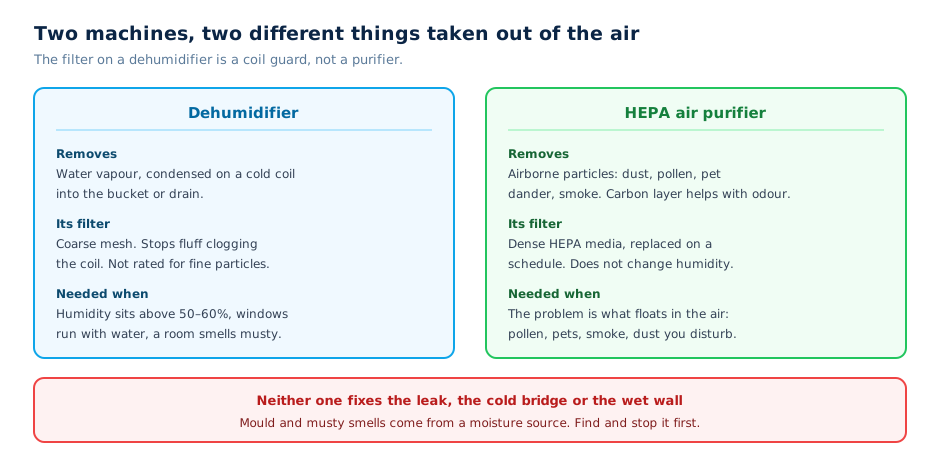
Start with what you can see, smell or measure:
| What you notice | Reach for | Why |
|---|---|---|
| Windows running with water, damp air, humidity stuck above 60% | Dehumidifier | The problem is water vapour |
| Musty smell in a damp room | Dehumidifier, and find the moisture source | The smell follows the damp, not the particles |
| Pollen, pet dander, smoke drifting in | HEPA air purifier | The problem is particles in the air |
| Dust you can wipe off a shelf | Cloth or vacuum | Settled dust is not in the air any more |
| A patch of mould on the wall | Neither, fix the water first | See below |
If your reading is above the band, measure before you buy: the EPA advises keeping indoor humidity below 60%, ideally 30 to 50%. If it already sits in that band, a dehumidifier has nothing to do, and what a dehumidifier does and does not do about dust explains why it will not clear a dusty room either.
Mould is where the two get confused
Do not rely on a purifier or a dehumidifier to deal with a mould patch. Fix the water source first. The EPA says a patch under about 10 square feet (roughly 1 square metre) can usually be cleaned by the householder following its guidelines, while larger areas or heavy water damage need its remediation guidance.
This is where marketing blurs the line. The EPA’s air cleaner guide states plainly that portable air cleaners and furnace filters “do not address the cause of mold and musty odors”. It adds that they may remove some mould particles but will not resolve a mould and moisture problem. Its mould guide puts it the other way round: “The key to mold control is moisture control.”
So the order is: find the leak, condensation or damp, fix it, and then lower the humidity while materials dry out. A dehumidifier helps with that second step. A purifier can tidy up airborne particles while you do the work, as a supplement. Neither is a cure for a wet wall.
Where a 2-in-1 air purifier dehumidifier falls short
Three weak points, none of them dramatic.
Placement conflict. A dehumidifier works best near the damp, with a clear gap round it, and a purifier works best where you breathe, usually a bedroom or living room. Those are often not the same spot.
Two consumables. A HEPA filter is replaced on a schedule, and a dehumidifier needs its bucket emptied and its mesh washed. A combo makes you do both, and a missed task on one side affects the other.
One fault, two losses. If the fan or board fails, the purifier and the dehumidifier go down together.
My honest opinion: buy the stand-alone dehumidifier that matches your room, using the sizing guide, and add a stand-alone purifier only if particles are a real problem. A combo makes sense only in a small room, such as a box room or a closet, where both jobs are needed and floor space is the limiting factor. That is a judgement call, not a tested result.
Run both together only when the room needs both
Can you run a dehumidifier and a purifier in the same room? Of course, and they do not interfere. A damp, dusty, pet-filled flat can need both, a dehumidifier for the moisture and a purifier for the particles. Put the dehumidifier near the damp and the purifier near where you sit or sleep, and give each some clear space around it.
If only one of the problems is real, run only that machine. Running a purifier in a damp room does nothing about the damp, and running a dehumidifier in a dry, dusty room does nothing about the dust.
Settle the damp first, then decide whether an air purifier dehumidifier earns its place
If the room reads above 60%, start with a dehumidifier and the water source. If the complaint is pollen, pets or smoke, start with a HEPA purifier and ignore the humidity. If both are real, two machines placed where each does its work beat a compromise box, and a 2-in-1 air purifier dehumidifier is a fair choice only in a space too small for two.
FAQ
Does an air purifier dehumidify a room?
No. An air purifier pulls air through a filter and returns it with the same moisture content, so it does not change the humidity. If the room is damp, you need a dehumidifier or to fix the source of the water.
Does a dehumidifier purify the air?
Not in the HEPA sense. A dehumidifier condenses water vapour on a cold coil, and its mesh filter protects the coil rather than cleaning the air. It can make conditions less friendly to damp-loving mould and dust mites, but it does not trap fine particles.
Is an air purifier dehumidifier combo worth buying?
Only in a small space where you need both jobs and have room for just one machine. For most rooms, a stand-alone dehumidifier plus a stand-alone purifier does each job better and means a single fault does not take out both.
Can I use an air purifier and a dehumidifier in the same room?
Yes. They do different jobs and do not interfere with each other. Keep each with clear space around it, the dehumidifier near the damp and the purifier near where you breathe most.
Which is better for mould, an air purifier or a dehumidifier?
A dehumidifier, because mould needs moisture, but only as part of fixing the water problem. The EPA says portable air cleaners do not address the cause of mould, so neither device replaces finding and stopping the source.

