
Last Updated on October 23, 2026 by Umar Farooq
How to prevent mold in a storage unit: put in only things that are completely dry, keep them off the floor and away from the walls, use lidded plastic bins instead of cardboard, and check the unit on a schedule. A closed unit has no way to dry itself out, so whatever moisture goes in with your belongings stays in.
I think of a storage unit as a very large, very patient wardrobe with a padlock. Nobody opens the door for weeks, nothing moves the air, and the first sign of trouble is a smell that reaches you only once the damage is done.

Why a storage unit grows mould when a house might not
Mould needs moisture, an organic material to feed on, and time. A storage unit hands it all three, because it is closed, rarely opened and usually full of paper, fabric and wood.
Four things do most of the damage:
- Damp going in. A mattress slept on last week, a sofa from a damp flat, a box of towels that never quite dried. This is the biggest cause, and it is the one entirely in your hands.
- No climate control. Without it the unit follows the weather. The EPA’s indoor target is relative humidity below 60%, ideally 30 to 50%, and an unconditioned unit has nothing keeping it there. I could not find a measured figure for a typical unit, so I will not quote one.
- Cardboard and soft contents. Cardboard, books, bedding and upholstery hold water and feed mould. Metal and glass do neither.
- Tight packing. Boxes stacked against walls and each other leave no air path, so any damp patch that forms stays damp.
If you want the wider picture of what humidity does, the humidity mould grows at covers the thresholds. The same moisture rules apply here as at home, just with nobody around to notice.
Does the metal box make it worse?
Often, yes, and this one catches people out. Metal conducts heat quickly, so on a cold night the walls and roof drop below the temperature of the air inside. Warm, damp air touching that cold metal drops its water as condensation, usually on the ceiling and walls, and then drips onto whatever is underneath.

An indoor unit inside a heated or insulated building has far less of this. An outdoor metal one has most of it. That is the single biggest reason an indoor unit is a better bet for anything damp-sensitive, and I would say so even if every storage company in the country disagreed. (Several of them are, naturally, quite keen on their indoor units.)
I have not measured conditions inside any real unit, so treat this as the mechanism, not a reading.
Dry everything before it goes in
Do not store anything that already has visible mould. It will spread to everything it touches, and porous items such as upholstery, mattresses and cardboard may be beyond saving. The EPA says absorbent or porous materials may have to be thrown away once mouldy. If you clean mould yourself, stay within the EPA’s limit of about 10 square feet (about 1 square metre) and fix the water problem first.
Most storage mould is packed in, so this is where the effort belongs.
- Wash, then dry fully. Fabrics, cushions, curtains and clothes need to be bone dry, not “dry by the radiator”. Give them an extra day on top of when you think they are ready.
- Let wooden and leather items settle. Furniture that has come from a damp room should dry out in a warm, airy one for some days before it goes in.
- Empty and dry appliances. Fridges, freezers and washing machines need cleaning, draining and propping open so the inside can dry.
- Be wary of “just in case” wet items. A tent packed away damp after a camping trip is the classic.
The EPA’s own rule for water-damaged things is to dry them within 24 to 48 hours. That is a drying deadline for wet materials, not a clock that starts when the door closes. The measured timescale for visible growth is days to weeks, not hours.
Choose lidded plastic bins over cardboard, with one catch
Cardboard absorbs moisture and is food for mould, so for anything you care about, lidded plastic bins are the better container.
The catch is that a plastic bin only keeps moisture out if it is dry when you close it. The Library of Congress is blunt on this: plastic is useful as secondary protection against water, but a plastic container in an area of high humidity increases mould risk. Seal damp air in and the bin becomes the very pocket of humidity you were trying to avoid.
My own rule, which is judgement rather than a measured result:
- Use plastic for textiles, toys, kitchenware and paperwork you cannot replace.
- Keep cardboard for short stays and things that do not matter.
- Wrap furniture in breathable cotton sheets, not plastic film, which holds moisture against the surface.
- Do not close a bin on a hot, humid afternoon. Pack on a dry day.
Lift boxes off the floor and leave air gaps
Concrete floors hold and pass moisture, and a stack touching the floor and the wall has nowhere to dry. The fix costs very little: pallets or shelves, a gap behind the stacks, and a walkway.
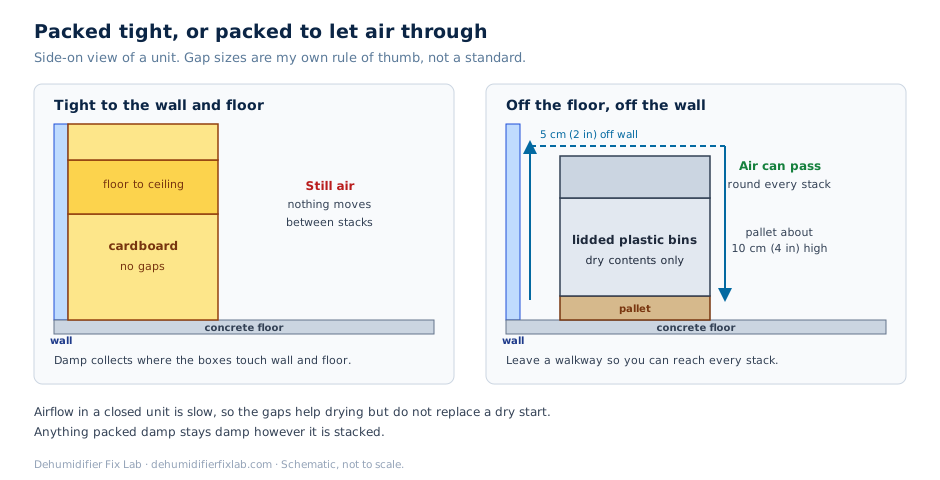
- On pallets or shelves, about 10 cm (4 in) up, so the bottom box is not touching bare concrete.
- 5 cm (2 in) from the walls, which is where cold surfaces and condensation are.
- Heavy and sturdy at the bottom, light and soft at the top, with a clear path so you can reach everything.
- No mattress flat on the floor. Stand it on its edge on a pallet or a clean cotton sheet over a board.
Honestly, a half-full unit with air round every stack beats a packed one every time. It is irritating to pay for a bigger size, and still cheaper than replacing the sofa.
Where moisture absorbers fit, and where they do not
A desiccant is a good tool for a small sealed space and a poor one for a whole unit. A tub of calcium chloride or a bag of silica gel can only hold so much water, so I would use them inside a sealed bin, a wardrobe box or a filing box, not hung from a shelf in the middle of a unit and trusted to dry it.
Which type to use depends on the job. Silica gel versus calcium chloride sets out where each belongs, and the moisture absorber guide explains why a tub cannot dry a space of any size. Single-use disposable dehumidifiers work on the same principle and have the same ceiling.
If the unit is genuinely damp, the answer is to find the water, not to buy more tubs. Check the roof, door seal and floor for leaks, because a leak will beat any absorber you put out.
Check the unit, and watch for the first signs
Because you cannot see inside from the car park, build a routine:
- Put a cheap hygrometer inside and read it whenever you visit. A reading that stays above the EPA’s 60% ceiling is your signal to act. I would get one that records the minimum and maximum so you can see overnight peaks.
- Visit after heavy rain and at the changes of season, and look at the floor, the bottom boxes and the ceiling.
- Smell it. A musty smell on opening the door is the earliest warning you will get.
- Open the door for a while on a dry day, if the facility allows it, to swap the stale air for fresh.
- Rotate the stacks every few months so nothing sits against the same patch of wall.
Found mould? Take affected items out, work in the open air, and fix the cause before you repack. A small patch on a hard surface can be cleaned. Soft furnishings with growth are usually a discard, which is the EPA’s guidance on porous materials.
When is climate-controlled storage worth it?
Climate control earns its price for items that cannot be replaced or that react badly to swings: wooden furniture, leather, books, photographs, musical instruments, important papers and electronics. For a bed frame and a few plastic bins of kitchenware, an indoor unit and good packing are enough.
My blunt view: pay for climate control when the contents are worth more than a year’s difference in rent, or are the sort of thing mould cannot be cleaned off. Otherwise, spend the money on bins, pallets and a hygrometer. Whichever you choose, ask the facility what “climate controlled” actually means, because a unit that is only heated may still be humid.
If it is a home problem you are really trying to solve, how to prevent mould in the house covers the same logic with a dehumidifier available.
Pack dry, lift it, leave gaps: that is how to prevent mold in a storage unit
Almost every storage unit mould problem is the same story: wet things went in, boxes touched the floor, and nobody aired it. Dry everything, lift it, leave gaps, use bins for what matters, and let a hygrometer tell you the truth about the unit. Spend on climate control only when the contents justify it.
FAQ
Is mould common in storage units?
Yes, because units are closed, unventilated and rarely checked, and they are often full of paper, fabric and wood. Whether yours grows mould depends mostly on how dry the contents were when they went in and how much the unit’s humidity swings.
What is the best way to keep a storage unit from getting damp?
Pack only completely dry items, keep them off the floor on pallets or shelves, and leave a gap between stacks and walls. Add a hygrometer so you know the humidity, and aim to stay under the EPA’s 60% ceiling, ideally 30 to 50%.
Do moisture absorbers or silica gel work in a storage unit?
Inside a sealed bin or a wardrobe box, yes. Across a whole unit, no, because they hold a fixed amount of water and only affect the air close by. Treat them as a supporting tool, not a fix for a damp unit.
Is cardboard or plastic better for storage?
Lidded plastic bins are usually better, because cardboard absorbs moisture and feeds mould. But plastic only works if the contents are dry when you seal it, since a sealed bin traps whatever humidity is inside.
Should I put a dehumidifier in a storage unit?
Only if the facility allows it and the unit has a power supply, which varies from site to site. Check your rental terms first. Where it is not possible, dry contents, pallets and gaps do most of the work, and climate-controlled storage is the alternative.
How often should I check a storage unit for mould?
Every month or two is reasonable, and after heavy rain or a change of season. Look at the floor, the bottom boxes and the ceiling, and note any musty smell when you open the door.

