
Last Updated on October 23, 2026 by Umar Farooq
A disposable dehumidifier is a non-electric tub of calcium chloride crystals that pulls moisture from the air and dissolves into brine; it works in small, closed spaces such as wardrobes, and it cannot dry a room. I like them, within limits. The limits are the whole story, and most packaging is politely silent on them.

What a disposable dehumidifier actually is
It is a plastic pot, bag or hanging pouch holding a desiccant. The desiccant is almost always calcium chloride, a salt that attracts water. DampRid describes it as crystals that absorb moisture from the air and gradually dissolve into a brine (saltwater). The brine drips into a reservoir. When the crystals are gone, the tub is spent.
There are two versions. A refillable one has a pot you tip out and reload with new crystals. A truly disposable one is thrown away whole. The chemistry is identical, so the choice is about waste and price per month.
There is no fan, no compressor and no plug, which is the appeal. It is also why the capacity is so low: nothing moves the air to the crystals. The crystals only get what drifts past them.
How much water does a disposable dehumidifier hold?
Retail listings for multipacks give container sizes of roughly 300 to 500 ml. That is the reservoir, not the rate at which it fills, and the rate is what matters.
The best independent number I found is from consumer group CHOICE. In a mild test at 65% humidity, DampRid removed 2 ml of water per hour on average. The worst dehumidifier in the same review removed 113 ml per hour and the best removed 388 ml per hour.
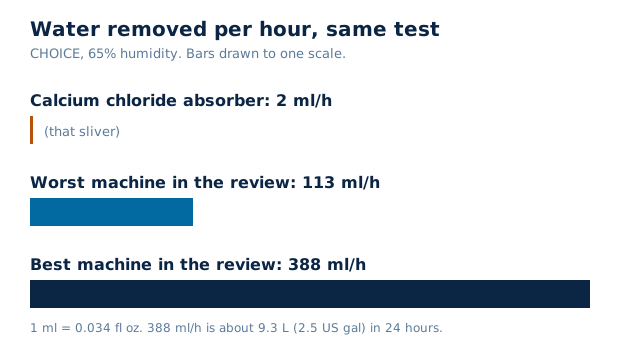
Here is the arithmetic, which is mine and not CHOICE’s:
| Per hour | Per 24 hours | |
|---|---|---|
| Calcium chloride absorber (CHOICE test) | 2 ml | about 48 ml (1.6 fl oz) |
| Worst dehumidifier in the review | 113 ml | about 2.7 L (5.7 US pints) |
| Best dehumidifier in the review | 388 ml | about 9.3 L (19.7 US pints) |
So the best machine moves roughly 190 times as much water as the tub, and even the worst moves more than 55 times as much. The best machine would fill a 500 ml tub’s reservoir in about 77 minutes. At the tub’s own test rate, it would take about ten days.
Two honest caveats. CHOICE tested one brand, so other tubs will differ. And a 2 ml/h average at 65% is not what happens in a shut wardrobe, which is why DampRid’s own claims run to several months per tub and CHOICE reports 45 days to six months. My reading is that a smaller, drier box gives the crystals less to do. Check the capacity and duration claims on the pack you are holding. I found no standard test behind the pack claims, so treat any figure that comes without test conditions with suspicion.
Wardrobes, caravans and cupboards: where the tubs earn their keep

The pattern is simple: a small volume of air, rarely changed, with no power. That describes:
- Wardrobes and closets, particularly on an outside wall. The closet guide covers this properly.
- Kitchen and under-stairs cupboards that smell stale.
- Caravans, boats and holiday homes left shut for weeks, where a machine would need a socket you do not have.
- Seasonal storage: winter coats, camping kit, boxes in a loft hatch.
In all of these the tub does a modest job well. It is also cheap enough to forget about, which is half its value.
Rooms, basements and washing: where they cannot cope
A bedroom with running condensation, a basement with damp walls or a house drying laundry on airers is producing litres of water, not millilitres. The arithmetic above shows what a tub does against that.
I would say it bluntly: buying five tubs for one damp room is paying for consumables to avoid buying a machine, and it does not avoid the problem. You will empty brine every few weeks and still wipe the windows every morning. If the room needs real drying, work out the size you need, and if the space is cold, read the desiccant versus compressor guide first.
A tub also does nothing about the source. Condensation, a leak or rising damp keeps adding water. Lowering humidity across the house starts with finding that source. The EPA’s guide to mould and moisture makes the same point: control the moisture and fix the water problem first.
Five questions that settle tub or machine
- Is the space smaller than a wardrobe-sized box and mostly shut? Tub.
- Is there a socket and a room you actually live in? Machine.
- Is the water coming from a source that keeps going (washing, showers, a leak)? Fix it, then machine.
- Do you need it for one season only? Tub is cheap for that.
- Are you replacing tubs every month? You are already buying a machine, in instalments.
If you are weighing other passive options, the natural dehumidifier methods, rated honestly, put tubs in context.
Pouring the brine away without making a mess
Calcium chloride is an irritant. Keep tubs out of reach of children and pets, which DampRid also states, and avoid contact with eyes and skin. CHOICE advises the same. Do not drink the brine or let anyone else, and wear gloves if you are emptying a lot of it.
Follow the instructions on your own product first. The ones I could open say:
- DampRid: for refillable products, empty the brine into the toilet, then refill with new crystals. For disposable ones, throw the unit away once the crystals are gone.
- CHOICE says the liquid can go down the toilet or the sink.
I would use the toilet, since both sources agree on it. I would not pour it on the garden or pot plants; I have no source saying that is safe, so I treat it as not. If a pack gives different advice, the pack wins.
Practical handling: carry the tub flat and level, because a tipped one leaks brine over whatever it sits on, and do not leave it where a pet can knock it over.
A disposable dehumidifier is a patch for a small box, not a fix for a damp room
Use one where the space is small, closed and unpowered, and expect weeks to months of quiet work. Do not expect it to change the humidity of a room: the one independent test I could find has it removing 2 ml an hour against 113 to 388 ml for machines. If you are weighing a tub against a plug-in unit for a room, the machine is the answer and the tub is for the wardrobe.
FAQ
Do disposable dehumidifiers really work?
Yes, in small closed spaces. CHOICE found a calcium chloride absorber did lower humidity in a closet-sized sealed chamber, but at 65% humidity it removed only 2 ml of water per hour on average, far below any dehumidifier.
How long does a disposable dehumidifier last?
It depends on the temperature, humidity and space. DampRid says several months, and CHOICE cites 45 days to six months depending on product. In a damper space the crystals dissolve faster and need replacing sooner.
Can I pour the liquid down the sink?
CHOICE says the liquid can go down the toilet or the sink, and DampRid says to empty refillable brine into the toilet. Check your own product label, and keep it off plants unless the label says otherwise.
Are disposable dehumidifiers safe around pets and children?
Keep them out of reach. Calcium chloride irritates skin and eyes and should not be swallowed, and a tipped tub spills brine.
Can a disposable dehumidifier replace an electric one?
Not in a room. The capacity gap is around 55 to 190 times in CHOICE’s figures, so a tub suits a wardrobe and a machine suits a room.
Are scented or refillable ones better?
Refillable ones create less waste and the crystals are the same chemistry. Scent adds nothing to the drying, so it is purely a preference.

