
Last Updated on October 24, 2026 by Umar Farooq
Why is my house humid when it rains? Because rain-soaked outdoor air is close to saturated, so it cannot dry your home, and wet weather also stops you venting, drying washing outside and keeping the walls warm. The house is not necessarily leaking; it has simply lost its usual ways of getting rid of moisture.
Most people respond by throwing the windows open. I’d gently suggest that is the one thing not to do, and the reason comes down to a single number called the dew point.

Dew point, in kitchen terms
Relative humidity (RH) is how full the air is, as a percentage, at its current temperature. Warm air can hold much more water than cold air, so the same amount of water gives a low RH when warm and a high RH when cold.
Dew point is simpler. It is the temperature at which that air would be completely full and start dropping water. It tells you how much water is actually in the air, and it does not change when you heat the room. The US National Weather Service explains it as a better gauge of how muggy it feels than RH, with a dew point above about 55 °F (13 °C) starting to feel sticky.
During steady rain the outdoor air is near 100% RH, which means its dew point is roughly its own temperature. Bring that air indoors and warm it, and the dew point stays put while the RH drops only as far as the temperature rise allows.
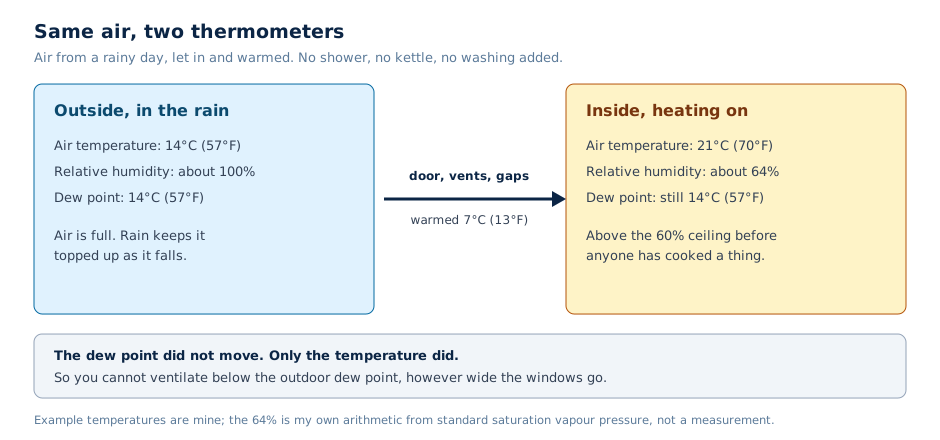
My worked example: 14 °C (57 °F) rain air at about 100% RH, warmed to 21 °C (70 °F), reads roughly 64% RH. That is my own arithmetic from standard saturation figures, not a measurement from a house, and your numbers will differ. The point is that the indoor reading lands above the 60% ceiling that the EPA recommends staying under before anyone has had a shower.
Why opening windows after rain makes it worse
If outdoor air has a dew point of 14 °C, ventilation alone cannot take your indoor air below that dew point. You can only swap your air for wetter air, or equally wet air, at the cost of heat.
The exception is when the indoor air is wetter than the outdoor air, for instance after a steamy shower. Then a few minutes of cross-ventilation does help. During or just after rain it usually doesn’t, and a long airing lets in more water than it lets out. I cover the general case in does opening windows reduce humidity.
The same applies to trickle vents and air bricks. They carry on working when it rains, so a house with generous background ventilation can feel damper on a wet day than a tighter one.
The rainy-day moisture you add yourself
Rain also takes away the outdoor clothesline. It is the weather in which people dry washing indoors, run the tumble dryer without a vent, cook with the extractor off and keep every door closed to hold in the heat. All of that adds water to the air while the house has nowhere to put it.

I won’t invent a figure for how much a load of washing gives off, because it varies with the load and the spin speed. The direction is not in doubt, though. If you must dry clothes inside on wet days, how to dry clothes indoors without mould covers the setup.
There is a second, quieter effect. Rain and wind cool the outside surface of external walls, so the inner surface follows. Warm indoor air touching a cold wall can condense, usually behind wardrobes and in corners. Because it only appears on wet days, it is often mistaken for a leak.
Check the number before you do anything else
Guessing is how people end up with a £200 machine for a problem that needed a £10 gadget. A digital hygrometer tells you where you actually are.
Take readings in the room that feels worst, at about the same time on a dry day and a wet day. The target, from both the EPA and ENERGY STAR, is 30-50% RH, and below 60% as an upper limit.
- Under 50% on the wet day: the damp feeling is the weather, not your house. Do nothing.
- 50-60%: shut the windows, keep doors closed to unheated rooms and carry on watching. That band is my own working judgement, not an official figure.
- Over 60%, or climbing day after day: you need to remove water, not move air around. See what indoor humidity should be for the full bands.
Close up, then run a dehumidifier
When it is wet outside, the house should be a sealed box that you dry from the inside. Close the windows, use the extractor in the kitchen and bathroom (a vented one, to outside), keep washing off the radiators if you can and leave internal doors open so one machine can reach the whole floor.
Then run a dehumidifier. This is the one time I’ll say a machine is the answer rather than a last resort: it removes water from the indoor air whatever the dew point outside, which ventilation cannot do. A compressor unit works best in a warm room, so put it in the heated part of the house rather than the cold porch.
Size matters less than people think for a short wet spell, but if you’re buying, what size dehumidifier do I need sets out the working. Summer storms are the same story with warmer air, which I go into in dehumidifier in summer.
Rule out a real leak with three checks
Rain humidity should fall back within a day or so of the rain stopping. If it doesn’t, or if one patch is damp while the rest of the room is fine, suspect water getting in.
Never poke around near a wet ceiling light fitting or a damp socket. If water is coming through near any electrics, switch off at the consumer unit and call an electrician.
- Look at the pattern. Condensation is spread over cold surfaces and wipes away. A leak leaves a stain with an edge, which often grows after heavy rain.
- Check the outside. Overflowing gutters, a cracked downpipe or soil piled above the damp-proof course send water at the wall. Fix the water first, then dry the room.
- Compare the hygrometer. If the room reads normal but the wall is wet to the touch, that is a leak, not humidity.
Anything you can’t trace is a job for a surveyor, not a dehumidifier.
Why is my house humid when it rains: wet air, not a wet wall
That is the whole of it. Wet-weather humidity is the outdoor dew point plus what you add indoors, and the cure is to close up, measure and dry from the inside. A patch that stays damp after the weather clears is a different problem, and I’d rather you found it early.
FAQ
Does rain increase humidity indoors?
It can, but not by itself. Rain makes the outdoor air wetter, and that air then comes in through vents, doors and gaps. Indoor activities like drying washing and cooking, which you do more of on wet days, add more.
Why does my house feel damp when it rains but the humidity reading is fine?
Air with a high dew point feels clammy even at a moderate RH, and cold interior surfaces feel damp to the touch. If the hygrometer is in the target band, it is probably comfort rather than a moisture problem.
Should I open windows when it rains?
Generally no, unless the room is full of steam from a shower or cooking, in which case a short burst helps. Otherwise rain air is as wet as it gets and you are letting that in.
How long does humidity stay high after it rains?
Until the outdoor air dries and damp materials give back their moisture. A day or two is common in my experience, but measure it rather than trust me. If it drags on for a week, look for a leak.
Will a dehumidifier help when it rains?
Yes. It lowers indoor humidity whatever the outdoor dew point, which opening a window cannot do. Run it in the heated part of the house with doors and windows shut.
How do I know if it’s a leak or just humidity?
Humidity is spread across cold surfaces and shows on a hygrometer. A leak is local, leaves a tide mark and shows up after heavy rain without a matching hygrometer rise.

