
Last Updated on October 23, 2026 by Umar Farooq
Silica gel vs calcium chloride comes down to size and tidiness: silica gel is the reusable choice for small sealed spaces like camera bags and document boxes, while calcium chloride holds far more water, turns it into liquid brine, and suits a damp wardrobe or cupboard where you can throw it away. Neither dries a room (the moisture absorber guide explains why), and picking the wrong one is how people end up with a puddle in a camera bag.
I get asked this often enough that it deserves a straight answer, with the numbers labelled for what they are. Several of the best-known capacity figures come from companies that sell desiccant, so where a number is a vendor’s, I say so.

Surface versus solution: how each one holds water
The two work in different ways, and nearly every other difference follows from that.
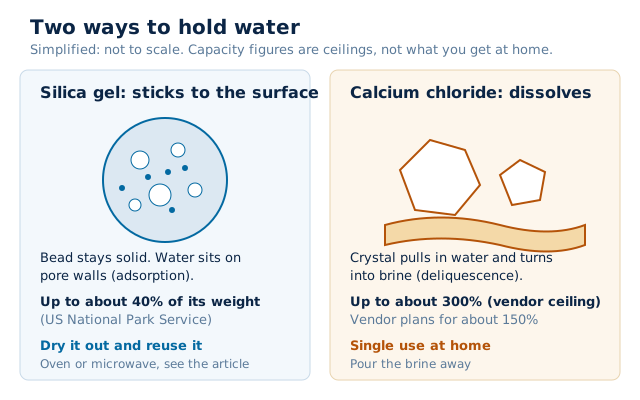
Silica gel adsorbs. Water vapour sticks to the walls of millions of tiny pores inside each bead, and the bead stays hard and dry to the touch. The US National Park Service describes it as a hard, inert material that can take up to 40% of its weight in moisture through millions of tiny pores, and notes that it is non-toxic.
Calcium chloride absorbs, then dissolves. It is a salt that is both hygroscopic and deliquescent: it pulls water from the air until the crystals turn into liquid. That liquid is the brine you see in the bottom of a moisture-absorber tub. It is the same chemistry I covered in the disposable dehumidifier guide, where I also set out how little a tub removes in an independent test.
What a kilo of each can take, by my arithmetic
This is the headline difference, and the figures need careful handling.
- Silica gel: up to about 40% of its own weight (National Park Service). Other sources quote 35% to 37%, so treat 35 to 40% as the range.
- Calcium chloride: up to 300% of its own weight is the figure vendors print. Absortech, a desiccant supplier, says to plan around roughly 150% rather than 300%.
Turning those into something you can picture, my own arithmetic, not a measurement: 1 kg (2.2 lb) of silica gel could hold at most about 0.35 to 0.4 kg of water, roughly 350 to 400 ml (12 to 13.5 fl oz). 1 kg of calcium chloride could hold about 1.5 litres (3 US pints) at the vendor’s planning figure, and up to 3 litres at the ceiling.
So by weight, calcium chloride takes roughly four to eight times as much water as silica gel, on paper. These are ceilings reached at high humidity, not what a tub on a wardrobe shelf collects in a month. The independent test I trust for that, from CHOICE, is in the disposable dehumidifier article, and it is humbling.
Recharging silica gel, and why calcium chloride is a one-way trip
Silica gel’s real advantage is not capacity, it is that you can dry it out and use it again. Steven Weintraub’s conservation paper says all silica gels have an infinite life in terms of the ability to adsorb or desorb moisture and can be reconditioned and reused indefinitely.
Heat only gel that is not in a plastic or fabric sachet unless the maker says the sachet can take it, and never leave a hot tray unattended. Indicating gel (the blue-to-pink kind) should not go above 120 °C, because its dye is heat sensitive. If you use a microwave, only glass, ceramic or microwave-safe plastic, because the beads become very hot.
The National Park Service gives a simple oven method:
- Spread the loose gel no more than 1/2 inch (12 mm) deep in a shallow, heat-resistant pan.
- Set the oven to 150 °F (about 65 °C) and heat it for four hours. The NPS adds that time and temperature vary with how wet the gel is.
- In a microwave instead: shallow glass dish, same depth, two minutes on high, cool for one minute outside the oven, and repeat up to ten times or until dry.
Weintraub notes that a lower temperature just means a longer drying time and less chance of damaging the gel. That matches my own preference: low and slow, then straight into a sealed jar to cool so it does not re-absorb on the counter.
Calcium chloride is different. Once it has dissolved there is no sensible home way to turn the brine back into dry crystals. One supplier, Streampeak, says industrial reheating at 250 °C for at least an hour can drive the water off. That is a factory process and not something to try in a kitchen. At home, treat it as single use, and buy refill crystals if your tub has a refillable design.

Where each one belongs
| Job | Better pick | Why |
|---|---|---|
| Camera bag, lens case, gun safe | Silica gel | Small and sealed, nothing worth wetting, reusable |
| Document box, photo storage, tool chest | Silica gel | Dry bead, no liquid to spill |
| Electronics shipping and storage | Silica gel | Packets are made for it |
| Wardrobe, shoe cupboard, small cupboard | Calcium chloride | More water per tub, brine stays in the pot |
| Caravan or boat locker in a damp season | Calcium chloride | Takes more, and you can bin it at the season’s end |
| A whole damp room | Neither | Use a machine and size it properly |
For the last row, what size dehumidifier you need is the next thing to read. For the wardrobe row, the closet dehumidifier guide has the full options.
My opinion, and I will stand by it: for a wardrobe, buy calcium chloride and do not bother with silica gel. Silica gel’s capacity is low enough that you would need a lot of it, and the NPS notes silica gel can only maintain a microenvironment in a well-sealed enclosure. A wardrobe is rarely well sealed. For a camera bag, the reverse holds, because a spilled tub of brine near a lens is a far worse problem than a bead that is a little less hungry.
Neither works in a leaky space
Here is the extra point most comparison pages skip. Both desiccants are only as good as the box. The NPS says silica gel can only maintain a microenvironment in a well-sealed enclosure and advises sealing leaks first. The same logic applies to a calcium chloride tub: every time you open the wardrobe, you let in a fresh load of damp air for it to work through.
So before you pick a desiccant, ask whether the space is small, mostly shut and unpowered. If it is, either will do the job. If it is a damp room, a bathroom or a cellar, neither will keep up, and the cause of the damp needs finding. The natural dehumidifier guide covers the passive options and where each runs out.
Safety and disposal: beads in the bin, brine down the toilet
Silica gel is the gentler of the two. The NPS describes it as non-toxic, and I would still keep packets away from children and pets, because “do not eat” is printed on them for a reason. For disposal of dry, spent beads, I found no authoritative rule that I could cite, so check the pack and your local council’s guidance. Never use indicating beads where food is stored unless the pack says it is food safe.
Calcium chloride deserves more respect.
Calcium chloride can irritate skin and eyes and should not be swallowed or inhaled. Keep tubs out of reach of children and pets, carry them level, and wear gloves if you are emptying brine. If your product gives different instructions, follow the product.
CHOICE says the liquid collected in a DampRid-type container can be flushed down the toilet or poured down the sink. I use the toilet. I would not tip it on the garden, because I have no source saying that is safe.
Silica gel vs calcium chloride: choose by the size of the box
If you want one rule: match the desiccant to the space, not to the humidity. Small, sealed and full of valuables, use silica gel and recharge it in a low oven. Larger, leakier and mostly full of clothes, use calcium chloride and accept that it is a consumable. If the real problem is a room, the answer in the silica gel vs calcium chloride debate is neither, and you need a machine.
FAQ
Which is better, silica gel or calcium chloride?
Neither wins everywhere. Calcium chloride takes much more water by weight and suits larger, damper spaces like wardrobes. Silica gel holds less but stays dry and can be reused, which suits small sealed spaces and anything electronic.
Can you reuse silica gel?
Yes. Conservation guidance says silica gel can be reconditioned and reused indefinitely. The National Park Service method is a shallow layer in an oven at about 65 °C (150 °F) for four hours, then sealed away to cool.
Can you recharge calcium chloride?
Not at home. It dissolves into brine as it absorbs water, and there is no practical way to turn that back into dry crystals in a kitchen. One supplier describes industrial heating at 250 °C, which is not a household job.
Is calcium chloride safe around children and pets?
It is an irritant and should not be swallowed, so keep tubs out of reach and upright. CHOICE gives the same advice for the common calcium chloride absorbers.
Which desiccant is better for a damp wardrobe?
Calcium chloride, in my view. It holds more water per tub and keeps the brine in its own container. Silica gel works best in smaller, tightly sealed spaces.
Does silica gel work in a damp room?
No. A room is too big and too leaky for any bag of desiccant. A dehumidifier sized for the space is the right tool.

