
Last Updated on October 23, 2026 by Umar Farooq
How to prevent mold in house: control the moisture, because mould needs a damp surface to grow, and the EPA’s advice is to fix leaks, keep indoor humidity below 60% (ideally 30 to 50%) and dry anything that gets wet within 24 to 48 hours. There is no product that makes a damp house mould-proof.
The good news is that the list of water sources is short, and most of them are free to fix. The order you fix them in is what saves you money.

Start with the water that should not be there
Leaks beat everything else on the list, so check them first. A dripping pipe, a failed roof tile or a blocked gutter feeds a wall every day, and no amount of ventilation outruns that.
The EPA’s guidance is to dry water-damaged areas and items within 24 to 48 hours. That is a drying deadline for wet materials, not a promise about when mould appears. For the real timescale, see how long mould takes to grow.
Outside the house, the EPA says to clean and repair roof gutters regularly and make sure the ground slopes away from the foundation. UGA Extension puts numbers on it: a 5% slope, running at least 10 feet (3 m) from the house on every side.
Which moisture source comes first? A five-step order
My view: most people reach for a dehumidifier first and the hygrometer last. I would reverse that. A machine pulling water out of a house that is still taking water in is a very expensive way to stand still.
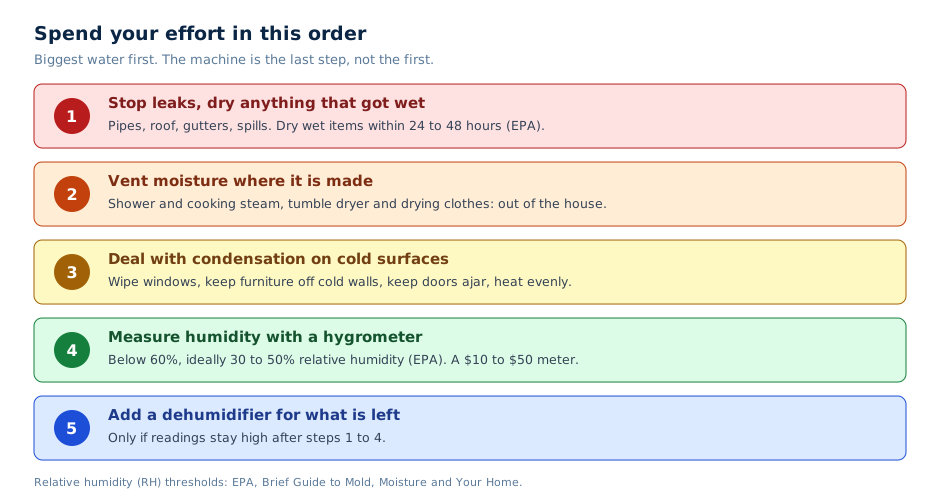
The ranking is my judgement, not a tested standard, but each threshold in it is the EPA’s.
Keep showers, cooking and kettles from soaking the air
Everyday living puts water into the air. The EPA says to use exhaust fans or open windows whenever you cook, run the dishwasher or wash up, and to vent moisture-producing appliances such as clothes dryers to the outdoors where possible.
The practical version:
- Run the bathroom fan during the shower and keep it on afterwards. The EPA gives no minute count. UGA Extension suggests shorter or cooler showers too, which means less steam to remove.
- Use the cooker hood while cooking and lids on pans.
- Check the fan actually vents outside. A fan that blows into the loft just relocates the damp.
- Open windows only when the air outside is drier. UGA’s rule is outdoor relative humidity below 50%.
The full room-by-room list sits in how to lower humidity in the house, so I will not repeat it here.
Do not dry laundry in a room you sleep in
A load of wet washing is a bucket of water that evaporates into the room. I have not measured how much, and it varies with the load, but the water has to go somewhere.
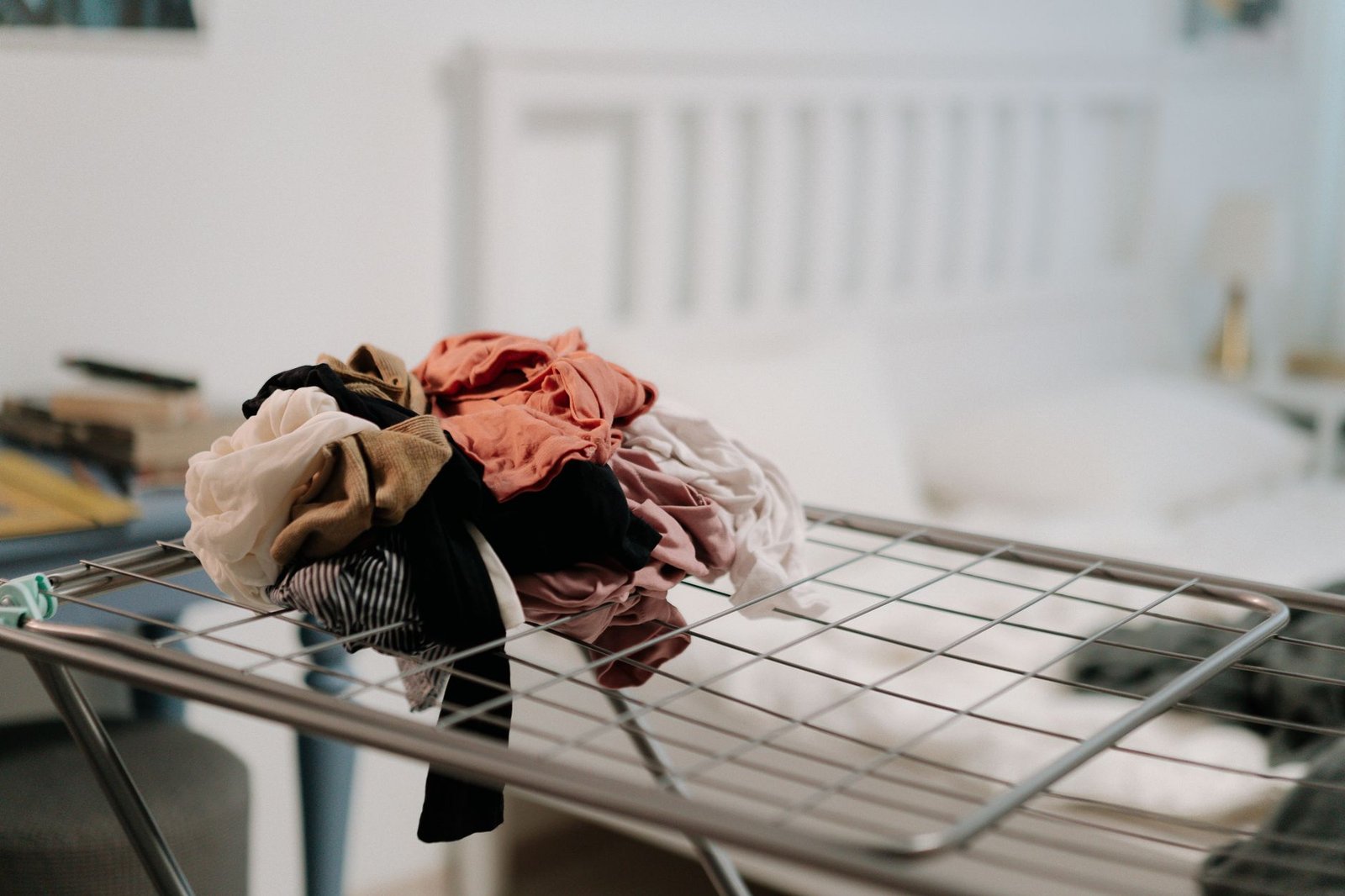
The rules that help:
- Vent the tumble dryer outside or use a condenser dryer, and empty the condenser tank.
- Dry in a room with the door shut and the window open, away from bedrooms, if you must dry indoors.
- Do not leave wet washing in the drum. Take it out when the cycle ends.
- Spread items out. A bunched pile dries slowly and holds its water longer.
Condensation is a warning, not just a nuisance
The EPA says condensation can be a sign of high humidity. Warm, damp room air meets a cold window, wall or pipe, and the water lands there. The room reading can look fine while the wall surface stays wet.
- Wipe windows and sills when they run with water, then open a window.
- Pull furniture a few centimetres off cold outside walls. That gap is my rule of thumb, not a standard.
- Keep rooms evenly heated, and leave doors ajar so air moves between them.
Windows are where it shows first. The causes and fixes for mould around windows are covered separately.
Get a hygrometer and read it for a week
The EPA describes a hygrometer as a small, inexpensive instrument, $10 to $50, from a hardware store. Check it at different times of day, and in the rooms you suspect. Below 60% is the EPA’s line, and 30 to 50% is the ideal.
Humidity swings by season and by room, so one reading tells you little. What humidity should be in each season and room explains how to read the numbers.
Add a dehumidifier only once the readings say so
If the hygrometer stays above 60% after the leaks, steam and laundry are sorted, the house is making or letting in more water than ventilation can clear. That is a dehumidifier’s job. The EPA lists air conditioners and dehumidifiers as options when needed.
Size matters more than brand. An undersized unit runs flat out and never gets there. This guide to what size dehumidifier you need works it out from the room and its dampness.
If you already see mould, or a patch keeps returning, prevention is not the job any more. The EPA says areas over about 10 square feet need a professional, and no spray fixes an active leak. Find and stop the water first.
How to prevent mold in house: manage the water in this order, not by buying products
You prevent mould the way you would stop a bath overflowing: turn the tap off before you reach for the mop. Fix leaks, vent steam and laundry, wipe condensation, read the hygrometer, and add a dehumidifier last. Do the first four properly and many houses never need the fifth.
FAQ
What is the best way to prevent mold in a house?
Control moisture. Fix leaks, dry wet materials within 24 to 48 hours, vent bathrooms, kitchens and dryers outdoors, and keep indoor relative humidity below 60%, ideally 30 to 50%, according to the EPA.
What humidity level prevents mold?
The EPA advises keeping indoor humidity below 60%, ideally between 30 and 50%. A hygrometer costing $10 to $50 will show where your rooms sit.
Does a dehumidifier prevent mold?
It helps when high humidity is the problem, because it lowers the moisture mould depends on. It does not fix a leak or condensation on cold walls, so use it after those are dealt with.
Does opening windows help prevent mold?
Sometimes. UGA Extension says to open windows only when the outdoor relative humidity is below 50%, because damp outside air just brings more water in.
Can you prevent mold in a house with a lot of rain or humid weather?
You can reduce the risk, but not by ventilation alone. Clean gutters, slope the ground away from the foundation, vent steam outdoors and keep a hygrometer on the wall so you notice a rise early.

